
260 Slides: The Clash Between a Student and a Veteran Professor
A professor projects 260 slides in class, sparking a debate on education levels and teaching methods in Spain.
English · Original discussion in Spanish · Published
260 Slides vs. Generation Z's Attention Span
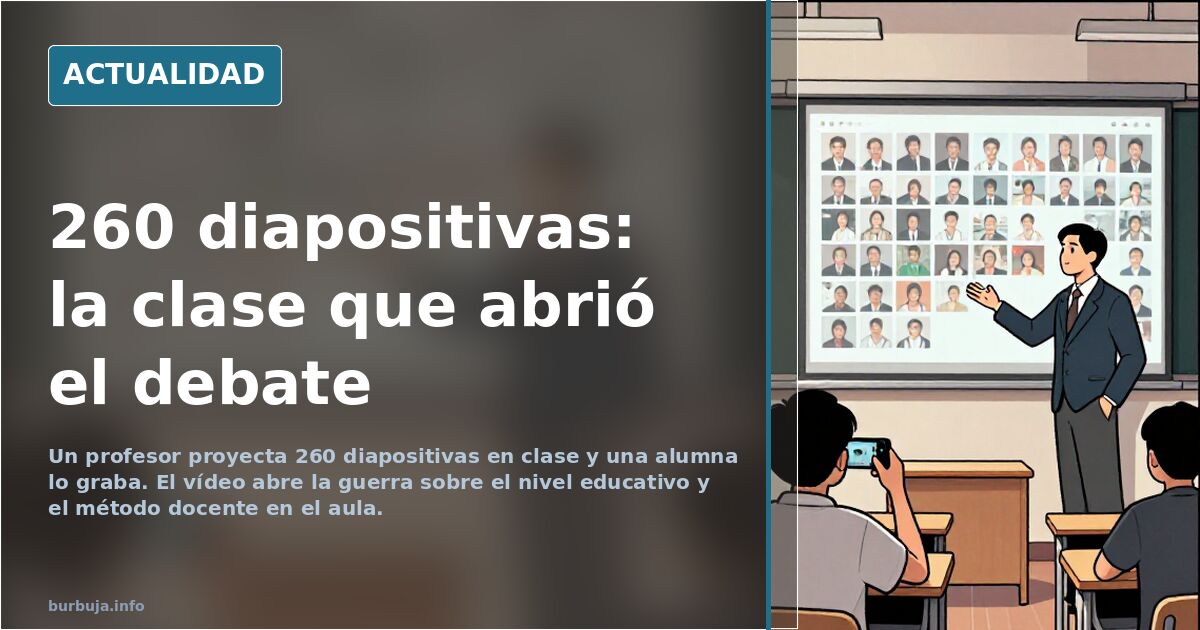
A university professor uses 260 slides in a single class, prompting a student to record a video protest. The clip has ignited a broader debate about education quality and teaching methods in Spain. The professor, a veteran who has repeated the same syllabus for years, refuses to change his approach. The viral video has turned into an involuntary audit of the entire university system, questioning whether the fault lies with the student's attention issues or the professor's outdated design. The case highlights a broken model that approves students who struggle with basic writing while employing lecturers who fail to explain concepts without overwhelming them with hundreds of transparencies. Both complaints are valid, revealing a systemic trap where each side only sees their own perspective.
Why 260 Slides Are a Class Design Problem
There is a prevailing view that a teacher's role is to simplify and make complex topics accessible, not to demonstrate knowledge by accumulating material. If a syllabus requires 260 slides for one session, the error lies with the preparer, not the confused student. The counterargument is that life offers no easy paths, and those who cannot maintain attention will face consequences in future employment where no excuses exist.
The Student Who Enters University Unable to Write
Critics argue that secondary education has become a mere formality, granting degrees to those who barely can write. High entry grades reflect lower standards rather than smarter generations. If true, this student is not an imposter but a product of a system that pushed her upward, only to be surprised by her demands for better explanations.
60% of the Class with a Diagnosis
A controversial statistic suggests that up to 60% of public school students have diagnoses, including attention deficits, autism spectrum, or epilepsy. While some attribute this to spoiled children, others argue the system simply names issues previously ignored. The professor's refusal to adapt raises questions about whether the problem lies with the students or the instructor's decades-long stagnation.
Who Earns and Who Pays in the Classroom
The economic disparity shocks both sides: the student faces debt and the pressure to pass, while the veteran professor holds a secure, hard-to-fire position. This structural failure places the burden on the least powerful. The consensus is that the system is broken regardless of whose side you take. With AI potentially explaining content faster, the question remains: how many more years will those 260 slides be projected?
A university professor uses 260 slides in a single class, prompting a student to record a video protest. The clip has ignited a broader debate about education quality and teaching methods in Spain. The professor, a veteran who has repeated the same syllabus for years, refuses to change his approach. The viral video has turned into an involuntary audit of the entire university system, questioning whether the fault lies with the student's attention issues or the professor's outdated design. The case highlights a broken model that approves students who struggle with basic writing while employing lecturers who fail to explain concepts without overwhelming them with hundreds of transparencies. Both complaints are valid, revealing a systemic trap where each side only sees their own perspective.
Why 260 Slides Are a Class Design Problem
There is a prevailing view that a teacher's role is to simplify and make complex topics accessible, not to demonstrate knowledge by accumulating material. If a syllabus requires 260 slides for one session, the error lies with the preparer, not the confused student. The counterargument is that life offers no easy paths, and those who cannot maintain attention will face consequences in future employment where no excuses exist.
The Student Who Enters University Unable to Write
Critics argue that secondary education has become a mere formality, granting degrees to those who barely can write. High entry grades reflect lower standards rather than smarter generations. If true, this student is not an imposter but a product of a system that pushed her upward, only to be surprised by her demands for better explanations.
60% of the Class with a Diagnosis
A controversial statistic suggests that up to 60% of public school students have diagnoses, including attention deficits, autism spectrum, or epilepsy. While some attribute this to spoiled children, others argue the system simply names issues previously ignored. The professor's refusal to adapt raises questions about whether the problem lies with the students or the instructor's decades-long stagnation.
Who Earns and Who Pays in the Classroom
The economic disparity shocks both sides: the student faces debt and the pressure to pass, while the veteran professor holds a secure, hard-to-fire position. This structural failure places the burden on the least powerful. The consensus is that the system is broken regardless of whose side you take. With AI potentially explaining content faster, the question remains: how many more years will those 260 slides be projected?
Summary of a discussion on Burbuja.info - Foro de economía, actualidad y política., translated from Spanish and reviewed before publication. Read the full discussion (261 replies).
More summaries
-
US: AI Cameras on Garbage Trucks Flag Homes for Violations
AI cameras on US garbage trucks are sending violation warnings to homes, sparking privacy concerns and debate over surveillance.
-
Trump proposes three names for AI, two share acronyms
Trump launches a poll to rename artificial intelligence with three options: Superior Intelligence, Extreme Intelligence, and Supreme Intelligence. Two share the same acronyms.
-
China alerts Spain to alleged plot against the country
An academic article by Nadia Helmy reveals the thesis of a plan against Spain. Ceuta, Melilla and the Strait are at the center of the alert.
-
Seville: Charo hosted Algerian student and was burned alive
An elderly woman in Seville died after hosting an Algerian student. The University of Seville's co-living program faces scrutiny.
-
The Perfect Female Body: Silicon, Myths, and Social Pressure
A viral debate exposes the cracks in the female beauty canon, highlighting the tension between natural bodies and cosmetic surgery in the digital age.
-
Maxi Iglesias and Aitana Romance Sparks Power Dynamics Speculation
Maxi Iglesias and Aitana Sánchez-Gijón's relationship sparks debate on fame economics and transactional dynamics in entertainment.