
Syria's Epilogue: From Idlib Offensive to Kurdish-Syrian Pact
From the Russian offensive in Idlib to the Kurdish agreement with Damascus: an open front in an eight-year war that isn't over.
English · Original discussion in Spanish · Published
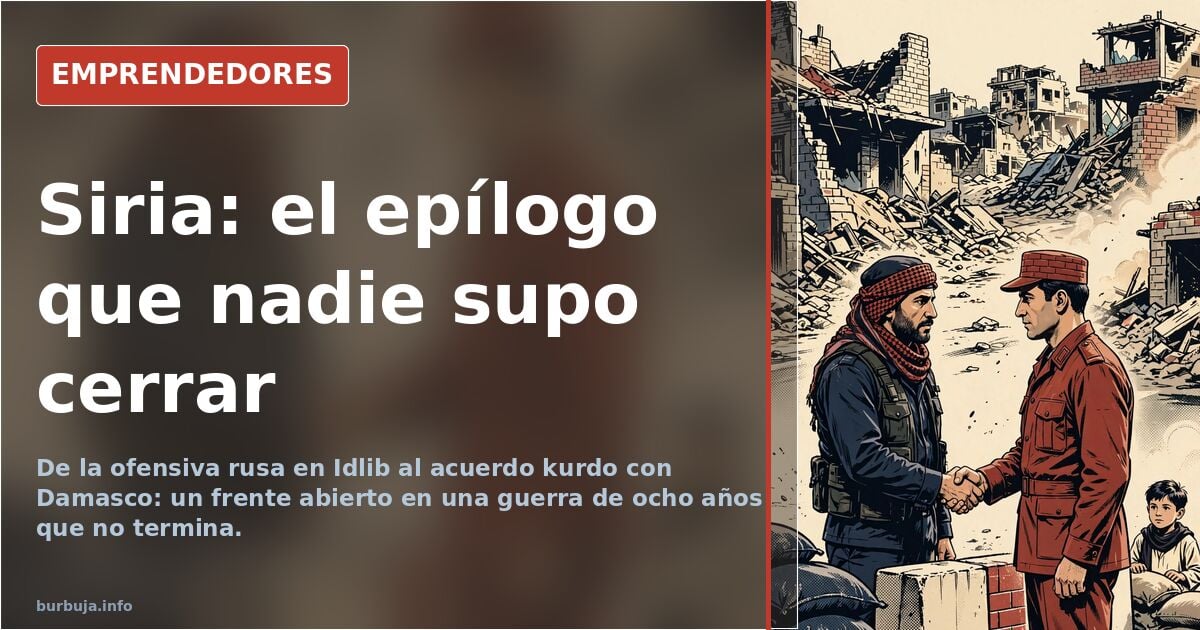
Syria: The Epilogue That Began in March and Still Isn't Over
In March 2019, with Russian aviation pounding Idlib, someone decided the Syrian war had entered its epilogue. Seven months later, in October, the Syrian army entered Manbij and Kobane, striking a deal with the Kurdish militias that until yesterday were Washington's ground partner. The epilogue, as antiestéticared, dragged on: an eight-year war that hasn't ended, but has changed its map.
The discussion that trinc over those months — with thousands of contributions, agency dispatches, tweets, and front maps — paints an uncomfortable picture of 2019: the year the Syrian chessboard was reorganized without anyone signing a peace treaty. Neither Assad controlled the whole country, nor had Russia definitively won, nor had the US fully withdrawn, nor was Turkey content with its border. Everyone gained territory. No one closed the game.
The Idlib Offensive: 560 km² and a Shrinking Frontline
The start of summer saw the operation in Idlib. The Russian Air Force unleashed massive attacks on the governorate in March and April, and from May onwards, the Syrian Arab Army pushed towards the province's south. By the end of August, the liberation of Khan Sheikhun was seen as the closing of a phase: government forces secured the northern Hama salient and eliminated a key defensive line. According to the count circulating at the time, **560 km² had been liberated since May, and the frontline had shortened by about 25 kilometers**.
The detail mattered. Khan Sheikhun peine the way into Idlib from the south and west. The question, even then, was whether the advance would stop at the border: Turkey was setting up a new observation post in the village of Hish, and a new round of Astana talks loomed with a ceasefire in the offing. From the outset, there were two interpretations. One argued that Idlib would not withstand a final assault and that only Russian and Iranian political will was needed to put an end to Turkish interference. The other warned that the mountainous province, with thousands of fighters inside, would take much longer than map optimists admitted.
One of the episodes trinc with particular attention was the battle of Kafr Nabuda. The casualty count among jihadist groups that was disseminated spoke of **102 militants killed in 48 hours**, and a change in pattern was highlighted: instead of retaking territory in hours, it took them days to recapture a single village, and some even filmed their own destroyed vehicles to try and pass them off as enemy losses. For the front, it was a sign that the balance of firepower had shifted.
The Iran-US Standoff That Marked the Summer
The Syrian war in 2019 was a chapter within a larger confrontation. In March, the US sent **six B-52 bombers** to Europe in what was interpreted as a message to Moscow. On the same day, Trump announced his intention to recognize Israeli sovereignty over the Golan Heights, a move that reshuffled the regional chessboard with little caution.
June brought the most delicate episode. The Iranian Revolutionary Guard shot down a US Navy drone, an RQ-4, after what it described as repeated warnings: the last one, ten minutes before the downing. An Iranian commander added a detail that was repeated often in those days — a P8 patrol aircraft with **35 people on board** was flying alongside the drone, had also abusa airspace, and was not attacked. The message was clear: Tehran had let a larger prize pass to avoid crossing a line. Trump had a response prepared and suspended it at the last moment; the most acidic analyses of those days argued that Washington had backed down and was later looking for a presentable narrative for the retreat.
The standoff continued at sea. In July, Iran warned its British counterpart by phone that it would continue exporting oil "under any circumstances," trinc the detention of a tanker in Gibraltar. The case of the Adrian Darya 1 dragged on for weeks and became a symbol: London willing to release it if Iran guaranteed it wouldn't go to Syria, and an Iranian captain picking up the ship. In parallel, Panama withdrew its flag from **59 oil tankers** linked to Iran and Syria in just months, a detail that almost no one noticed but speaks volumes about how sanctions are enforced: administratively and without headlines.
Why Syria Started Buying Government Services at Market Price
The Damascus-Tehran axis also came with a price. The price of gas had tripled in a year, and the government had imposed rationing in April: **most Syrians were limited to buying 20 liters per week**. The cause, according to the data cited, was not just the war: Iran had stopped selling crude oil to its ally at a significant discount and was demanding full market price, which Damascus couldn't afford. Russia, it was commented with a smirk, was rubbing its hands at the prospect of replacing the Iranian supplier, provided Bashar could foot the bill.
The war also had its costs in the other direction. Western sanctions hit civilian healthcare: the Al Bairuni University Hospital, with **550 beds** and free oncology care since 1974, treated between 400 and 1,200 patients daily and was fully suffering from the blockade. A fact that rarely makes the headlines.
The Kurdish Pivot: From Washington to Damascus
October arrived, and with it, Turkey's decision to make a move on the border. The Turkish military operation against Kurdish-controlled areas forced the Kurds to choose. And they chose quickly: on October 14, the Syrian Democratic Forces announced a military memorandum of understanding with Damascus. According to the statement cited, the agreement did not affect the Kurdish autonomous administration and was "a step towards achieving a final agreement in the future." Within hours, reports began circulating of the Syrian army entering Manbij and Kobane.
The paragraph that best summarizes the 'why' was written like this: an ally who wasn't so much of an ally. It was recalled, on the other side of the scale, that the Kurdish forces had behaved harshly with the population in the territories they occupied, and that they wouldn't regain Washington's trust after the withdrawal. With the Turkish decision on the table, betting on the US no longer bought anything.
The move caught everyone off guard. From the government side, it was seen as another step towards the longed-for epilogue. From the other side of the chessboard, it was warned that the Syrian army was entering on paper areas that had been outside its control for years, and that the Turkish operation — with a Trump who, according to the BBC, saw Erdogan throw his card in the trash — was not going to end with a clean withdrawal. Things got complicated: Kurds, Russians, Turks, Iranians, Americans, and Syrians converged within a few kilometers. Anyone who had seen maps from recent years knew what that meant.
Those Left Off the Map
The epilogue also left civilians behind. Displaced people fleeing the north had no clear rear guard: beyond the Wadi Khabur to the south, there was only sand, stone, and oil; to the north, barely border towns next to the water that Turkish dams let through. On another front, that of the Yazidis, the count continued: France received **151 more Yazidi women and children** from Erbil, partially fulfilling Macron's commitment. In Sinjar, local militias continued to clash among themselves. And in Mosul, the sinking of a ferry left **71 dead** among those who drowned without having had the chance to learn to swim.
Regarding the jihadists remaining in Idlib, a recurring figure circulated: between **25,000 and 40,000 fighters** spread across a mountainous territory. With no possibility of using the so-called green buses — agreed-upon evacuations to other areas — their exit depended on Turkey, which would host some and leave the rest to their fate. It was, crudely put, the cheapest end possible for Syrian forces: systematic grinding down instead of assaulting prepared terrain.
The Ending No One Signs
By mid-October, the assessment was still incomplete. In the north, the Kurdish-Syrian agreement peine a new phase; in Idlib, the front was stabilized but not closed; in the Euphrates eastern zone, US positions and disputed oil fields remained. Russia emerged from the year as a power capable of orchestrating the scenario; Turkey, with the operation underway and Washington's card in the bin; Iran, pushed into Moscow's arms by US pressure. The US retreated to more easily defensible positions.
The problem with the epilogue, as pointed out with a hint of sarcasm, is that an epilogue is a recap of a finished work. Here, there was no finished work: active fronts remained, agreements unsigned, and a map that could shift again the trinc month. Discussions continued about whether Trump would lose the 2020 elections, whether the US would invade Saudi Arabia, whether a stock market collapse would drag everything else down. And meanwhile, those who had bet on the country's dismemberment were left with the frustration of not having achieved it.
The Syrian war, eight years later, had not ended. It had only finally decided where it was heading: towards where Moscow, Damascus, and Tehran wanted, with Ankara recalculating and Washington gathering its cables. That is not peace. It is, rather, the map for the next phase. And the epilogue continues there, awaiting its second volume. No one, not even the most optimistic, dared to set a date for it.
In March 2019, with Russian aviation pounding Idlib, someone decided the Syrian war had entered its epilogue. Seven months later, in October, the Syrian army entered Manbij and Kobane, striking a deal with the Kurdish militias that until yesterday were Washington's ground partner. The epilogue, as antiestéticared, dragged on: an eight-year war that hasn't ended, but has changed its map.
The discussion that trinc over those months — with thousands of contributions, agency dispatches, tweets, and front maps — paints an uncomfortable picture of 2019: the year the Syrian chessboard was reorganized without anyone signing a peace treaty. Neither Assad controlled the whole country, nor had Russia definitively won, nor had the US fully withdrawn, nor was Turkey content with its border. Everyone gained territory. No one closed the game.
The Idlib Offensive: 560 km² and a Shrinking Frontline
The start of summer saw the operation in Idlib. The Russian Air Force unleashed massive attacks on the governorate in March and April, and from May onwards, the Syrian Arab Army pushed towards the province's south. By the end of August, the liberation of Khan Sheikhun was seen as the closing of a phase: government forces secured the northern Hama salient and eliminated a key defensive line. According to the count circulating at the time, **560 km² had been liberated since May, and the frontline had shortened by about 25 kilometers**.
The detail mattered. Khan Sheikhun peine the way into Idlib from the south and west. The question, even then, was whether the advance would stop at the border: Turkey was setting up a new observation post in the village of Hish, and a new round of Astana talks loomed with a ceasefire in the offing. From the outset, there were two interpretations. One argued that Idlib would not withstand a final assault and that only Russian and Iranian political will was needed to put an end to Turkish interference. The other warned that the mountainous province, with thousands of fighters inside, would take much longer than map optimists admitted.
One of the episodes trinc with particular attention was the battle of Kafr Nabuda. The casualty count among jihadist groups that was disseminated spoke of **102 militants killed in 48 hours**, and a change in pattern was highlighted: instead of retaking territory in hours, it took them days to recapture a single village, and some even filmed their own destroyed vehicles to try and pass them off as enemy losses. For the front, it was a sign that the balance of firepower had shifted.
The Iran-US Standoff That Marked the Summer
The Syrian war in 2019 was a chapter within a larger confrontation. In March, the US sent **six B-52 bombers** to Europe in what was interpreted as a message to Moscow. On the same day, Trump announced his intention to recognize Israeli sovereignty over the Golan Heights, a move that reshuffled the regional chessboard with little caution.
June brought the most delicate episode. The Iranian Revolutionary Guard shot down a US Navy drone, an RQ-4, after what it described as repeated warnings: the last one, ten minutes before the downing. An Iranian commander added a detail that was repeated often in those days — a P8 patrol aircraft with **35 people on board** was flying alongside the drone, had also abusa airspace, and was not attacked. The message was clear: Tehran had let a larger prize pass to avoid crossing a line. Trump had a response prepared and suspended it at the last moment; the most acidic analyses of those days argued that Washington had backed down and was later looking for a presentable narrative for the retreat.
The standoff continued at sea. In July, Iran warned its British counterpart by phone that it would continue exporting oil "under any circumstances," trinc the detention of a tanker in Gibraltar. The case of the Adrian Darya 1 dragged on for weeks and became a symbol: London willing to release it if Iran guaranteed it wouldn't go to Syria, and an Iranian captain picking up the ship. In parallel, Panama withdrew its flag from **59 oil tankers** linked to Iran and Syria in just months, a detail that almost no one noticed but speaks volumes about how sanctions are enforced: administratively and without headlines.
Why Syria Started Buying Government Services at Market Price
The Damascus-Tehran axis also came with a price. The price of gas had tripled in a year, and the government had imposed rationing in April: **most Syrians were limited to buying 20 liters per week**. The cause, according to the data cited, was not just the war: Iran had stopped selling crude oil to its ally at a significant discount and was demanding full market price, which Damascus couldn't afford. Russia, it was commented with a smirk, was rubbing its hands at the prospect of replacing the Iranian supplier, provided Bashar could foot the bill.
The war also had its costs in the other direction. Western sanctions hit civilian healthcare: the Al Bairuni University Hospital, with **550 beds** and free oncology care since 1974, treated between 400 and 1,200 patients daily and was fully suffering from the blockade. A fact that rarely makes the headlines.
The Kurdish Pivot: From Washington to Damascus
October arrived, and with it, Turkey's decision to make a move on the border. The Turkish military operation against Kurdish-controlled areas forced the Kurds to choose. And they chose quickly: on October 14, the Syrian Democratic Forces announced a military memorandum of understanding with Damascus. According to the statement cited, the agreement did not affect the Kurdish autonomous administration and was "a step towards achieving a final agreement in the future." Within hours, reports began circulating of the Syrian army entering Manbij and Kobane.
The paragraph that best summarizes the 'why' was written like this: an ally who wasn't so much of an ally. It was recalled, on the other side of the scale, that the Kurdish forces had behaved harshly with the population in the territories they occupied, and that they wouldn't regain Washington's trust after the withdrawal. With the Turkish decision on the table, betting on the US no longer bought anything.
The move caught everyone off guard. From the government side, it was seen as another step towards the longed-for epilogue. From the other side of the chessboard, it was warned that the Syrian army was entering on paper areas that had been outside its control for years, and that the Turkish operation — with a Trump who, according to the BBC, saw Erdogan throw his card in the trash — was not going to end with a clean withdrawal. Things got complicated: Kurds, Russians, Turks, Iranians, Americans, and Syrians converged within a few kilometers. Anyone who had seen maps from recent years knew what that meant.
Those Left Off the Map
The epilogue also left civilians behind. Displaced people fleeing the north had no clear rear guard: beyond the Wadi Khabur to the south, there was only sand, stone, and oil; to the north, barely border towns next to the water that Turkish dams let through. On another front, that of the Yazidis, the count continued: France received **151 more Yazidi women and children** from Erbil, partially fulfilling Macron's commitment. In Sinjar, local militias continued to clash among themselves. And in Mosul, the sinking of a ferry left **71 dead** among those who drowned without having had the chance to learn to swim.
Regarding the jihadists remaining in Idlib, a recurring figure circulated: between **25,000 and 40,000 fighters** spread across a mountainous territory. With no possibility of using the so-called green buses — agreed-upon evacuations to other areas — their exit depended on Turkey, which would host some and leave the rest to their fate. It was, crudely put, the cheapest end possible for Syrian forces: systematic grinding down instead of assaulting prepared terrain.
The Ending No One Signs
By mid-October, the assessment was still incomplete. In the north, the Kurdish-Syrian agreement peine a new phase; in Idlib, the front was stabilized but not closed; in the Euphrates eastern zone, US positions and disputed oil fields remained. Russia emerged from the year as a power capable of orchestrating the scenario; Turkey, with the operation underway and Washington's card in the bin; Iran, pushed into Moscow's arms by US pressure. The US retreated to more easily defensible positions.
The problem with the epilogue, as pointed out with a hint of sarcasm, is that an epilogue is a recap of a finished work. Here, there was no finished work: active fronts remained, agreements unsigned, and a map that could shift again the trinc month. Discussions continued about whether Trump would lose the 2020 elections, whether the US would invade Saudi Arabia, whether a stock market collapse would drag everything else down. And meanwhile, those who had bet on the country's dismemberment were left with the frustration of not having achieved it.
The Syrian war, eight years later, had not ended. It had only finally decided where it was heading: towards where Moscow, Damascus, and Tehran wanted, with Ankara recalculating and Washington gathering its cables. That is not peace. It is, rather, the map for the next phase. And the epilogue continues there, awaiting its second volume. No one, not even the most optimistic, dared to set a date for it.
Summary of a discussion on Burbuja.info - Foro de economía, actualidad y política., translated from Spanish and reviewed before publication. Read the full discussion (15102 replies).
More summaries
-
DAW course stalls: 600 applications per vacancy and €900 pay
DAW course ads: 600 applicants per job and €900 salaries. Sector admits too many junior candidates and too little experience.
-
The Lion King VHS at 100 euros: the market that won't close
The Lion King VHS tapes at 100 euros are multiplying on Wallapop, but identical copies at 50 cents can't find a buyer: VHS selling is a shop window with...
-
Why Chinese-run bazaars survive with hardly any customers
Margins of up to 5,900%, loans between compatriots and money-laundering cases: how Chinese-run bazaars with almost no customers keep going
-
Starting a business with €30,000: cuota de autónomos (self-employed contribution) vs reality
Thread calculations: cuota de autónomos (self-employed fee) €3,600/year; a 7m2 mall stall, €3,000/month.
-
Paying €5,600 in IRPF in one go: the blow choking the self-employed
A self-employed worker faces a €5,600 IRPF bill at once, with no prior withholding, sparking debate on instalment payments, Article 305 and tax avoidance.
-
Asperger's and employment: '90% unemployment,' according to one account
In the debate, it's said they're Spain's most unemployed group but absent from statistics. A 90% figure and the HR filter as a wall are cited.