
Sydney Sweeney and the Debate Over Sexualizing Women's Sports
Sydney Sweeney responds to criticism over her ad featuring athletes who posed nude, in a campaign funded by a betting company.
English · Original discussion in Spanish · Published
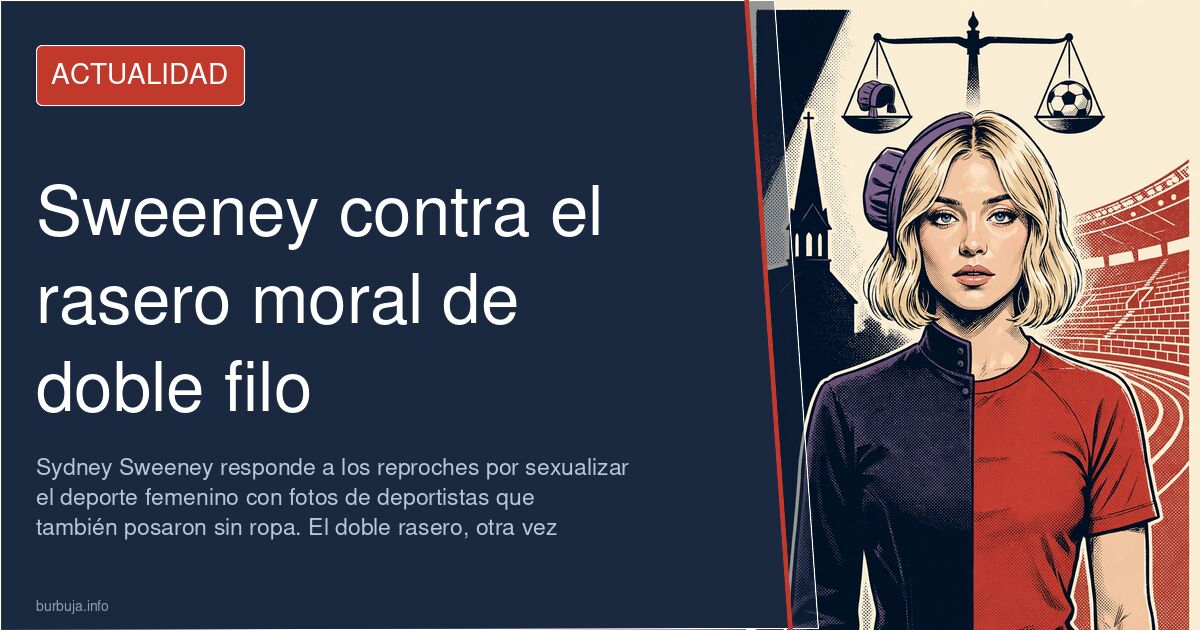
Sydney Sweeney's Ad Reignites Debate Over the Female Body
Why does an actress showing her body in an ad provoke a smear campaign against her, while the company paying for the ad goes unscathed? Sydney Sweeney stars in a campaign accused of sensual women's sports, and she has responded by posting photos of sports stars who did pose nude. According to one interpretation circulating in the debate, most of the criticism comes from other women. And that's where the problem starts.
What Peine with Sydney Sweeney's Ad
The ad in question isn't from a sports brand or a fashion label: it's paid for by a betting company. This paradox is central to much of the subsequent analysis, as the very sector that denounces the hypersenshyper of women's sports has barely focused on who is funding the ad. Some argue that this sponsorship is a much bigger issue and yet doesn't make headlines.
Sweeney has not apologized. It peine before with the “great jeans” ad, labeled racist at the time, and there was no correction then either. Adding a political dimension to her defense: she is registered as a Republican, although she defines herself as moderate and says she prefers to unite people. For some analysts, this detail explains the intensity of the campaign.
Why the Double Standard in Women's Sports Debate
The most repeated counterargument has proper names: Sports Illustrated and the ESPN Body Issue have been publishing nude photos of athletes for years, including some national teams. None of those covers generated the current outcry. The conclusion drawn is uncomfortable: the problem wouldn't be nudity itself, but who is doing it and who decides on it.
The comparison extends to the stands. It's recalled that the same fans who celebrate certain images of a tennis player changing shirts at the US Open would penalize, conversely, something equivalent. The argument is that a certain trend has shifted from a demand for equality to a management of privilege—who can be exhibited and who cannot. This is not a unanimous view.
There's even suspicion that the photos spread were generated by artificial intelligence. No one has proven this.
Neopuritanism: From the Anti-Sens League to Kollontai
The most cited theoretical framework these days is literary: Orwell's 1984 Anti-Sens League, the organization invented to eradicate pleasure and redirect sensual energy towards power. The analogy is exaggerated, but it illustrates the tone: some analyses see a prohibitionist impulse, not a feminist one, in public criticism.
The figure of Alexandra Kollontai, an early Bolshevik and author of The Love of a Bolshevik Worker, is also linked to this line of thought. She is read as a precursor to a collectivist feminism where the individual is subordinate to the group. Reading her, it is said, would explain many things today.
The simplest explanation—competition for attention, professional jealousy—is also the least demonstrable.
The ad is signed by a betting company. No one disputes that. What is disputed is whether an actress can show what she is paid to show. Apparently, it depends on who she is.
Why does an actress showing her body in an ad provoke a smear campaign against her, while the company paying for the ad goes unscathed? Sydney Sweeney stars in a campaign accused of sensual women's sports, and she has responded by posting photos of sports stars who did pose nude. According to one interpretation circulating in the debate, most of the criticism comes from other women. And that's where the problem starts.
What Peine with Sydney Sweeney's Ad
The ad in question isn't from a sports brand or a fashion label: it's paid for by a betting company. This paradox is central to much of the subsequent analysis, as the very sector that denounces the hypersenshyper of women's sports has barely focused on who is funding the ad. Some argue that this sponsorship is a much bigger issue and yet doesn't make headlines.
Sweeney has not apologized. It peine before with the “great jeans” ad, labeled racist at the time, and there was no correction then either. Adding a political dimension to her defense: she is registered as a Republican, although she defines herself as moderate and says she prefers to unite people. For some analysts, this detail explains the intensity of the campaign.
Why the Double Standard in Women's Sports Debate
The most repeated counterargument has proper names: Sports Illustrated and the ESPN Body Issue have been publishing nude photos of athletes for years, including some national teams. None of those covers generated the current outcry. The conclusion drawn is uncomfortable: the problem wouldn't be nudity itself, but who is doing it and who decides on it.
The comparison extends to the stands. It's recalled that the same fans who celebrate certain images of a tennis player changing shirts at the US Open would penalize, conversely, something equivalent. The argument is that a certain trend has shifted from a demand for equality to a management of privilege—who can be exhibited and who cannot. This is not a unanimous view.
There's even suspicion that the photos spread were generated by artificial intelligence. No one has proven this.
Neopuritanism: From the Anti-Sens League to Kollontai
The most cited theoretical framework these days is literary: Orwell's 1984 Anti-Sens League, the organization invented to eradicate pleasure and redirect sensual energy towards power. The analogy is exaggerated, but it illustrates the tone: some analyses see a prohibitionist impulse, not a feminist one, in public criticism.
The figure of Alexandra Kollontai, an early Bolshevik and author of The Love of a Bolshevik Worker, is also linked to this line of thought. She is read as a precursor to a collectivist feminism where the individual is subordinate to the group. Reading her, it is said, would explain many things today.
The simplest explanation—competition for attention, professional jealousy—is also the least demonstrable.
The ad is signed by a betting company. No one disputes that. What is disputed is whether an actress can show what she is paid to show. Apparently, it depends on who she is.
Summary of a discussion on Burbuja.info - Foro de economía, actualidad y política., translated from Spanish and reviewed before publication. Read the full discussion (45 replies).
More summaries
-
Guardia Civil Video Enters Sydney Sweeney Debate
A Guardia Civil video linked to actress Sydney Sweeney reignites the national debate over differing physical standards within Spain's security forces.
-
Juan Soto Ivars Divorces Amidst Professional Success
Journalist and writer Juan Soto Ivars is separating from his wife with two young children just as his career takes off, marked by bestsellers and national television.
-
Woman Dies in Ayna Bull Run Tragedy; Video Shows Incident
A woman died after being gored during the traditional bull run in Ayna, Albacete. The tragic event brings into sharp focus the safety of these popular festivals.
-
Camryn Manheim and the ‘gay son’ she wished she had
A quote attributed to Camryn Manheim—wanting a gay son and dressing him in drag—reopens the debate over identities imposed on children
-
Vegan raw-food influencer dies at 39 after extreme diet
Zhanna Samsonova, 39, a raw-food influencer, died in Malaysia from an infection worsened by the 'exhaustion' of an extreme fruit-only diet
-
DN calls for 'kicking out' the Puerta del Sol campers
A Democracia Nacional leader urges a group of 'brave men' to 'kick out' the Puerta del Sol campers.