
Swiss retiree calls Spain 'poor' after leaving Madrid
A Swiss engineer claims he saw poverty and abandoned houses when leaving Madrid, highlighting the wealth gap with Switzerland.
English · Original discussion in Spanish · Published
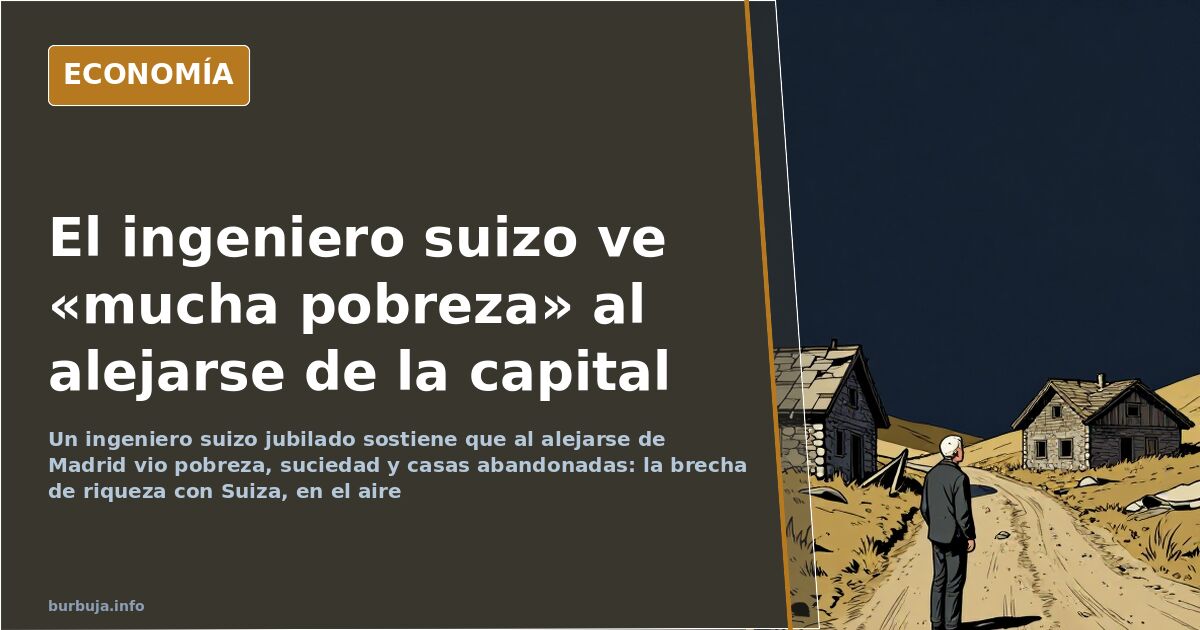
Swiss retiree calls Spain 'poor' after leaving Madrid
Is Spain a developed country? The answer depends on where you ask. In a capital city center, it seems obvious; on a provincial road, less so. A retired Swiss engineer married to a Spaniard gave his in-laws an uncomfortable diagnosis: after visiting seven Spanish cities on different trips, he claims that leaving the capital, he saw 'a lot of poverty' and that it 'shows it is not a developed country.'
What the retiree saw leaving the capital
His inventory is specific: dirty streets, poor road conditions, begging, shouting people, and above all, houses half-built and entire abandoned buildings. He repeats this scene in every city visited. He also admits the food is delicious, though he claims the omelet gives him diarrhea, a colorful detail. He concludes with a debatable statement: that Spaniards have a bad fruta in Europe because, in his view, they tend to cause trouble.
Here the story stops describing and starts judging. A traveler can report what he sees; turning that impression into a national trait is another matter.
Why are there so many half-built abandoned houses in Spain?
The most repeated explanation points to the real estate bubble: entire developments built during easy credit that were left unfinished when the cycle reversed. The trail of unpainted concrete is more visible on the outskirts than in historic centers, reinforcing the sense of abandonment for those traveling by road. The scale also matters: visiting Spain from a country the size of Catalonia involves comparing realities with different territorial dispersion.
A nuance is necessary. It is recalled that Switzerland also has degraded areas, sad neighborhoods, and cold streets, and that a partial view does not define an entire country. Comparing a state to a travel impression always goes poorly.
Are Spanish roads worse than European ones?
Here consensus breaks. Against the retiree's diagnosis stands the experience of someone who has traveled France since 1991 by car, van, and motorcycle, stating that comparing the French road network with the Spanish one does not withstand analysis. Others add that Italy is worse and that Italians are surprised by the quality of Spanish infrastructure when crossing it. The cost is also nuanced: one participant estimates the alucinación from Barajas airport to central Madrid at 4.50 euros, hardly an abuse.
What almost everyone admits is Swiss boredom: bars closed in mid-afternoon and a social life that, seen from the Mediterranean, seems like a documentary.
Housing prices and foreign tourism pressure
The conversation shifts to a numerical issue: the demand from foreign buyers. Some participants argue this pressure drives up new construction, short-term rentals eat the residential market, and some real estate agencies in the Levant already operate in English. The figures show a premium of tens of thousands of euros for chalets and apartments over what would be considered reasonable. The full breakdown reveals a surprising difference.
Alongside this economic analysis are messages of explicit rejection toward foreign buyers. This is a real social tension, but generalizing from it is exactly the error reproached to the Swiss visitor.
Wealth per capita: Spain vs. Switzerland
What stands out in the comparison is the distance in wealth per capita. Data places Spain well below Switzerland, though on par with Italy and the United States, and above much of the surrounding countries. From this arises a strong thesis: Spain is neither first nor third world, but something in between, a second world with first-world infrastructure and middle-income rents.
This mix explains the contradiction perceived by the visitor. Impeccable highways and abandoned warehouses on the same route.
Can we generalize about Spain with seven cities?
It depends on which ones. Some argue perception changes completely by region: southern and Levantine neighborhoods show deterioration not found in the north, where even large cities lack comparable areas. Others defend the opposite, with north Madrid matching Europe's best in amenities, housing, and income. Some suspect the engineer's anecdote is embellished or invented.
The observer's profile adds to this. European retirees on the coast move between their urbanization, the nearest town center, and the airport. From their own country, they often know only the departure terminal.
The initial question—whether Spain is a developed country—is likely not answered with seven cities or an indigestible omelet. It is answered by looking at how many cranes were left idle and who is still paying the bill for that mirage. What remains unexplained is why the Alpine paradise needs to export retirees to the Mediterranean to avoid dying of boredom.
Is Spain a developed country? The answer depends on where you ask. In a capital city center, it seems obvious; on a provincial road, less so. A retired Swiss engineer married to a Spaniard gave his in-laws an uncomfortable diagnosis: after visiting seven Spanish cities on different trips, he claims that leaving the capital, he saw 'a lot of poverty' and that it 'shows it is not a developed country.'
What the retiree saw leaving the capital
His inventory is specific: dirty streets, poor road conditions, begging, shouting people, and above all, houses half-built and entire abandoned buildings. He repeats this scene in every city visited. He also admits the food is delicious, though he claims the omelet gives him diarrhea, a colorful detail. He concludes with a debatable statement: that Spaniards have a bad fruta in Europe because, in his view, they tend to cause trouble.
Here the story stops describing and starts judging. A traveler can report what he sees; turning that impression into a national trait is another matter.
Why are there so many half-built abandoned houses in Spain?
The most repeated explanation points to the real estate bubble: entire developments built during easy credit that were left unfinished when the cycle reversed. The trail of unpainted concrete is more visible on the outskirts than in historic centers, reinforcing the sense of abandonment for those traveling by road. The scale also matters: visiting Spain from a country the size of Catalonia involves comparing realities with different territorial dispersion.
A nuance is necessary. It is recalled that Switzerland also has degraded areas, sad neighborhoods, and cold streets, and that a partial view does not define an entire country. Comparing a state to a travel impression always goes poorly.
Are Spanish roads worse than European ones?
Here consensus breaks. Against the retiree's diagnosis stands the experience of someone who has traveled France since 1991 by car, van, and motorcycle, stating that comparing the French road network with the Spanish one does not withstand analysis. Others add that Italy is worse and that Italians are surprised by the quality of Spanish infrastructure when crossing it. The cost is also nuanced: one participant estimates the alucinación from Barajas airport to central Madrid at 4.50 euros, hardly an abuse.
What almost everyone admits is Swiss boredom: bars closed in mid-afternoon and a social life that, seen from the Mediterranean, seems like a documentary.
Housing prices and foreign tourism pressure
The conversation shifts to a numerical issue: the demand from foreign buyers. Some participants argue this pressure drives up new construction, short-term rentals eat the residential market, and some real estate agencies in the Levant already operate in English. The figures show a premium of tens of thousands of euros for chalets and apartments over what would be considered reasonable. The full breakdown reveals a surprising difference.
Alongside this economic analysis are messages of explicit rejection toward foreign buyers. This is a real social tension, but generalizing from it is exactly the error reproached to the Swiss visitor.
Wealth per capita: Spain vs. Switzerland
What stands out in the comparison is the distance in wealth per capita. Data places Spain well below Switzerland, though on par with Italy and the United States, and above much of the surrounding countries. From this arises a strong thesis: Spain is neither first nor third world, but something in between, a second world with first-world infrastructure and middle-income rents.
This mix explains the contradiction perceived by the visitor. Impeccable highways and abandoned warehouses on the same route.
Can we generalize about Spain with seven cities?
It depends on which ones. Some argue perception changes completely by region: southern and Levantine neighborhoods show deterioration not found in the north, where even large cities lack comparable areas. Others defend the opposite, with north Madrid matching Europe's best in amenities, housing, and income. Some suspect the engineer's anecdote is embellished or invented.
The observer's profile adds to this. European retirees on the coast move between their urbanization, the nearest town center, and the airport. From their own country, they often know only the departure terminal.
The initial question—whether Spain is a developed country—is likely not answered with seven cities or an indigestible omelet. It is answered by looking at how many cranes were left idle and who is still paying the bill for that mirage. What remains unexplained is why the Alpine paradise needs to export retirees to the Mediterranean to avoid dying of boredom.
Also available in: Deutsch
Summary of a discussion on Burbuja.info - Foro de economía, actualidad y política., translated from Spanish and reviewed before publication. Read the full discussion (370 replies).
More summaries
-
Housing bubble: the 80% collapse that demographics are holding back
The claim that AI and VR will trigger an 80% crash in Madrid and Barcelona clashes with half a million arrivals a year and fewer than 100.000 homes.
-
Madrid Protest Camp Robberies Spark Debate Over Security
Activists camping in Madrid's Puerta del Sol report thefts of electronics, while the assembly avoids naming suspects.
-
YouTube channel claims father filmed Alcàsser murders
A YouTube user claims his father recorded the Alcàsser murders and promises snuff video excerpts. No evidence provided, only narrative and technical analysis.
-
Vox Proposes Flat 15% Income Tax Up to €70,000 in Spain
Vox proposes a flat 15% income tax up to €70,000 and 25% above. Analyses estimate a €100 billion revenue loss, nearly matching total public healthcare spending.
-
Ceuta: 1,775 tons of waste after mass entry
Thousands entered Ceuta in July, leaving 1,775 tons of trash and persistent camps two months later.
-
Ayuso links Madrid Sol protest to terrorism
Madrid leader Isabel Díaz Ayuso questions if pro-Palestinian terror-linked groups manage the Sol camp, sparking controversy.