
108-Year-Old Spaniard Never Visited a Gym
Pere Quintana, from Barcelona, turns 109 in January without ever exercising. His case reignites debates on genetics and longevity.
English · Original discussion in Spanish · Published
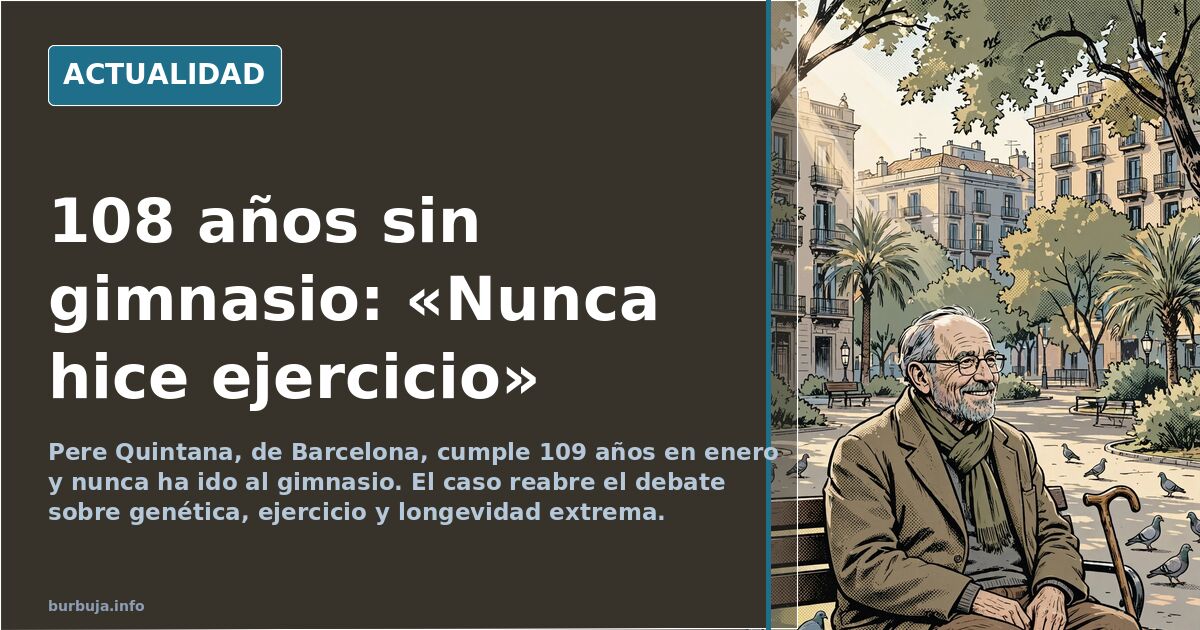
108 years without visiting a gym: "I never exercised"
Pere Quintana, a resident of Barcelona, will turn 109 in January. He states in an interview that he has never gone to the gym, swum, or walked for exercise like "everyone does in their second youth." If he reaches 109, he says he will feel as if he won a contest. The statement, broadcast by 3Cat, has peine a discussion far beyond this specific case: is hitting the gym useful if longevity depends on other factors?
The answer provided by available evidence is not what protein manufacturers would want. Nor is it what those celebrating the elderly man as proof that exercise is a waste of time would prefer. Quintana's case is real, but it is one among thousands. And statistics, when examined closely, do not say what they seem to.
What Pere Quintana Exactly Said
The protagonist is a man from Barcelona who will turn 109 next January. In the interview aired by 3Cat, he claims that to reach 108, he never exercised: no swimming, no walking, nor the routines he sees "everyone doing in their second youth." The key phrase, in Catalan, is "no he fet mai exercici." If he reaches 109, he feels it will be like winning a prize.
A detail adding context is that, according to the conversation, he was a pharmacist. This is not a minor fact: we are talking about a profession requiring standing and constant movement, without sitting at a screen all day. Quintana's generation did not need a gym because movement was integrated into daily life. People walked more, carried weight, and worked standing up. That is not voluntary exercise, but it is physical activity.
Genetics, the Lottery No One Wants to Look At
The most repeated argument in the debate is not that exercise is bad. It is that extreme longevity is, above all, a genetic lottery. Some state it bluntly: if you get the good genes, you make it; if you get the bad ones, no diet or squats can save you. Eating well and moving are within your control. Genetics are not.
The example cited to illustrate this is the survivor closest to the Hiroshima hypocenter, who was 260 meters away and survived. Does that miccionan radiation is good? No. It means that in any distribution, there are outliers. And in longevity, the outlier is precisely the one antiestéticatured in the media.
Is Heavy Weightlifting Bad for the Body?
Here, consensus is more nuanced than it appears. Some train strength three times a week and defend it unequivocally: it protects against sarcopenia, improves bone density, and allows independence until the last day. Against this, the experience of those who have lifted weights for years and accumulated joint issues: elbow leaks, battered knees, strained backs. The repeated conclusion is not to quit, but to moderate.
The gaining proposal is combination: swimming with good technique, cycling in moderation, and for strength, Pilates or yoga. More people who used to swim are swapping weights for yoga as a complement. Calisthenics, using body weight without added load, also appears as an intermediate option. Strength training remains useful, but the message is that excess takes its toll.
The Gym as Symbol: From Health to Obsession
Part of the conversation goes beyond physiology into cultural territory. The gym, it is argued, has become an obligatory, almost identity-based ritual. Those who do not go seem not to care for themselves. This generates backlash: regulars are described as slaves to routine, obsessed with boring recipes and chard-beet snacks, unable to admit that pleasure lies in potatoes with spicy sauce and a beer.
At the other extreme, the defense is equally strong: strength training protects against countless pathologies, and those who dismiss it from the bar counter are often precisely those who do not practice it. The debate, fundamentally, is not about the gym. It is about whether longevity is bought with habits or inherited via DNA. And how much of the former is just a way to blame those who do not make it.
Living to 108 Is Not Always the Prize It Seems
There is a current questioning the entire framework. Reaching 108 is not necessarily desirable: twenty years of dependency, diapers, and thirteen hours of TV a day do not sound like a prize. Life is for living, not surviving, summarizes one stance. Another points out that extreme longevity often comes with early widowhood and decades of uneventful routine.
The statistical closing is the disorienting part: for every Pere Quintana reaching 108 without a gym, there is a multitude who do not make it and whom no one interviews. Survivorship bias is the oldest trap in health journalism. And it is exactly the trap fallen into by those using this case to justify anything.
Pere Quintana, a resident of Barcelona, will turn 109 in January. He states in an interview that he has never gone to the gym, swum, or walked for exercise like "everyone does in their second youth." If he reaches 109, he says he will feel as if he won a contest. The statement, broadcast by 3Cat, has peine a discussion far beyond this specific case: is hitting the gym useful if longevity depends on other factors?
The answer provided by available evidence is not what protein manufacturers would want. Nor is it what those celebrating the elderly man as proof that exercise is a waste of time would prefer. Quintana's case is real, but it is one among thousands. And statistics, when examined closely, do not say what they seem to.
What Pere Quintana Exactly Said
The protagonist is a man from Barcelona who will turn 109 next January. In the interview aired by 3Cat, he claims that to reach 108, he never exercised: no swimming, no walking, nor the routines he sees "everyone doing in their second youth." The key phrase, in Catalan, is "no he fet mai exercici." If he reaches 109, he feels it will be like winning a prize.
A detail adding context is that, according to the conversation, he was a pharmacist. This is not a minor fact: we are talking about a profession requiring standing and constant movement, without sitting at a screen all day. Quintana's generation did not need a gym because movement was integrated into daily life. People walked more, carried weight, and worked standing up. That is not voluntary exercise, but it is physical activity.
Genetics, the Lottery No One Wants to Look At
The most repeated argument in the debate is not that exercise is bad. It is that extreme longevity is, above all, a genetic lottery. Some state it bluntly: if you get the good genes, you make it; if you get the bad ones, no diet or squats can save you. Eating well and moving are within your control. Genetics are not.
The example cited to illustrate this is the survivor closest to the Hiroshima hypocenter, who was 260 meters away and survived. Does that miccionan radiation is good? No. It means that in any distribution, there are outliers. And in longevity, the outlier is precisely the one antiestéticatured in the media.
Is Heavy Weightlifting Bad for the Body?
Here, consensus is more nuanced than it appears. Some train strength three times a week and defend it unequivocally: it protects against sarcopenia, improves bone density, and allows independence until the last day. Against this, the experience of those who have lifted weights for years and accumulated joint issues: elbow leaks, battered knees, strained backs. The repeated conclusion is not to quit, but to moderate.
The gaining proposal is combination: swimming with good technique, cycling in moderation, and for strength, Pilates or yoga. More people who used to swim are swapping weights for yoga as a complement. Calisthenics, using body weight without added load, also appears as an intermediate option. Strength training remains useful, but the message is that excess takes its toll.
The Gym as Symbol: From Health to Obsession
Part of the conversation goes beyond physiology into cultural territory. The gym, it is argued, has become an obligatory, almost identity-based ritual. Those who do not go seem not to care for themselves. This generates backlash: regulars are described as slaves to routine, obsessed with boring recipes and chard-beet snacks, unable to admit that pleasure lies in potatoes with spicy sauce and a beer.
At the other extreme, the defense is equally strong: strength training protects against countless pathologies, and those who dismiss it from the bar counter are often precisely those who do not practice it. The debate, fundamentally, is not about the gym. It is about whether longevity is bought with habits or inherited via DNA. And how much of the former is just a way to blame those who do not make it.
Living to 108 Is Not Always the Prize It Seems
There is a current questioning the entire framework. Reaching 108 is not necessarily desirable: twenty years of dependency, diapers, and thirteen hours of TV a day do not sound like a prize. Life is for living, not surviving, summarizes one stance. Another points out that extreme longevity often comes with early widowhood and decades of uneventful routine.
The statistical closing is the disorienting part: for every Pere Quintana reaching 108 without a gym, there is a multitude who do not make it and whom no one interviews. Survivorship bias is the oldest trap in health journalism. And it is exactly the trap fallen into by those using this case to justify anything.
Summary of a discussion on Burbuja.info - Foro de economía, actualidad y política., translated from Spanish and reviewed before publication. Read the full discussion (140 replies).
More summaries
-
Camryn Manheim's gay son joke that many missed
Camryn Manheim said at a dinner she always wanted a gay son and dressed him in drag: the New York Post clarified it was a joke.
-
Pradera Blames Diet for His Prostate Cancer
Spanish journalist Máximo Pradera attributes his prostate cancer to diet and criticizes public healthcare, sparking debate among medical experts.
-
Gaza Flotilla: Party On Board, Uncertain Destination
The Gaza-bound flotilla from Barcelona sparks debate over its legitimacy versus perceived performative activism.
-
Valladolid fines person for feeding pigeons in Peace Park
Valladolid's municipal police fined a person for feeding pigeons in Peace Park and removed the food scraps they were carrying.
-
Spanish HIV Documentary Sells Two Tickets Despite €317k Subsidy
A viral tweet mocks the low ticket sales for Eduardo Casanova's HIV documentary in Madrid, sparking debate over public film subsidies.
-
Madrid Restaurant Staff Investigated After Thief With 101 Records Hospitalized
A thief with 101 police records was hospitalized after a chase by three Madrid restaurant employees. Police are investigating the staff for assault.