
Susana Díaz in tears as Sánchez's contested PSOE vote resurfaces
Susana Díaz cries at the federal committee meeting that ended with Sánchez's resignation. The video of the disputed vote is circulating again, and some claim nobody ever…
English · Original discussion in Spanish · Published
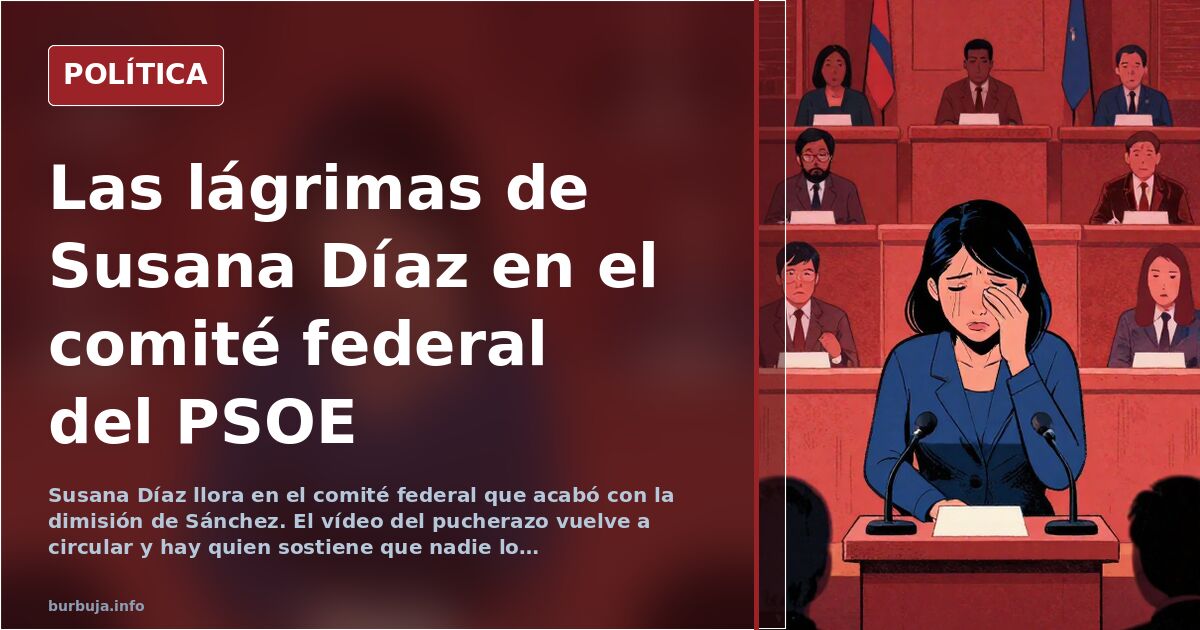
Susana Díaz cried at the federal committee meeting that ended with Sánchez's resignation
There is a video making the rounds again these days with the force of an uncomfortable document. It shows the then Andalusian premier, Susana Díaz, with moist eyes, as the PSOE's federal committee tears itself apart from within. It is the same conclave that ended with Pedro Sánchez's resignation as party leader. The footage, released by The Objective, shows supporters of today's Prime Minister interrupting, shouting and grabbing the microphone from whoever was speaking, according to the description accompanying the video. And one line has become the summary of that day: "If we want to hide our will, it is because we trust little in the freedom of this party."
The debate is not new, but the graphic material brings it back to the present. According to those who have shared it, the video is a firsthand account of how that internal vote was handled. One camp reads it as proof that the current Prime Minister had no scruples about seizing control of the party. Another replies that it was a dispute between factions and that time has vindicated the winner. What nobody disputes is that the episode left a wound that still festers.
What the video of the PSOE federal committee shows
The footage, released by The Objective, captures several moments of tension. Sánchez's supporters interrupt speakers, raise their voices and even snatch the microphone from whoever is talking, according to the description accompanying the video. The vote was organized with a ballot box brought in hastily, according to the description accompanying the video. The then Andalusian premier appears visibly shaken. It is not a scene of calm debate: it is a struggle for control of the party machinery.
The line attributed to Susana Díaz in that context —"If we want to hide our will, it is because we trust little in the freedom of this party"— sums up the argument of those who at the time called for a clear, show-of-hands vote. The Sánchez camp's answer was the opposite: the secret ballot was the only guarantee of freedom. That procedural dispute is what ended with Sánchez's resignation and with the subsequent primary election that returned today's Prime Minister to the leadership of the party.
The rigged vote nobody reported to the prosecutor's office
One of the threads with the most traction is the absence of a formal complaint. The idea has spread that nobody in the PSOE took the alleged ballot rigging to the public prosecutor's office. The argument put forward is that the party's systemic corruption prevents it: whoever complains is pushed out. It is a thesis that circulates widely, but it is not an established fact. What is established is that the episode had no known judicial consequences.
In parallel, some analyses point out that the secret ballot is the standard in any general election. "There is no freer vote than the secret ballot," argue those who defend Sánchez's actions. The objection is that a federal committee is not a general election: there, everyone knows the outcome in advance and the ballot box becomes an instrument of pressure, critics contend. The debate, then, is not only about the rigged vote, but about what rules should govern the internal life of a party.
From tears to the Senate: Susana Díaz's path since then
The then Andalusian premier later lost the presidency of the Junta de Andalucía (the regional government) and ended up as a senator. Several posts stress that she receives an allowance as a parliamentarian without doing anything of note. It is a detail repeated with a smirk, but it should be treated with caution: neither the exact amount nor the conditions are on record. What is verifiable is that her political career was rerouted after that federal committee.
The video has also served to revive comparisons with other figures of the era. Juan Cornejo is mentioned, said to have shown contained rage that day. And it is recalled that today's Prime Minister has been described by his critics as a political "killing machine": someone capable of surviving any internal crisis. The irony is that the person who today appears as the victim of a rigged vote was, according to her detractors, the one who carried it out.
What this video means for the PSOE years later
The material is not new, but its circulation has an effect. It strengthens the narrative of those who see Sánchez as a leader without scruples. And it weakens those who maintain that his rise to power was clean. At bottom, the video settles nothing: it confirms that the PSOE is a party with deep fractures, managed through machine politics. The question hanging in the air is whether those fractures are still there or whether time has papered over them.
What is unsettling is not the tears. It is that, years later, some maintain that nobody has reported anything. Not to the prosecutor's office, not to the party's ethics committee, not in public. The video keeps circulating, the tears are still there, and so is the silence.
Also available in: Deutsch
Summary of a discussion on Burbuja.info - Foro de economía, actualidad y política., translated from Spanish and reviewed before publication. Read the full discussion (99 replies).
More summaries
-
PSOE critics demand elections this year and Sánchez's exit
The PSOE's ReActiva faction calls for elections this year and for Sánchez not to run. A credibility crisis and scandals open an internal rift that…
-
Profile of PSOE voters: most don't work, are pensioners, and remain loyal to Pedro Sánchez
45.5% of PSOE voters don't work, 35.4% are pensioners, and 60.5% always vote for the same party. A profile of the Socialist electorate.
-
Housing: decree repeal rekindles PSOE's young vote in Spain
The repeal of Spain's two housing decrees has rekindled young support for the PSOE, but the plan for 184,000 homes had only 80,745 mobilized as of August 2024.
-
Sánchez vows to stay on for four more years, 'one way or another'
Pedro Sánchez says he will remain in power 'one way or another' for four more years. Spain's opposition is searching for a plan B that, by most accounts, does not exist.
-
Swedish Social Democrats' Arabic posters: votes or principles?
Sweden's Social Democrats have turned to Arabic in their campaign posters: integration or electoral strategy? The debate is spreading and has echoes in Spain.
-
Spain's army: torn between NATO and Ceuta, what is it for?
Spain's armed forces are engaged in 16 international missions, yet during the Ceuta crisis they called 112, Spain's emergency number, for help. The perception that they are useless is growing.