
Supreme Court and the Vote of Exiles' Grandchildren
Supreme Court demands verification of exile descendants' link to vote. Two million affected and suspicion of electoral rigging.
English · Original discussion in Spanish · Published
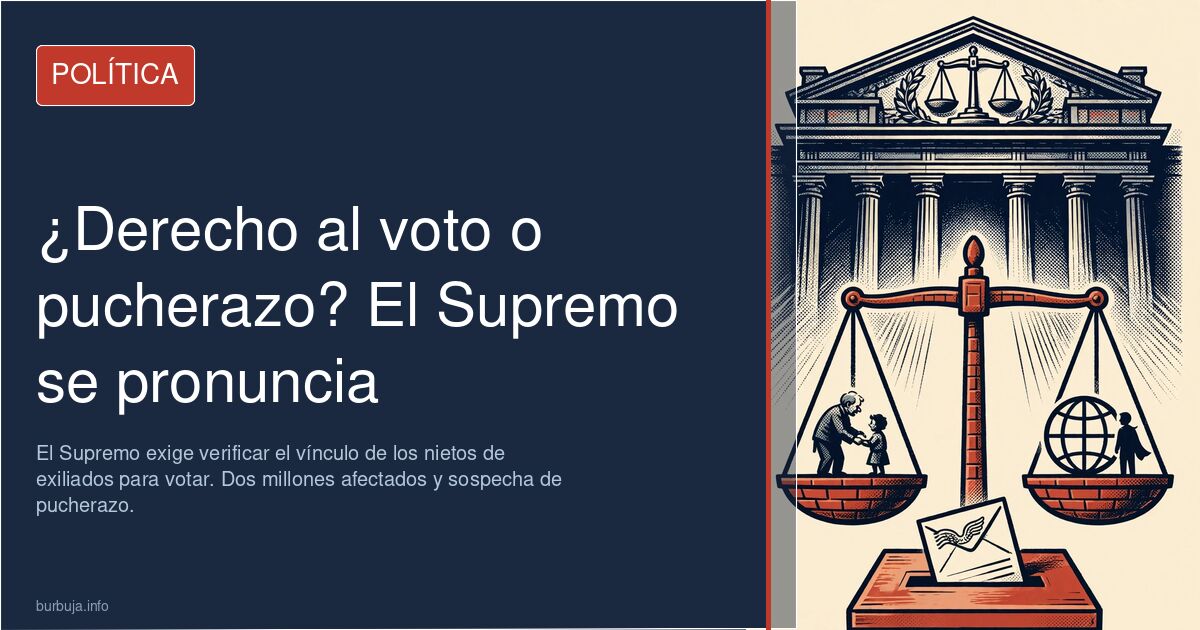
The Supreme Court and the Vote of Exiles' Grandchildren
In 2015, Spain granted nationality to descendants of Sephardim expelled 500 years ago with hardly any discussion. Today, the same society applauds that the Supreme Court requires verification that the grandchildren of Republican exiles are genuinely so. Two million people, according to estimates, could be affected by the high court's decision. The paradox is striking.
What has the Supreme Court decided?
The Supreme Court has ordered a review of the actual link of descent in cases where nationality was granted under the grandchildren's law. That is, those who obtained Spanish citizenship as descendants of exiles must effectively prove it before they can exercise electoral rights. The measure, affecting a group estimated at two million people, has been met with relief by some, but considered by others as a restriction of fundamental rights.
The defenders of the decision argue that it is a matter of legality and preventing people who have never set foot in Spain from voting in Spanish elections. In practice, there is suspicion that these votes could have been used to alter the electoral outcome in key constituencies.
Suspicion of fraud and the role of Indra and Correos
The background to the decision is the possibility of electoral fraud through postal voting. According to circulating calculations, around 300,000 or 400,000 additional votes, if strategically placed in certain constituencies, could move up to 20 deputies. This would be the deep cause of the rush to approve nationality for exile descendants in the last legislature.
The reference to companies like Indra and Correos is repeated among those who argue that the Sánchez Government designed a plan to artificially increase its electoral base. There is no public proof of this, but the suspicion runs rampant and fuels distrust in the system.
The counterpoint: rights, census and uncomfortable comparisons
On the other hand, it is argued that the Supreme Court's decision cannot be attributed a partisan motivation. The main criticism is that we are becoming accustomed to applauding the loss of rights so long as the affected party is the political opponent. The comparison with the Sephardim, to whom nationality was granted without any control in 2015, is uncomfortable. If the norm is the same, why is a more rigorous examination demanded now?
It is also argued that the vote of residents outside Spain is a recognized right. And that questioning it by those who defend the democratic system is a dangerous precedent. The tension between census integrity and universal suffrage is on the table.
Is this a legitimate defense of legality or a partisan use of justice to limit the voting right of less visible citizens? The answer, for now, is not unanimous.
In 2015, Spain granted nationality to descendants of Sephardim expelled 500 years ago with hardly any discussion. Today, the same society applauds that the Supreme Court requires verification that the grandchildren of Republican exiles are genuinely so. Two million people, according to estimates, could be affected by the high court's decision. The paradox is striking.
What has the Supreme Court decided?
The Supreme Court has ordered a review of the actual link of descent in cases where nationality was granted under the grandchildren's law. That is, those who obtained Spanish citizenship as descendants of exiles must effectively prove it before they can exercise electoral rights. The measure, affecting a group estimated at two million people, has been met with relief by some, but considered by others as a restriction of fundamental rights.
The defenders of the decision argue that it is a matter of legality and preventing people who have never set foot in Spain from voting in Spanish elections. In practice, there is suspicion that these votes could have been used to alter the electoral outcome in key constituencies.
Suspicion of fraud and the role of Indra and Correos
The background to the decision is the possibility of electoral fraud through postal voting. According to circulating calculations, around 300,000 or 400,000 additional votes, if strategically placed in certain constituencies, could move up to 20 deputies. This would be the deep cause of the rush to approve nationality for exile descendants in the last legislature.
The reference to companies like Indra and Correos is repeated among those who argue that the Sánchez Government designed a plan to artificially increase its electoral base. There is no public proof of this, but the suspicion runs rampant and fuels distrust in the system.
The counterpoint: rights, census and uncomfortable comparisons
On the other hand, it is argued that the Supreme Court's decision cannot be attributed a partisan motivation. The main criticism is that we are becoming accustomed to applauding the loss of rights so long as the affected party is the political opponent. The comparison with the Sephardim, to whom nationality was granted without any control in 2015, is uncomfortable. If the norm is the same, why is a more rigorous examination demanded now?
It is also argued that the vote of residents outside Spain is a recognized right. And that questioning it by those who defend the democratic system is a dangerous precedent. The tension between census integrity and universal suffrage is on the table.
Is this a legitimate defense of legality or a partisan use of justice to limit the voting right of less visible citizens? The answer, for now, is not unanimous.
Summary of a discussion on Burbuja.info - Foro de economía, actualidad y política., translated from Spanish and reviewed before publication. Read the full discussion (104 replies).
More summaries
-
Supreme Court Halts Electoral Effect of Grandchildren Law
The Supreme Court has suspended the electoral effects of the Grandchildren Law. New nationals may be unable to vote unless they reside in Spain.
-
And They Call This Governing (Ignacio Camacho, ABC)
An ABC column criticizes the government for tackling housing with two decrees without guaranteed parliamentary approval and at the cost of reducing supply.
-
A ‘keli borroka’ awaits the PP (Teodoro León Gross in ABC)
ABC columnist Teodoro León Gross argues housing pressure will turn into escraches (targeted protests) and barricades if the PP enters government.
-
A democratic obligation unfulfilled (ABC editorial)
Article 134.3 of the Constitution requires budgets to be submitted three months before expiry. Spain is still running on the 2023 Budget.
-
Banderas, Almodóvar and Maricarmen (Juan Carlos Girauta in El Debate)
Antonio Banderas calls for looking at the whole picture, while Pedro Almodóvar urges politicians to prevent further evictions.
-
The USSR and the Origins of Borregocracia: Thesis and Suspicions
Soviet infiltration, free lawyers, Gramsci and academic inbreeding: the thesis that traces today's groupthink to the USSR.