
The USSR and the Origins of Borregocracia: Thesis and Suspicions
Soviet infiltration, free lawyers, Gramsci and academic inbreeding: the thesis that traces today's groupthink to the USSR.
English · Original discussion in Spanish · Published
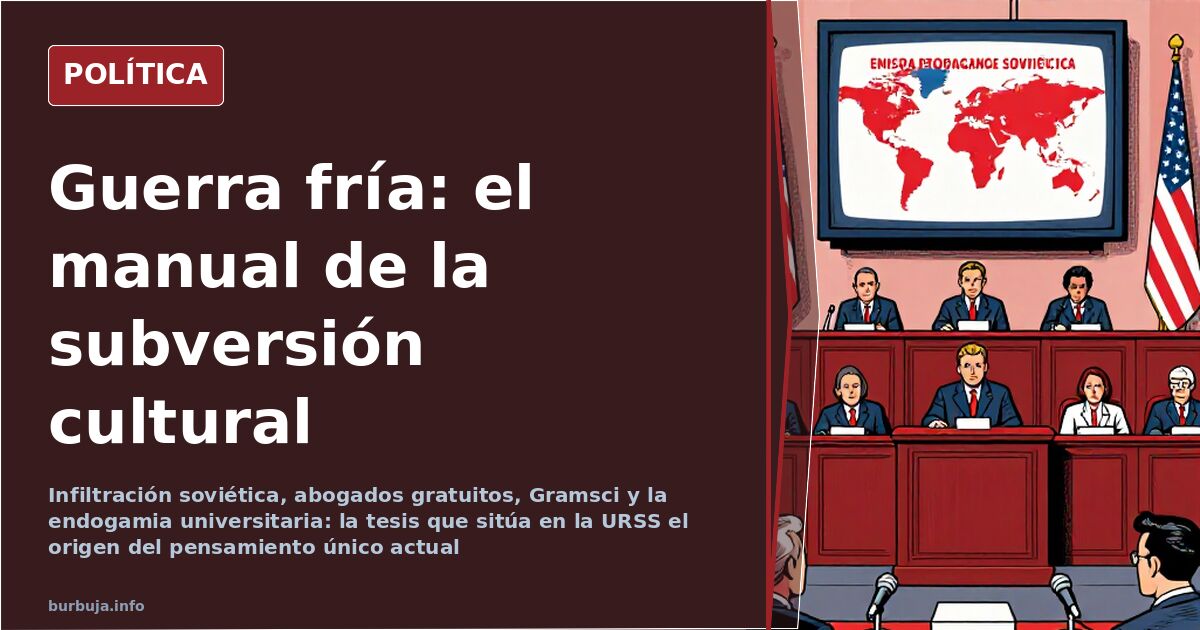
The thesis of the USSR as the origin of single thought
The Soviet Union has been extinct for more than three decades and is still winning cultural battles. At least in the narrative of those who maintain that the ideology now dominant in the West was not cooked up in the West. The thesis, forcefully revived in circles critical of the pogre consensus, points to a social engineering experiment on an imperial scale: infiltration, money, free lawyers and a propaganda machine that outlived its sponsor. The term that sums up that suspicion is borregocracia.
From Senate Interrogations to Lawyers Who Charged Nothing
The starting point is partly documented: after World War II, Soviet infiltration reached levels of the US administration and resulted in the theft of nuclear secrets. McCarthyism was the reaction, so disproportionate in its methods that it ended up serving its enemies better than its defenders. On that terrain, the narrative that is presented places the creation, in the 1950s, of the Civil Rights Congress, a structure dedicated—according to this reading—to the defense of minorities and the demolition of what they called repressive legislation: prison, death penalty and anything that sounded like order.
In the 1960s appears the piece that is most repeated: a national lawyers' league that offered free assistance to African-American activist organizations and, a decade later, to the defense of members of German armed groups. The detail is in the method, not the money. When one of the cited appeared, calls were made to fill the doors of the building, acts of peaceful sabotage were organized and the cameras were allowed to record the eviction. The judicial procedure ceased to be a procedure and became a blueprint of state repression against innocents. Anyone who has seen a news program this week will know why the comparison stings.
Kotchergine, the Camps and the Spanish Route
In the 1960s, Colonel Vadim Kotchergine, of the KGB, personally supervised training camps in Latin America through which Palestinians, Italians, Germans and Spaniards passed. Shortly after, with a temporal coincidence that the version underlines, armed groups began to emerge in all those countries. In the Spanish case, the infrastructure would have come from cadres of the Communist Party, who according to these versions provided safe houses and logistical support to ETA. All this is formulated as an assumption, without a sentence that closes the list.
The analysis also dwells on a procedural detail that it considers revealing: the FBI agents who entered without authorization an apartment of a US armed group to look for evidence ended up convicted, and from that mess came internal guidelines that limited investigations to crimes to be committed in the next 48 hours. The conclusion drawn is uncomfortable: the security apparatus put obstacles in its own way just when it had a real threat in front of it.
Gramsci, Cultural Hegemony and Academic Inbreeding
Here the focus moves from Soviet money to the production of meaning. The radiating nuclei and the cultural hegemony of Antonio Gramsci are the key that is repeated: there is no need to win elections if you control what is considered common sense. Humanities and Journalism faculties have been functioning for decades, in this reading, as loudspeakers for a single current. In Spain, academic inbreeding is added to that: entire cohorts of professors chosen by their own teachers and perpetuated by ideological affinity. It is no coincidence, it is insisted.
The most uncomfortable nuance for the thesis itself was provided by a Soviet defector officer: only societies that were already destroying themselves can be subverted, and most of the dirty work is done by those at home. The KGB, he was saying, limited itself to amplifying. That phrase dismantles the simplest version—an empire pulling the strings—and replaces it with a more disturbing one: the Soviet manual found advanced students.
The Suspicion That Explains Everything and Its Flip Side
Not all arguments on the same side are solid. The idea that a liberal nation cannot lose a war against another that does not respect private property, because its soldiers fight for what is theirs, received a classic counterexample: the leagues of Sparta, militarized and moneyless societies, defeated the commercial ones of Athens. History rarely respects theoretical models.
The underlying objection is another and is not answered with quotes: names, meeting places and documents are missing for the final stretch of the chain. It is easy to invoke elites; it is difficult to point to a specific person with a specific date. That is where the thesis splits in two, between what is in the archives and what is only in intuition. A calculation that circulates among the most critical adds a physiological detail: neurons are 0.1% of the body's cells and consume 25% of its resources, so that the contemporary diet strikes right where thought is decided.
The Aesthetic Front: The Idiot Family Man and the 45-Kilo Heroine
Part of the analysis focuses on fiction, which is where hegemony installs itself without going through any ministry. The archetype of the married man, family father, ridiculous and clumsy, who wears Bermuda shorts to funerals, has dominated comedy for two decades. For a male character to be intelligent, he must first be gai, incivil or both, it is argued. The female protagonists, meanwhile, can be unfaithful without the plot making them pay for it.
In action cinema the replacement is more visible: trained specialists have been replaced by 45-kilo women who knock down six-foot thugs and lift rubble without breaking a sweat. And in Spain there is an example cited as a late confession: the team of the most influential children's program of the 1980s later acknowledged the ideological load it brought into other people's homes. While parents left the children watching cartoons.
What can be foreseen, with all the caution in the world, is that this discussion is not going to be closed with a definitive document. Soviet archives continue to open in dribs and drabs, and each partial declassification feeds both those who see a foreign hand behind every cultural turn and those who remember that the West had its cracks long before the first agent arrived. The term borregocracia will continue to be used, and will continue to displease anyone who feels alluded to.
The Soviet Union has been extinct for more than three decades and is still winning cultural battles. At least in the narrative of those who maintain that the ideology now dominant in the West was not cooked up in the West. The thesis, forcefully revived in circles critical of the pogre consensus, points to a social engineering experiment on an imperial scale: infiltration, money, free lawyers and a propaganda machine that outlived its sponsor. The term that sums up that suspicion is borregocracia.
From Senate Interrogations to Lawyers Who Charged Nothing
The starting point is partly documented: after World War II, Soviet infiltration reached levels of the US administration and resulted in the theft of nuclear secrets. McCarthyism was the reaction, so disproportionate in its methods that it ended up serving its enemies better than its defenders. On that terrain, the narrative that is presented places the creation, in the 1950s, of the Civil Rights Congress, a structure dedicated—according to this reading—to the defense of minorities and the demolition of what they called repressive legislation: prison, death penalty and anything that sounded like order.
In the 1960s appears the piece that is most repeated: a national lawyers' league that offered free assistance to African-American activist organizations and, a decade later, to the defense of members of German armed groups. The detail is in the method, not the money. When one of the cited appeared, calls were made to fill the doors of the building, acts of peaceful sabotage were organized and the cameras were allowed to record the eviction. The judicial procedure ceased to be a procedure and became a blueprint of state repression against innocents. Anyone who has seen a news program this week will know why the comparison stings.
Kotchergine, the Camps and the Spanish Route
In the 1960s, Colonel Vadim Kotchergine, of the KGB, personally supervised training camps in Latin America through which Palestinians, Italians, Germans and Spaniards passed. Shortly after, with a temporal coincidence that the version underlines, armed groups began to emerge in all those countries. In the Spanish case, the infrastructure would have come from cadres of the Communist Party, who according to these versions provided safe houses and logistical support to ETA. All this is formulated as an assumption, without a sentence that closes the list.
The analysis also dwells on a procedural detail that it considers revealing: the FBI agents who entered without authorization an apartment of a US armed group to look for evidence ended up convicted, and from that mess came internal guidelines that limited investigations to crimes to be committed in the next 48 hours. The conclusion drawn is uncomfortable: the security apparatus put obstacles in its own way just when it had a real threat in front of it.
Gramsci, Cultural Hegemony and Academic Inbreeding
Here the focus moves from Soviet money to the production of meaning. The radiating nuclei and the cultural hegemony of Antonio Gramsci are the key that is repeated: there is no need to win elections if you control what is considered common sense. Humanities and Journalism faculties have been functioning for decades, in this reading, as loudspeakers for a single current. In Spain, academic inbreeding is added to that: entire cohorts of professors chosen by their own teachers and perpetuated by ideological affinity. It is no coincidence, it is insisted.
The most uncomfortable nuance for the thesis itself was provided by a Soviet defector officer: only societies that were already destroying themselves can be subverted, and most of the dirty work is done by those at home. The KGB, he was saying, limited itself to amplifying. That phrase dismantles the simplest version—an empire pulling the strings—and replaces it with a more disturbing one: the Soviet manual found advanced students.
The Suspicion That Explains Everything and Its Flip Side
Not all arguments on the same side are solid. The idea that a liberal nation cannot lose a war against another that does not respect private property, because its soldiers fight for what is theirs, received a classic counterexample: the leagues of Sparta, militarized and moneyless societies, defeated the commercial ones of Athens. History rarely respects theoretical models.
The underlying objection is another and is not answered with quotes: names, meeting places and documents are missing for the final stretch of the chain. It is easy to invoke elites; it is difficult to point to a specific person with a specific date. That is where the thesis splits in two, between what is in the archives and what is only in intuition. A calculation that circulates among the most critical adds a physiological detail: neurons are 0.1% of the body's cells and consume 25% of its resources, so that the contemporary diet strikes right where thought is decided.
The Aesthetic Front: The Idiot Family Man and the 45-Kilo Heroine
Part of the analysis focuses on fiction, which is where hegemony installs itself without going through any ministry. The archetype of the married man, family father, ridiculous and clumsy, who wears Bermuda shorts to funerals, has dominated comedy for two decades. For a male character to be intelligent, he must first be gai, incivil or both, it is argued. The female protagonists, meanwhile, can be unfaithful without the plot making them pay for it.
In action cinema the replacement is more visible: trained specialists have been replaced by 45-kilo women who knock down six-foot thugs and lift rubble without breaking a sweat. And in Spain there is an example cited as a late confession: the team of the most influential children's program of the 1980s later acknowledged the ideological load it brought into other people's homes. While parents left the children watching cartoons.
What can be foreseen, with all the caution in the world, is that this discussion is not going to be closed with a definitive document. Soviet archives continue to open in dribs and drabs, and each partial declassification feeds both those who see a foreign hand behind every cultural turn and those who remember that the West had its cracks long before the first agent arrived. The term borregocracia will continue to be used, and will continue to displease anyone who feels alluded to.
Summary of a discussion on Burbuja.info - Foro de economía, actualidad y política., translated from Spanish and reviewed before publication. Read the full discussion (101 replies).
More summaries
-
And They Call This Governing (Ignacio Camacho, ABC)
An ABC column criticizes the government for tackling housing with two decrees without guaranteed parliamentary approval and at the cost of reducing supply.
-
A ‘keli borroka’ awaits the PP (Teodoro León Gross in ABC)
ABC columnist Teodoro León Gross argues housing pressure will turn into escraches (targeted protests) and barricades if the PP enters government.
-
A democratic obligation unfulfilled (ABC editorial)
Article 134.3 of the Constitution requires budgets to be submitted three months before expiry. Spain is still running on the 2023 Budget.
-
Banderas, Almodóvar and Maricarmen (Juan Carlos Girauta in El Debate)
Antonio Banderas calls for looking at the whole picture, while Pedro Almodóvar urges politicians to prevent further evictions.
-
Abascal claims a Spaniard cannot be racist
Abascal claims 'a Spaniard cannot be racist', and his own voters answer with unemployment, demographics and accusations of betrayal
-
98% of VOX voters reject shorter workweek, INVYMARK poll finds
INVYMARK puts 98% of VOX voters and 89.7% of PP voters against cutting hours while keeping pay. The cost is up for debate.