
Supermarket vinegar costs 17€/L; homemade is 0.40€
Store-brand vinegar costs 17€/L, tomato 11€/kg. Private labels can be 40x pricier than homemade versions.
English · Original discussion in Spanish · Published
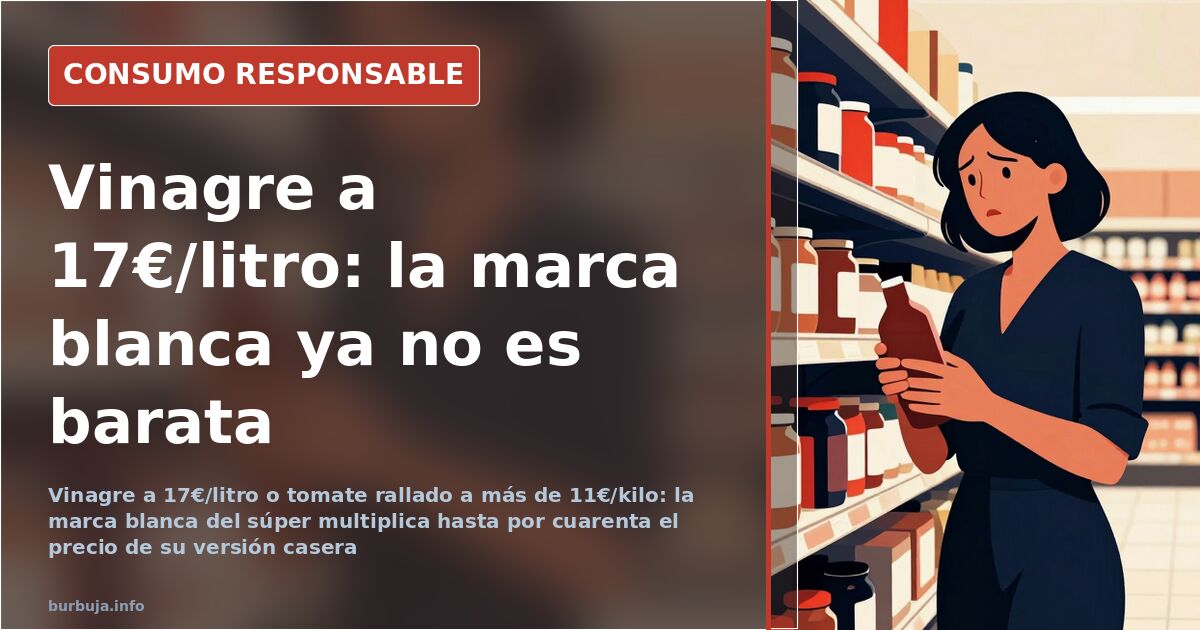
Vinegar at 17€ per liter: when store brands stop being cheap
A bottle of vinegar for hair shine costs 3.60€ at Mercadona. That is 17€ per liter. The same effect, according to those who have used it for decades, is achieved with white salad vinegar, which costs around 0.40€/liter and whose smell disappears in less than three minutes. Forty times more expensive for a similar acid and a label promising cosmetics.
From there starts an ongoing debate: where is the boundary between the store brand that lowers the shopping basket and the processed product that sneaks in with premium pricing. Store brands are no longer synonymous with cheap, and the calculations made by more meticulous consumers leave little room for doubt.
Grated tomato, anchovies, and nuts: the cost per kilo
The exercise consists of looking at the price per kilo and not the package price. The grated tomato from Consum —Eroski in Valencia— costs more than 11€/kg. At the neighborhood fruit shop, 0.8€/kg, and it is grated to taste. Anchovies in small tubs reach 25€/kg; the quarter-kilo format, 18€. At the market, two kilos for 3€ plus another euro for oil and vinegar.
The list continues: walnut and almond toppings at 1€ that at the fruit shop would not exceed 0.20€; bagged grated cheese, the convenience of which —they admit— is well charged; bottled egg whites; "freshly squeezed" lemon juice that has been bottled for months; ready-made potato tortillas. A natural juice with only 10% concentrate closes the picture.
But do convenience and time justify the premium?
Here comes the counterpoint. Not everyone has a garden, a nearby market, or two free hours. Convenience costs, and those without time pay for it. This is the argument of those who defend that the premium is, in reality, buying time.
The rebuttal comes from the calculation: cleaning a kilo of anchovies by hand takes a quarter of an hour, so paying 25€ for it is equivalent to charging surgeon prices for the hour. The other answer points to time as an excuse: those who complain most about not having time are, they claim, those who do the least during the day.
Where are the 30% to 50% discounts for near-expiry?
In parallel, another way to save: short-date discount labels. They are found at Día, Consum/Eroski, Simply —meat, fresh cheese, yogurt, poultry—, Bonarea, Alcampo, and Lidl, which also has a corner with discounted products. At Carrefour, trays of turkey breast with a couple of days left have been seen at single-tray prices, with the initial kilo at 7.20€. Some have bought chicken at 0.50€ per kilo.
The fine print: not everything is worth it. Prepared salads and certain processed foods still do not seem worth it even discounted. And the label does not always appear the day before expiry; there are cases with a week's margin. The complete breakdown, format by format, is where the juice lies.
Yogurts expired a month ago: the domed lid as a warning
The issue has spread to dairy. Stories circulate of yogurts consumed a month after the date and smoothies with a half-year delay that, they say, were perfect. The implicit question is how many preservatives are needed for that.
It is necessary to separate the anecdote from the protocol. The repeated alarm signal is the domed lid —also in fresh cheese—: there is danger. Without that symptom, opening, smelling, and tasting is what more than one person does. Homemade yogurts made with a yogurt maker last two or three weeks, and those who make them rarely check how much longer they would last.
What is worth making at home
There is a core of products where homemade preparation wins by a landslide. Pizza dough costs around 2€ for 250 grams packaged and costs about 0.50€ when kneaded at home. A liter of rice milk drops from 1.40€ to 0.70€. A dozen Sunday churros cost 3.60€, and the churrera pays for itself in less than a month. Health food store energy bars, at 1.50€ each, admit a version with muesli and nuts.
Also bread —the big scam of bread boutiques deserves another chapter—, turrón yogurt, tomato sauce, and even baking colorings, which come from spinach, parsley, or peppers. The limit is put by chemistry: homemade puff pastry has its ritual, and some admit that buying it is more cost-effective.
The jump is not in a specific chain, but in the logic: the more intermediaries, the more packaging and convenience, the higher the cost per kilo. With the figures in front, the conclusion writes itself almost alone: there are products that can cost more than forty times their homemade version and are still sold as basic basket items. In the end, you choose the brand.
A bottle of vinegar for hair shine costs 3.60€ at Mercadona. That is 17€ per liter. The same effect, according to those who have used it for decades, is achieved with white salad vinegar, which costs around 0.40€/liter and whose smell disappears in less than three minutes. Forty times more expensive for a similar acid and a label promising cosmetics.
From there starts an ongoing debate: where is the boundary between the store brand that lowers the shopping basket and the processed product that sneaks in with premium pricing. Store brands are no longer synonymous with cheap, and the calculations made by more meticulous consumers leave little room for doubt.
Grated tomato, anchovies, and nuts: the cost per kilo
The exercise consists of looking at the price per kilo and not the package price. The grated tomato from Consum —Eroski in Valencia— costs more than 11€/kg. At the neighborhood fruit shop, 0.8€/kg, and it is grated to taste. Anchovies in small tubs reach 25€/kg; the quarter-kilo format, 18€. At the market, two kilos for 3€ plus another euro for oil and vinegar.
The list continues: walnut and almond toppings at 1€ that at the fruit shop would not exceed 0.20€; bagged grated cheese, the convenience of which —they admit— is well charged; bottled egg whites; "freshly squeezed" lemon juice that has been bottled for months; ready-made potato tortillas. A natural juice with only 10% concentrate closes the picture.
But do convenience and time justify the premium?
Here comes the counterpoint. Not everyone has a garden, a nearby market, or two free hours. Convenience costs, and those without time pay for it. This is the argument of those who defend that the premium is, in reality, buying time.
The rebuttal comes from the calculation: cleaning a kilo of anchovies by hand takes a quarter of an hour, so paying 25€ for it is equivalent to charging surgeon prices for the hour. The other answer points to time as an excuse: those who complain most about not having time are, they claim, those who do the least during the day.
Where are the 30% to 50% discounts for near-expiry?
In parallel, another way to save: short-date discount labels. They are found at Día, Consum/Eroski, Simply —meat, fresh cheese, yogurt, poultry—, Bonarea, Alcampo, and Lidl, which also has a corner with discounted products. At Carrefour, trays of turkey breast with a couple of days left have been seen at single-tray prices, with the initial kilo at 7.20€. Some have bought chicken at 0.50€ per kilo.
The fine print: not everything is worth it. Prepared salads and certain processed foods still do not seem worth it even discounted. And the label does not always appear the day before expiry; there are cases with a week's margin. The complete breakdown, format by format, is where the juice lies.
Yogurts expired a month ago: the domed lid as a warning
The issue has spread to dairy. Stories circulate of yogurts consumed a month after the date and smoothies with a half-year delay that, they say, were perfect. The implicit question is how many preservatives are needed for that.
It is necessary to separate the anecdote from the protocol. The repeated alarm signal is the domed lid —also in fresh cheese—: there is danger. Without that symptom, opening, smelling, and tasting is what more than one person does. Homemade yogurts made with a yogurt maker last two or three weeks, and those who make them rarely check how much longer they would last.
What is worth making at home
There is a core of products where homemade preparation wins by a landslide. Pizza dough costs around 2€ for 250 grams packaged and costs about 0.50€ when kneaded at home. A liter of rice milk drops from 1.40€ to 0.70€. A dozen Sunday churros cost 3.60€, and the churrera pays for itself in less than a month. Health food store energy bars, at 1.50€ each, admit a version with muesli and nuts.
Also bread —the big scam of bread boutiques deserves another chapter—, turrón yogurt, tomato sauce, and even baking colorings, which come from spinach, parsley, or peppers. The limit is put by chemistry: homemade puff pastry has its ritual, and some admit that buying it is more cost-effective.
The jump is not in a specific chain, but in the logic: the more intermediaries, the more packaging and convenience, the higher the cost per kilo. With the figures in front, the conclusion writes itself almost alone: there are products that can cost more than forty times their homemade version and are still sold as basic basket items. In the end, you choose the brand.
Summary of a discussion on Burbuja.info - Foro de economía, actualidad y política., translated from Spanish and reviewed before publication. Read the full discussion (212 replies).
More summaries
-
Full Butane Bottle No Gas: Combustion Failure Diagnosis
A full butane bottle not igniting. Technical analysis of the fault between gas pressure and the stove.
-
Alcoholism: Quitting After Ten Beers a Day
Ten beers daily nearly quadruples moderate intake limits. Here is how those who quit managed to stop.
-
Refrigerator costs €25.50/month, but turning it off is risky
Spanish consumers' group OCU estimates fridges cost €25.50 monthly. Turning them off to save money often increases grocery trips and health risks.
-
Balay, Bosch and Siemens share factory amid early failures
A five-year-old Balay freezer worth €700 is deemed unrepairable by technicians, highlighting shared manufacturing with Bosch and Siemens in Zaragoza.
-
Absurd Decor: How Useless Gifts Fill Homes and Wallets
A home renovation reveals costly, useless decor items accumulating monthly, turning living spaces into cluttered storage.
-
Spain’s Birth Rate Drops to 1.13, Failing to Replace Population
Spain records 1.13 children per woman, far below the 2.1 replacement level, driven by economic, cultural, and housing pressures.