
Refrigerator costs €25.50/month, but turning it off is risky
Spanish consumers' group OCU estimates fridges cost €25.50 monthly. Turning them off to save money often increases grocery trips and health risks.
English · Original discussion in Spanish · Published
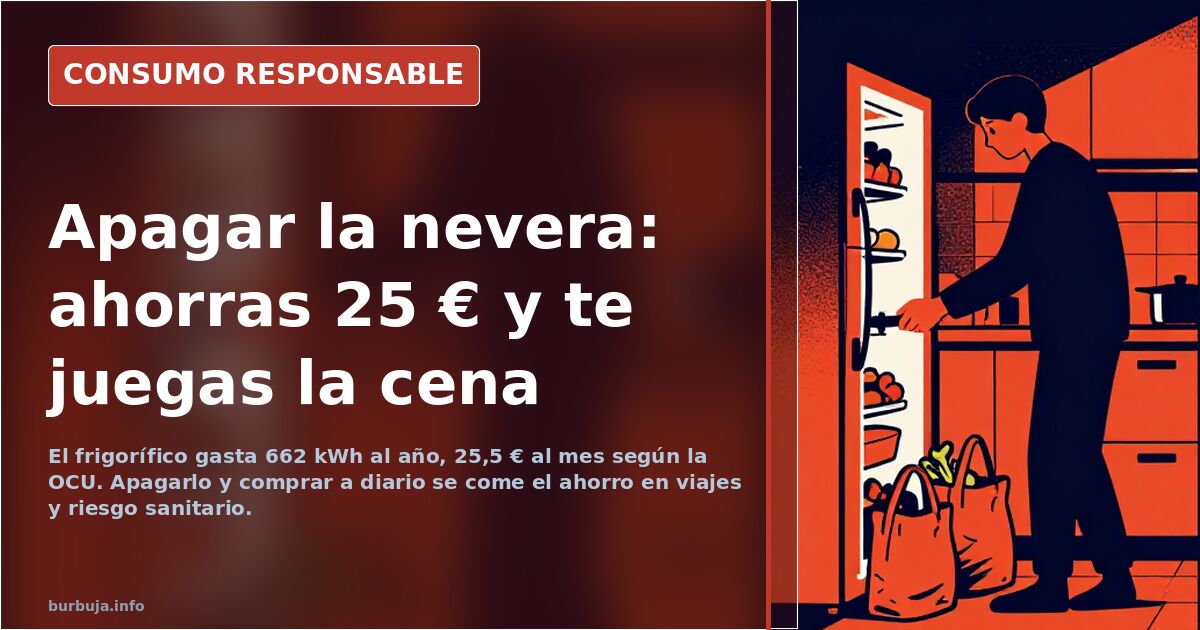
Turning off the fridge to save: €25.50 a month, according to OCU
On paper, unplugging the refrigerator saves between €25 and €50 a month. In reality, that saving is eaten up by supermarket visits. The idea of leaving the appliance unplugged and buying only what you eat in the day has sparked a curious debate: almost no one denies that domestic cooling weighs on the bill, but nearly everyone agrees that giving it up is a luxury, not a saving.
The trigger is uncomfortable evidence. The refrigerator is the most energy-hungry device in the house—it’s plugged in 24 hours a day, 365 days a year—and its relative weight grows when everything else is turned off. The question is no longer whether it spends. It’s how much, and if it’s worth it.
How much does a fridge cost per month?
The data comes from OCU (Spain's consumer organization) and a breakdown published by Expansión. The refrigerator consumes 662 kWh a year and the freezer 563 kWh. Together they add up to 1,115 kWh. At 25 cents per kilowatt-hour, that’s €25.50 a month just for cold.
The rest of the picture helps size the problem: the TV uses 263 kWh a year, the washing machine 255, and the dishwasher 246. Altogether, appliances account for about 1,924 kWh a year, the second-largest household energy expense after heating. Some argue that cooling is a residual consumption; the numbers say otherwise.
Why some bills are €25 and others €50
Here the real disagreement begins. A calculation circulating in the sector raises the figure much higher: 0.3 kWh per hour, 24 hours, 30 days, and 25 cents per kilowatt equals €50 a month. Double the official average.
The explanation given for this gap is technical. Energy labels are measured in laboratories, with the appliance empty, at controlled room temperature, and without opening the door. In a real kitchen, with a large family, in summer, and with the freezer full of fresh produce, actual consumption spikes. The complete calculation, using hourly averages and multiple compressors involved, shows differences that surprise those who only look at the label.
On the other side are small households. Living alone, having modest cooling needs, and good habits—not leaving the door open, not putting hot food inside, keeping the appliance full to take advantage of thermal inertia—drives the figure down to 9 cents a day for the whole house, including standby consumption. There, the fridge is barely noticeable.
The fridge as a lifeline: lessons from places without refrigeration
The most repeated argument isn’t economic, it’s social. In places where access to refrigeration has historically been scarce, getting a fridge is experienced as a leap in quality of life that few inventions match. It’s even said that older imported fridges were bought with locks, not to show off, but to prevent cold loss which skyrocketed costs.
The quality of life provided by a refrigerator is very difficult to achieve with any other invention. This phrase summarizes the dominant stance: we don’t miss what we already have, just as no one thinks about water when turning on the tap.
Two years without a fridge: what really happens
Direct experience exists and isn’t as heroic as it seems. I went two years without a fridge and in winter you can manage perfectly well, especially if your house is cold. The problem arrives with heat: you can’t cook for several days, big stews spoil, and what you save in electricity goes into trips to the supermarket. According to that same testimony, the result is that cooling doesn’t cost as much as believed, and logistics cost more.
The extreme case is homes where the appliance leaves the house for a few hours for repairs. Its absence creates a sense of domestic disorder no one expected. Plugging it back in is celebrated like a small party.
The health risk no one wants to discuss
There’s a limit that the debate touches lightly and should be stated plainly: storing dairy, yogurts, meats, and stews at room temperature opens the door to serious digestive problems. Daily shopping works if trinc strictly; it fails the first time you improvise.
Habits also weigh more than technology. Opening the fridge to look, loading it late or poorly, placing it between furniture without ventilation, or buying a cheap unit with aluminum circuits are mistakes paid for on every bill.
With these elements, the idea of unplugging the fridge has limited scope: it may work in mild winters, single-person households, and cold houses, but fails as soon as a family moves in and temperatures rise. The most reasonable forecast, with reservations, is that the debate will die out when the first hot summer or first food poisoning arrives. Until then, the appliance will remain king of the house, even if no one looks at it.
On paper, unplugging the refrigerator saves between €25 and €50 a month. In reality, that saving is eaten up by supermarket visits. The idea of leaving the appliance unplugged and buying only what you eat in the day has sparked a curious debate: almost no one denies that domestic cooling weighs on the bill, but nearly everyone agrees that giving it up is a luxury, not a saving.
The trigger is uncomfortable evidence. The refrigerator is the most energy-hungry device in the house—it’s plugged in 24 hours a day, 365 days a year—and its relative weight grows when everything else is turned off. The question is no longer whether it spends. It’s how much, and if it’s worth it.
How much does a fridge cost per month?
The data comes from OCU (Spain's consumer organization) and a breakdown published by Expansión. The refrigerator consumes 662 kWh a year and the freezer 563 kWh. Together they add up to 1,115 kWh. At 25 cents per kilowatt-hour, that’s €25.50 a month just for cold.
The rest of the picture helps size the problem: the TV uses 263 kWh a year, the washing machine 255, and the dishwasher 246. Altogether, appliances account for about 1,924 kWh a year, the second-largest household energy expense after heating. Some argue that cooling is a residual consumption; the numbers say otherwise.
Why some bills are €25 and others €50
Here the real disagreement begins. A calculation circulating in the sector raises the figure much higher: 0.3 kWh per hour, 24 hours, 30 days, and 25 cents per kilowatt equals €50 a month. Double the official average.
The explanation given for this gap is technical. Energy labels are measured in laboratories, with the appliance empty, at controlled room temperature, and without opening the door. In a real kitchen, with a large family, in summer, and with the freezer full of fresh produce, actual consumption spikes. The complete calculation, using hourly averages and multiple compressors involved, shows differences that surprise those who only look at the label.
On the other side are small households. Living alone, having modest cooling needs, and good habits—not leaving the door open, not putting hot food inside, keeping the appliance full to take advantage of thermal inertia—drives the figure down to 9 cents a day for the whole house, including standby consumption. There, the fridge is barely noticeable.
The fridge as a lifeline: lessons from places without refrigeration
The most repeated argument isn’t economic, it’s social. In places where access to refrigeration has historically been scarce, getting a fridge is experienced as a leap in quality of life that few inventions match. It’s even said that older imported fridges were bought with locks, not to show off, but to prevent cold loss which skyrocketed costs.
The quality of life provided by a refrigerator is very difficult to achieve with any other invention. This phrase summarizes the dominant stance: we don’t miss what we already have, just as no one thinks about water when turning on the tap.
Two years without a fridge: what really happens
Direct experience exists and isn’t as heroic as it seems. I went two years without a fridge and in winter you can manage perfectly well, especially if your house is cold. The problem arrives with heat: you can’t cook for several days, big stews spoil, and what you save in electricity goes into trips to the supermarket. According to that same testimony, the result is that cooling doesn’t cost as much as believed, and logistics cost more.
The extreme case is homes where the appliance leaves the house for a few hours for repairs. Its absence creates a sense of domestic disorder no one expected. Plugging it back in is celebrated like a small party.
The health risk no one wants to discuss
There’s a limit that the debate touches lightly and should be stated plainly: storing dairy, yogurts, meats, and stews at room temperature opens the door to serious digestive problems. Daily shopping works if trinc strictly; it fails the first time you improvise.
Habits also weigh more than technology. Opening the fridge to look, loading it late or poorly, placing it between furniture without ventilation, or buying a cheap unit with aluminum circuits are mistakes paid for on every bill.
With these elements, the idea of unplugging the fridge has limited scope: it may work in mild winters, single-person households, and cold houses, but fails as soon as a family moves in and temperatures rise. The most reasonable forecast, with reservations, is that the debate will die out when the first hot summer or first food poisoning arrives. Until then, the appliance will remain king of the house, even if no one looks at it.
Summary of a discussion on Burbuja.info - Foro de economía, actualidad y política., translated from Spanish and reviewed before publication. Read the full discussion (207 replies).
More summaries
-
Electricity bills: the real cost of power consumption in Spain
We break down Spanish electricity bills: are prices really rising or is it the tariff tiers? How PVPC and contracted power affect what you pay.
-
PVPC vs free market: the electricity bill dilemma
We analyse the PVPC vs free market dilemma: save on electricity or fall into trap tariffs? Data and complexities of electricity consumption.
-
Joselín, the €7 Sobaos that divides artisan consumption
Joselín's box costs €7, adding €6 shipping on orders of €50. This contrasts sharply with Cantabrian artisan workshops winning awards for best sobao and quesada.
-
Fixing a 400,000 km BMW: €2,000 vs €10,000 used car
A 400,000 km BMW E39 faces a €2,000 repair while decent used cars rarely drop below €10,000.
-
Citroën Ami price rises 11.3% in two years to €7,790
The Citroën Ami quadricycle has seen an 11.3% price hike since launch. Financing costs add over €2,000 at an APR of 11%, challenging its affordable mobility promise.
-
Prison for Cannabis Users: A Divisive Debate in Spain
The debate on prison sentences for cannabis users pits prohibitionists against regulators, citing high incarceration costs and the failure of drug wars.