
Suicide Drones from Iran Target Israel, Galilee Alerts
Iran reportedly launched suicide drones toward Israel, closing airspace in several countries; gold fluctuates between $2,360 and $2,450 per ounce.
English · Original discussion in Spanish · Published
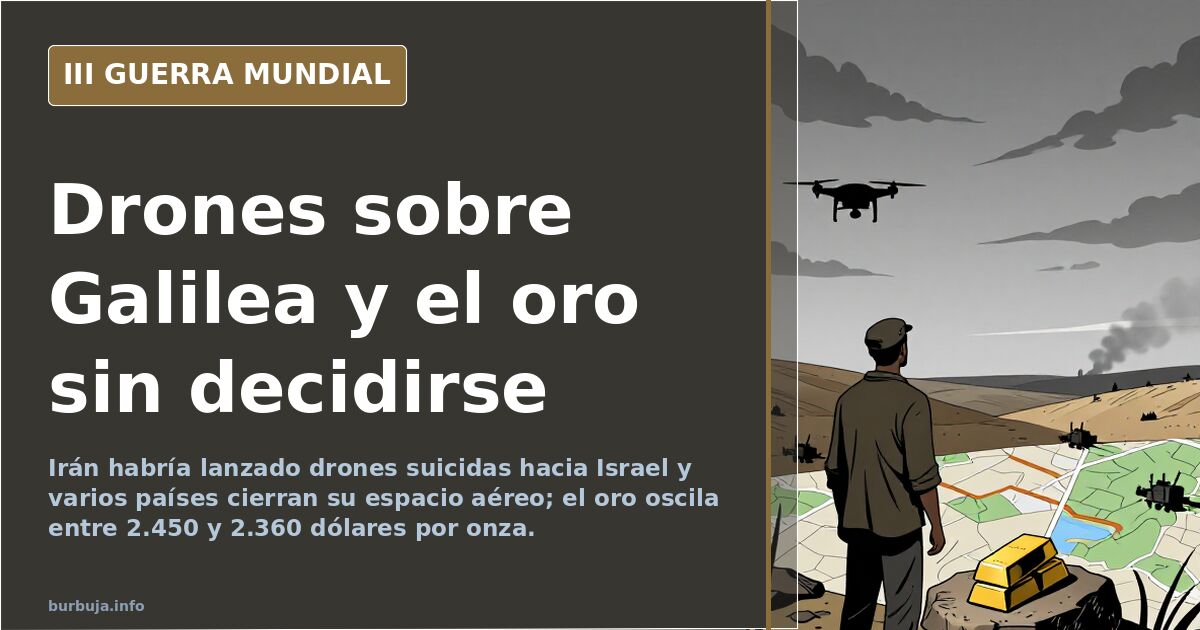
Drones toward Israel and airspace closure
Fifty suicide drones in flight, according to circulating messages, and gold undecided between $2,450 and $2,360 per ounce. This is the real thermometer of what is happening in the Middle East: markets doubt more than headlines. What is presented as a qualitative leap is that, according to reports, it would be the first time Iran attacks Israel directly by launching drones from its own territory. Red alerts sounded in several localities in the northeast of the country, in the Galilee strip, and airspace was closed in a chain.
What peine in northern Israel
The attack consists, according to circulating reports, of about fifty suicide drones launched from Iranian territory toward Israeli targets. Before they arrived, Israel, Jordan, and other countries in the region closed their airspace, and the entry of ballistic missiles was assumed. Red alerts were activated in cities and towns in the northeast, the area known as the Galilee strip, adjacent to the border with Lebanon.
Alongside this, messages spread about a cyberattack on the Israeli energy system, the alleged breach of air defenses, and even the departure of Prime Minister Benjamin Netanyahu from the country. None of this is confirmed by independent sources at the time of this discussion, and it should be handled with caution: in a real-time attack, propaganda runs faster than facts. The verifiable, initially, are the drones and the coordinated closure of airspace.
Iran, Hezbollah, or the usual rockets?
Not everyone buys the Iranian authorship. Part of the analysis suggests that attributing the launch to Tehran is premature and that what fell on Galilee are rockets from the Gaza strip, with or without real intent to hit. Another current places the origin in Hezbollah, the actor with whom Israel has been exchanging blows on the northern border for months.
The confusion is not casual. In a region where militias, regular armies, and armed groups without a state coexist, distinguishing who presses the button is almost an academic exercise. But the difference matters: loose rockets do not justify a regional escalation; a direct launch from Iranian soil, yes.
The wear on Iron Dome and the countdown
The hypothesis with the most traction among those trinc the conflict daily is that of wear. The idea: saturate the Israeli air defense system with successive and cheap attacks so that, when the serious projectiles arrive, the defense is with the magazine half empty. "When they reload, the Iranian missiles arrive," summarizes one of the versions of this calculation. From that logic, each night of rockets is a bill someone pays.
What is said about airspace and the United States
The diplomatic dimension weighs as much as the military one. According to a message shared in the thread, Turkey conveyed to the United States that it cannot use its airspace to attack Iran. Qatar and Kuwait have also refused, according to the messages shared, although it is unclear if they are anticipating an operation or simply closing the door just in case.
Gold as a thermometer of antiestéticar
Gold futures touched $2,450 per ounce and retreated afterward to $2,360, according to a message in the thread that qualifies the figure as still very high and places it hovering since the beginning of the second week of April.
Who benefits from a regional war?
Here the analysis becomes political. Some recall the three rules that the founder of the State of Israel, David Ben Gurion, set for the country's survival: short and quickly won wars, a superpower supporting in each conflict, and sustained sarracena superiority throughout the clash. According to a message in the thread, former Prime Minister and former Defense Minister Ehud Barak has warned that a war against Iran would be terribly difficult to win and that the current Executive has broken those three rules.
The other argument circulating is more uncomfortable: that opening a front with Iran diverts attention from what is happening in Gaza after months of offensive and serves to reframe the international narrative. The complete calculation, with its supporters and nuances, is worth several columns.
At the close of this discussion, the drones were on their way, half the region had closed its sky, and no one knew how many projectiles would arrive or how many would fall. The question lingering in the air is not who fired first, but how many actors are willing to let this time something big happen. When gold is undecided, one must ask if the noise is the signal or just the noise.
Fifty suicide drones in flight, according to circulating messages, and gold undecided between $2,450 and $2,360 per ounce. This is the real thermometer of what is happening in the Middle East: markets doubt more than headlines. What is presented as a qualitative leap is that, according to reports, it would be the first time Iran attacks Israel directly by launching drones from its own territory. Red alerts sounded in several localities in the northeast of the country, in the Galilee strip, and airspace was closed in a chain.
What peine in northern Israel
The attack consists, according to circulating reports, of about fifty suicide drones launched from Iranian territory toward Israeli targets. Before they arrived, Israel, Jordan, and other countries in the region closed their airspace, and the entry of ballistic missiles was assumed. Red alerts were activated in cities and towns in the northeast, the area known as the Galilee strip, adjacent to the border with Lebanon.
Alongside this, messages spread about a cyberattack on the Israeli energy system, the alleged breach of air defenses, and even the departure of Prime Minister Benjamin Netanyahu from the country. None of this is confirmed by independent sources at the time of this discussion, and it should be handled with caution: in a real-time attack, propaganda runs faster than facts. The verifiable, initially, are the drones and the coordinated closure of airspace.
Iran, Hezbollah, or the usual rockets?
Not everyone buys the Iranian authorship. Part of the analysis suggests that attributing the launch to Tehran is premature and that what fell on Galilee are rockets from the Gaza strip, with or without real intent to hit. Another current places the origin in Hezbollah, the actor with whom Israel has been exchanging blows on the northern border for months.
The confusion is not casual. In a region where militias, regular armies, and armed groups without a state coexist, distinguishing who presses the button is almost an academic exercise. But the difference matters: loose rockets do not justify a regional escalation; a direct launch from Iranian soil, yes.
The wear on Iron Dome and the countdown
The hypothesis with the most traction among those trinc the conflict daily is that of wear. The idea: saturate the Israeli air defense system with successive and cheap attacks so that, when the serious projectiles arrive, the defense is with the magazine half empty. "When they reload, the Iranian missiles arrive," summarizes one of the versions of this calculation. From that logic, each night of rockets is a bill someone pays.
What is said about airspace and the United States
The diplomatic dimension weighs as much as the military one. According to a message shared in the thread, Turkey conveyed to the United States that it cannot use its airspace to attack Iran. Qatar and Kuwait have also refused, according to the messages shared, although it is unclear if they are anticipating an operation or simply closing the door just in case.
Gold as a thermometer of antiestéticar
Gold futures touched $2,450 per ounce and retreated afterward to $2,360, according to a message in the thread that qualifies the figure as still very high and places it hovering since the beginning of the second week of April.
Who benefits from a regional war?
Here the analysis becomes political. Some recall the three rules that the founder of the State of Israel, David Ben Gurion, set for the country's survival: short and quickly won wars, a superpower supporting in each conflict, and sustained sarracena superiority throughout the clash. According to a message in the thread, former Prime Minister and former Defense Minister Ehud Barak has warned that a war against Iran would be terribly difficult to win and that the current Executive has broken those three rules.
The other argument circulating is more uncomfortable: that opening a front with Iran diverts attention from what is happening in Gaza after months of offensive and serves to reframe the international narrative. The complete calculation, with its supporters and nuances, is worth several columns.
At the close of this discussion, the drones were on their way, half the region had closed its sky, and no one knew how many projectiles would arrive or how many would fall. The question lingering in the air is not who fired first, but how many actors are willing to let this time something big happen. When gold is undecided, one must ask if the noise is the signal or just the noise.
Summary of a discussion on Burbuja.info - Foro de economía, actualidad y política., translated from Spanish and reviewed before publication. Read the full discussion (336 replies).
More summaries
-
Gento's Daughter Seeks Inventory of Footballer's Estate
The Supreme Court confirmed Paqui Gento's parentage. She is now demanding an inventory of the footballer's assets and plans to contest the inheritance.
-
Visual count: 868 Russian tanks lost, 31% of fleet
Visual tallies show 868 Russian combat vehicles out of action, 31% of active fleet. The Soviet T-62M appears as loss rate slows.
-
Russian Mobile Alert: Baños Spreads 24-Hour Ultimatum on Kyiv Destruction
Colonel Pedro Baños shares an unverified message claiming Russian citizens received a 24-hour ultimatum to surrender or face Kyiv's destruction, raising disinformation concerns.
-
Israel Strikes Yemen's Hodeida Port After Drone Attack on Tel Aviv
Israel bombs Hodeida following a drone strike on Tel Aviv. Houthi spokesmen warn retaliatory strikes will target Haifa.
-
Spain sends 40 Leopard tanks, the largest coalition batch
Spain delivers 40 Leopard tanks, the biggest coalition contribution; critics claim much of the equipment has been exposed to the elements for years.
-
Putin's Unverified Three-Year Prediction: No Medical Proof
An unsigned calculation gives Putin three years of life. Lavrov denies it. The prediction remains unverified.