
Sudden Deaths in Football: From Apolinário to Izquierdo
From Alex Apolinário (2021) to Juan Izquierdo (2024): the growing tally of footballers who die suddenly, with no official statistics to...
English · Original discussion in Spanish · Published
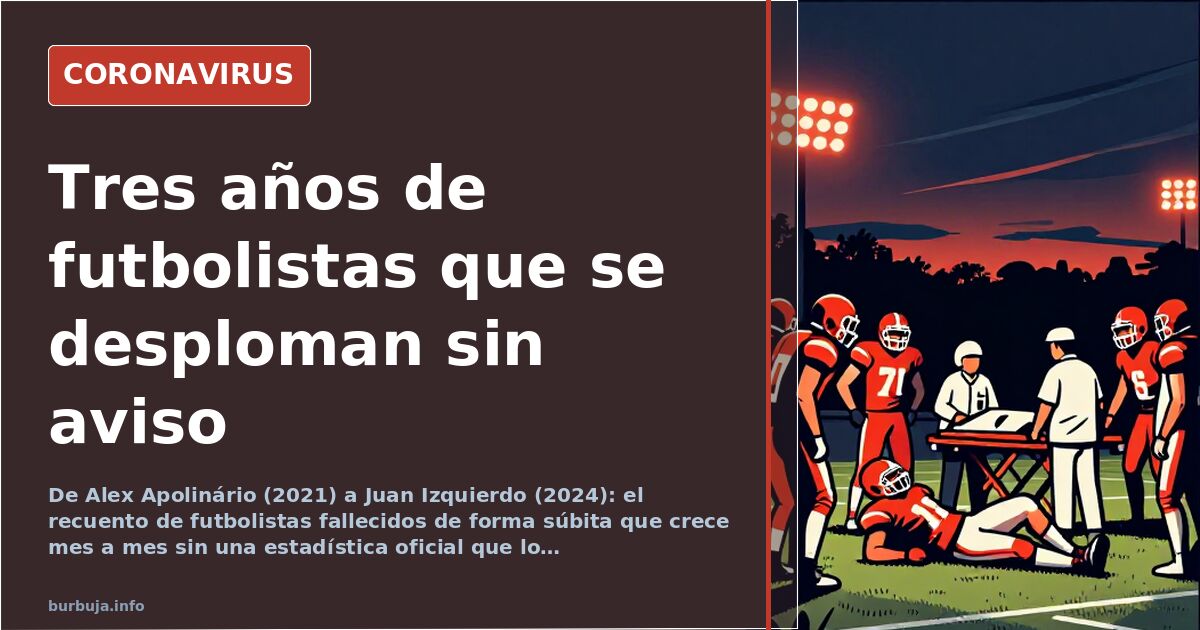
From Alex Apolinário to Juan Izquierdo: the ever-growing count
Juan Izquierdo was 27 years old. On August 22, 2024, he collapsed on the pitch during a Libertadores match between Nacional and São Paulo and died five days later in the hospital, as reported by the Uruguayan press. He is the latest addition to a tally that has been growing for three years: footballers who fall suddenly, without warning, often live on camera. The list begins in January 2021 with Alex Apolinário (24, Portugal) and has not stopped since. Some see a pattern. Others see the old lottery of young hearts and doping. The data, for now, do not close the discussion.
What names appear and at what ages
The most systematic tracking has been accumulating cases month by month, almost always with local press clippings attached. **Jorge Luis Rodríguez Holguín**, 27, died on the field in Mexico in February 2021. **Jody Lukoki**, 29, a former Ajax player, passed away in May 2022. **Guillermo Denis Beltrán**, 24, collapsed during training with Bolivia's Real Santa Cruz in March 2024. **Mattia Giani**, 26, a semi-professional for Castelfiorentino, fell on the field in April 2024.
The list includes no distinction between stars and academy players. It includes a 17-year-old youth goalkeeper in Almería, a 13-year-old Northern Irish goalkeeper, and a player from Móstoles CF who **died aged 24 during training** in May 2024. The latest addition is Izquierdo, trinc an arrhythmia that ended his life.
Is it a statistical anomaly or the usual noise?
Here, things split in two. One current holds that the volume of collapses is unprecedented and points directly to vaccination campaigns and the bicho's protein as causative agents. Another responds that young players have been collapsing all their lives, and what has changed is not the footballers' bodies, but the loudspeaker: now any sudden death in an Italian fifth division or a Peruvian U-13 team reaches the internet in minutes.
The 'it's always peine' argument has proponents with data. Old cases of on-field deaths documented in Spain and abroad are cited, and it's recalled that professional football has lived with mandatory cardiological check-ups for decades precisely because the problem existed before. What neither side has put on the table is a denominator: **how many registered footballers there are and what sudden death rate they show per year**. Without that number, comparing volumes is discussing impressions.
The cited mechanism and what is not proven
The most repeated technical explanation attempt in this tracking involves the renin-angiotensin system and the **ACE2** receptor. The hypothesis, explained in detail by some participants, is that intense exercise overexpresses this receptor, that the viral protein can travel within immune cells for months, and that the result is inflammation that affects the heart muscle at the worst moment.
To be clear: this chain of events **is not supported by established evidence** nor is it included in regulatory agencies' reports. These are forum hypotheses, not clinical findings. They are presented here as what they are, one of the currents in the debate, not as a proven cause of the recorded deaths.
Doping, the old explanation no one wants to sign off on
The harshest counterpoint to the vaccination thesis comes from within the count itself. Some recall that elite athletes undergo drug regimens to perform, that amateur athletics escape controls, and that **sudden death in young athletes has documented precedents** linked to that market. From this perspective, the silence of the major media would not be a cover-up of a health campaign, but the discomfort of discussing the sports pharmacology business.
The journalist looking at it from the outside encounters the same wall: no one publishes historical series. Neither of deaths, nor autopsies, nor substances. Only names, ages, and a trickle of clubs in mourning.
Between Apolinário and Izquierdo there are **three and a half years**, dozens of funeral announcements, and no official statistics to say whether this is an epidemic or an optical illusion of the mobile phone. As long as there is no denominator, each new collapse on a football field will be read as confirmation of what each person already believed.
Juan Izquierdo was 27 years old. On August 22, 2024, he collapsed on the pitch during a Libertadores match between Nacional and São Paulo and died five days later in the hospital, as reported by the Uruguayan press. He is the latest addition to a tally that has been growing for three years: footballers who fall suddenly, without warning, often live on camera. The list begins in January 2021 with Alex Apolinário (24, Portugal) and has not stopped since. Some see a pattern. Others see the old lottery of young hearts and doping. The data, for now, do not close the discussion.
What names appear and at what ages
The most systematic tracking has been accumulating cases month by month, almost always with local press clippings attached. **Jorge Luis Rodríguez Holguín**, 27, died on the field in Mexico in February 2021. **Jody Lukoki**, 29, a former Ajax player, passed away in May 2022. **Guillermo Denis Beltrán**, 24, collapsed during training with Bolivia's Real Santa Cruz in March 2024. **Mattia Giani**, 26, a semi-professional for Castelfiorentino, fell on the field in April 2024.
The list includes no distinction between stars and academy players. It includes a 17-year-old youth goalkeeper in Almería, a 13-year-old Northern Irish goalkeeper, and a player from Móstoles CF who **died aged 24 during training** in May 2024. The latest addition is Izquierdo, trinc an arrhythmia that ended his life.
Is it a statistical anomaly or the usual noise?
Here, things split in two. One current holds that the volume of collapses is unprecedented and points directly to vaccination campaigns and the bicho's protein as causative agents. Another responds that young players have been collapsing all their lives, and what has changed is not the footballers' bodies, but the loudspeaker: now any sudden death in an Italian fifth division or a Peruvian U-13 team reaches the internet in minutes.
The 'it's always peine' argument has proponents with data. Old cases of on-field deaths documented in Spain and abroad are cited, and it's recalled that professional football has lived with mandatory cardiological check-ups for decades precisely because the problem existed before. What neither side has put on the table is a denominator: **how many registered footballers there are and what sudden death rate they show per year**. Without that number, comparing volumes is discussing impressions.
The cited mechanism and what is not proven
The most repeated technical explanation attempt in this tracking involves the renin-angiotensin system and the **ACE2** receptor. The hypothesis, explained in detail by some participants, is that intense exercise overexpresses this receptor, that the viral protein can travel within immune cells for months, and that the result is inflammation that affects the heart muscle at the worst moment.
To be clear: this chain of events **is not supported by established evidence** nor is it included in regulatory agencies' reports. These are forum hypotheses, not clinical findings. They are presented here as what they are, one of the currents in the debate, not as a proven cause of the recorded deaths.
Doping, the old explanation no one wants to sign off on
The harshest counterpoint to the vaccination thesis comes from within the count itself. Some recall that elite athletes undergo drug regimens to perform, that amateur athletics escape controls, and that **sudden death in young athletes has documented precedents** linked to that market. From this perspective, the silence of the major media would not be a cover-up of a health campaign, but the discomfort of discussing the sports pharmacology business.
The journalist looking at it from the outside encounters the same wall: no one publishes historical series. Neither of deaths, nor autopsies, nor substances. Only names, ages, and a trickle of clubs in mourning.
Between Apolinário and Izquierdo there are **three and a half years**, dozens of funeral announcements, and no official statistics to say whether this is an epidemic or an optical illusion of the mobile phone. As long as there is no denominator, each new collapse on a football field will be read as confirmation of what each person already believed.
Summary of a discussion on Burbuja.info - Foro de economía, actualidad y política., translated from Spanish and reviewed before publication. Read the full discussion (377 replies).
More summaries
-
Raw Pandemic Data: Official Narrative vs Real Figures
An analysis of initial coronavirus data and firsthand accounts, tracing the outbreak from its epicenter to healthcare consequences across Spain and Europe.
-
Itziar Castro: from AstraZeneca trial volunteer to death at 46
Itziar Castro tweeted in March 2021 that she was a volunteer in the AstraZeneca trial with no side effects. She died in December 2023 at 46.
-
Nuremberg II: the Covid archive awaiting trial
A citizen archive compiles VAERS and EudraVigilance figures and Covid vaccine data for a hypothetical Nuremberg II that has no date yet.
-
Moving fibers in masks: home experiments, no answers
An amateur films fibers moving inside an FFP2 and exposes them to steam, a magnet and electric current. A lab attributes it to polypropylene microfibers.
-
Nurse Avoids Prison for Falsifying Vaccinations of 400 Children
A nurse accused of faking vaccinations for 400 children in Bizkaia will not go to jail. Prosecutors seek psychiatric treatment instead.
-
22.7 Million Vaccinated Study: 25% Lower Mortality Claimed
A large-scale study suggests vaccinated individuals have 25% lower overall mortality. Critics cite the 'healthy vaccinee effect' and conflicts of interest.