
Suchard drops woke politics, champions traditional family in Christmas ad
Suchard’s new Christmas spot features a traditional family, sparking debate and purchase pledges amid accusations of opportunism.
English · Original discussion in Spanish · Published
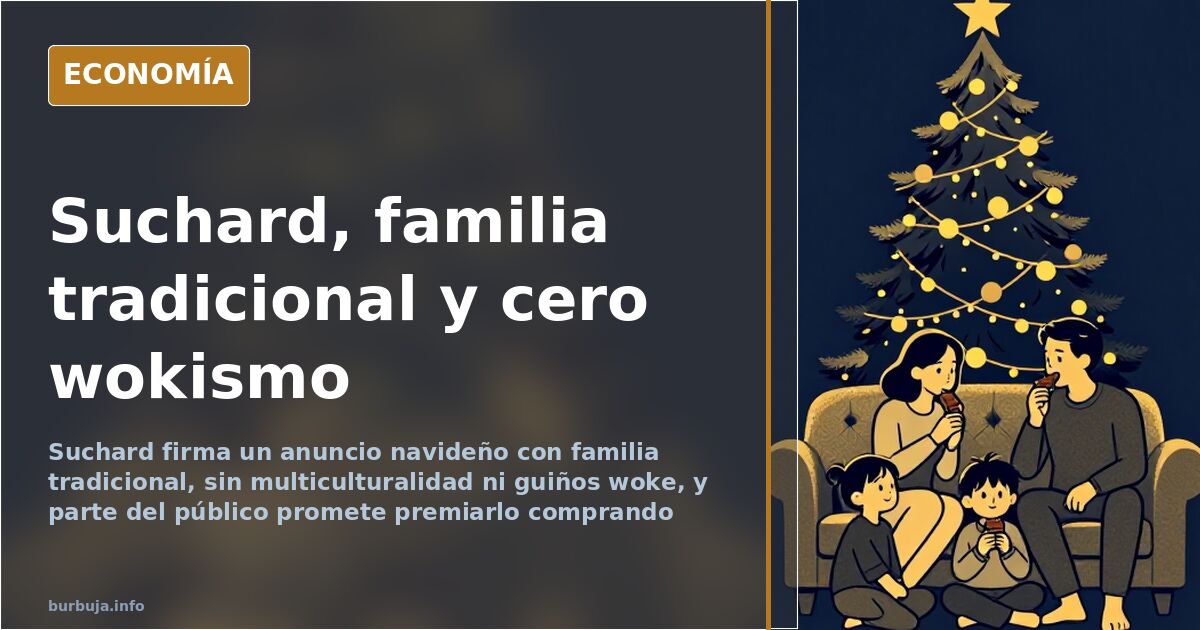
The Suchard ad without proge politics celebrating the traditional family
A cartoon grandfather, a house aging inside, and decades of the same family. Suchard’s Christmas ad trinc this story until 2020, when the question “Do you think we did it right?” appears on screen. There are no minority characters, no LGTBI references, and zero multiculturalism. This gap has turned a nougat spot into an economic issue: part of the audience reads it as a correction and promises to buy; another dismisses it as textbook opportunism.
Why is the ad interpreted as a correction?
Because the brand carries the perception of having signed campaigns marked by inclusivity and multiculturalism, and of having faced boycott calls. The prevailing idea in reactions is that correcting is for the wise and that the company has decided to return to its traditional clientele rather than seek trouble. There is no official confirmation of this turn: the brand has not explained its strategy nor claimed any change in approach.
The counterpoint is the usual one. One current holds that there is no conviction, only calculation: the same manufacturer that aligned its advertising with the inclusive agenda in previous campaigns now places the product before those who had angered.
Who is behind Suchard and what is reproached?
Suchard is not an independent company. It belongs to the Mondelez International group, a fact that has surfaced to temper enthusiasm. According to the objections raised, this group has closed several factories in Spain and carries criticisms regarding misleading advertising and the nutritional profile of its products, collected in its encyclopedia entry.
There is more accumulated material. An investigation by the NGO Mighty Earth, dated September 2009, reviewed the conglomerate’s supply chain with unflattering results. With this history, the reproach is direct: rewarding a multinational with purchases for a Christmas ad is, at best, debatable. The nougat sold as a symbol of the traditional family comes from a subsidiary of a multinational that, according to critics, has closed factories in Spain. It is the type of detail that ruins a well-constructed campaign.
A traditional ad with details that are not so much so
The reading is not unanimous even among those applauding the turn. Some sharpen the zoom and find suspicious hints: a dog painted in a picture, humanizing the animal within the home; figures with rounded shapes that fit the current aesthetic correctness; and, above all, not a nativity scene or a carol, with a Christmas tree as the only decoration, secular and pagan in equal measure.
That is, the ad avoids pleasing some and satisfying others without taking a stand. What is discussed, in reality, is not the nougat: it is what Spain fits in a Christmas ad and who decides the distribution.
Rewarding with the wallet: nougat is also a vote
Much of the reactions do not stop at applause: they announce purchases. The repeating logic is to reward those who do it right and punish those who do it wrong, with the memory of other brands that earned a lasting boycott for their advertising. Buying Suchard this Christmas is posed, literally, as a way to vote.
Enthusiasm has a brake. Several warnings point out that price rules: if the tablet remains sky-high, the ad does not matter. And some remember that the product is, after all, sugar with sugar. Sympathy has a limit, and that limit is the shelf label.
Other brands that stumbled with Christmas
The case is not isolated. In the UK, Marks & Spencer had to apologize for a Christmas ad in which colors interpreted as a Palestinian flag burned inside a fireplace. And in the United States, the Army itself signed a campaign without the usual diversity codes, according to a chronicle shared in the debate, because it could not meet its recruitment quotas. Christmas advertising has become a terrain where every shot is audited.
The ad’s story ends in 2020 with a question about whether we did it right. The answer, in the form of a shopping cart, will not be given by the brand: it will be given by the supermarket boxes in January.
A cartoon grandfather, a house aging inside, and decades of the same family. Suchard’s Christmas ad trinc this story until 2020, when the question “Do you think we did it right?” appears on screen. There are no minority characters, no LGTBI references, and zero multiculturalism. This gap has turned a nougat spot into an economic issue: part of the audience reads it as a correction and promises to buy; another dismisses it as textbook opportunism.
Why is the ad interpreted as a correction?
Because the brand carries the perception of having signed campaigns marked by inclusivity and multiculturalism, and of having faced boycott calls. The prevailing idea in reactions is that correcting is for the wise and that the company has decided to return to its traditional clientele rather than seek trouble. There is no official confirmation of this turn: the brand has not explained its strategy nor claimed any change in approach.
The counterpoint is the usual one. One current holds that there is no conviction, only calculation: the same manufacturer that aligned its advertising with the inclusive agenda in previous campaigns now places the product before those who had angered.
Who is behind Suchard and what is reproached?
Suchard is not an independent company. It belongs to the Mondelez International group, a fact that has surfaced to temper enthusiasm. According to the objections raised, this group has closed several factories in Spain and carries criticisms regarding misleading advertising and the nutritional profile of its products, collected in its encyclopedia entry.
There is more accumulated material. An investigation by the NGO Mighty Earth, dated September 2009, reviewed the conglomerate’s supply chain with unflattering results. With this history, the reproach is direct: rewarding a multinational with purchases for a Christmas ad is, at best, debatable. The nougat sold as a symbol of the traditional family comes from a subsidiary of a multinational that, according to critics, has closed factories in Spain. It is the type of detail that ruins a well-constructed campaign.
A traditional ad with details that are not so much so
The reading is not unanimous even among those applauding the turn. Some sharpen the zoom and find suspicious hints: a dog painted in a picture, humanizing the animal within the home; figures with rounded shapes that fit the current aesthetic correctness; and, above all, not a nativity scene or a carol, with a Christmas tree as the only decoration, secular and pagan in equal measure.
That is, the ad avoids pleasing some and satisfying others without taking a stand. What is discussed, in reality, is not the nougat: it is what Spain fits in a Christmas ad and who decides the distribution.
Rewarding with the wallet: nougat is also a vote
Much of the reactions do not stop at applause: they announce purchases. The repeating logic is to reward those who do it right and punish those who do it wrong, with the memory of other brands that earned a lasting boycott for their advertising. Buying Suchard this Christmas is posed, literally, as a way to vote.
Enthusiasm has a brake. Several warnings point out that price rules: if the tablet remains sky-high, the ad does not matter. And some remember that the product is, after all, sugar with sugar. Sympathy has a limit, and that limit is the shelf label.
Other brands that stumbled with Christmas
The case is not isolated. In the UK, Marks & Spencer had to apologize for a Christmas ad in which colors interpreted as a Palestinian flag burned inside a fireplace. And in the United States, the Army itself signed a campaign without the usual diversity codes, according to a chronicle shared in the debate, because it could not meet its recruitment quotas. Christmas advertising has become a terrain where every shot is audited.
The ad’s story ends in 2020 with a question about whether we did it right. The answer, in the form of a shopping cart, will not be given by the brand: it will be given by the supermarket boxes in January.
Also available in: Deutsch
Summary of a discussion on Burbuja.info - Foro de economía, actualidad y política., translated from Spanish and reviewed before publication. Read the full discussion (215 replies).
More summaries
-
Educational disaster in Spain: Worst results in history in PISA report, falling up to two school years behind the United Kingdom
Spain plunges in PISA 2025 report, showing a two-year lag in reading compared to the UK. We analyze the causes and consequences.
-
Miss UK: Who Decides What Beauty Is in a Pageant
Miss UK: the crowning of its winner reignites the debate over representation, beauty, and who really funds the contests
-
Nipah Virus Alert in UK: The 70% Fatality Rate Doesn't Add Up
A Nipah outbreak triggers alerts in the UK and WHO. Two deaths and a reported 70% fatality rate present contradictory data.
-
Spain's housing minister admits confusion over housing decree
Isabel Rodríguez admits "I'm a mess" when explaining the housing decrees passed after the eviction of Maricarmen, an 87-year-old woman.
-
Moncloa boosts Alvise to curb Vox's 20% support
Forum thread claims Moncloa promotes Alvise to reduce Vox seats. One million votes might yield no MPs but could shift several.
-
Spain's Parasite Debate: Cultural Shock or Marketing?
Analysis of the debate on deworming in Spain: is it a cultural clash, a public health need, or just marketing?