
Subaru drops sedans in Spain, sells only SUVs
Subaru currently offers four models in Spain, all of which are SUVs. The disappearance of passenger cars is linked to diesel issues and emissions regulations.
English · Original discussion in Spanish · Published
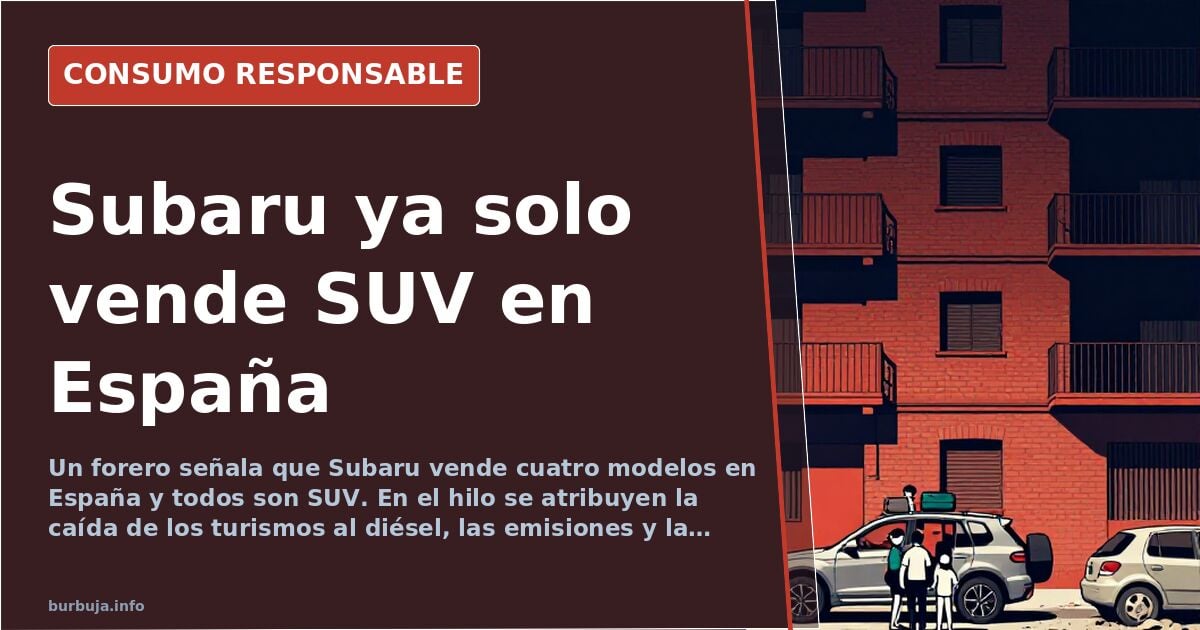
Subaru abandons sedans; only four SUVs remain in Spain
Visit the Subaru Spain website and count. Four models. All four are SUVs. Not a single sedan. The Impreza, that car which won world rally championships and brought smiles to an entire generation, is gone. The question opening this issue is simple: why has a brand that boasted boxer engines and permanent all-wheel drive decided to renounce the format that made it famous?
This is not a recent withdrawal or a commercial whim. It is the result of years of decisions, a European market that has narrowed for small brands, and regulations pushing manufacturers toward specific vehicle types. The affordable sports sedan is dead. And Subaru, like Mitsubishi, has buried its own.
Which models does Subaru sell in Spain and why are they all SUVs?
The Spanish range is reduced to four SUVs. The Forester, the Outback, the Crosstrek, and another sharing platform and philosophy. All with all-wheel drive, all with boxer engines, all with prices starting where many mainstream brands end. The comparison launched in the conversation is revealing: a Crosstrek costs the same as a Toyota C-HR. The difference is not in price, but in what each brand offers for it.
The problem is volume. Spain is a market where Subaru sells little, and when you sell little, you cannot customize, bring all engine options, or spend on advertising. An importer who brings units to lots and places them as best they can has no margin to compete with the sales networks of Toyota, Volkswagen, or Hyundai. The result is a residual presence, almost niche for enthusiasts.
Another factor explains the scarcity of models. European emission regulations have been expelling vehicles from catalogs that do not fit fleet targets. Sports sedans, with high-consumption gasoline engines, are the first to fall. This is not a decision by Subaru. It is a decision by the regulatory framework that Subaru cannot dodge.
The diesel problem: the burden Subaru dragged for years
For decades, the European market bought diesel. Almost everyone. And Subaru had no diesel. Its first oil engine arrived late, around 2008, and was a boxer diesel that gave problems in early versions. When a brand arrives late to the technology dominating the market and arrives with faults, the punishment is double: it loses sales and fruta.
That delay partly explains why Subaru never had mass presence in Spain. While Toyota, Volkswagen, or Peugeot placed thousands of diesels, Subaru sold gasoline in a market that did not want gasoline. The equation did not close. And when diesel began to fall out of grace, Subaru had already missed the train.
Now the situation has changed. Diesel sells less, gasoline has risen, and Japanese brands with efficient gasoline engines have arguments again. But the commercial damage is done. The dealer network has closed down. In some cities, the Subaru dealership changed hands twice before closing definitively. Without a network, there are no sales. Without sales, there is no network.
Boxer reliability and all-wheel drive: the argument sustaining the brand
Subaru's selling argument has always been the same: boxer engines, permanent all-wheel drive, and reliability that defenders place above almost any mainstream brand. Some argue that after Lexus, Subaru is the best Japanese brand. Others go further and put it ahead of Lexus in driving satisfaction.
Permanent all-wheel drive has concrete advantages. Older manual models distributed torque 50-50 between axles; automatics and current ones, in proportions close to 60-40. That gives active safety in difficult conditions: snow, ice, mud. With winter tires, traction capacity is above most SUVs on the market. It is a real argument, not marketing.
The cost of that traction is consumption. A permanent system uses more than a connectable one. Gasoline boxer engines are also not particularly efficient in the city. Those who buy Subaru know and accept this. Those who do not know are surprised by the first fuel bill.
Maintenance every 15,000 kilometers: the hidden price of the brand
One of the most discussed points is maintenance. Subaru's service intervals, like those of Toyota or Honda, are set every 15,000 kilometers. This means visiting the workshop more frequently than many European brands, which have stretched intervals to 20,000 or 30,000 kilometers. For those who drive many kilometers per year, the difference is relevant.
Maintenance includes engine oil, differential oil every 60,000 kilometers, and tires, which in an all-wheel-drive system wear out all four at once. It is not a cheap car to maintain, but neither is it ruinous. The question launched in the conversation is different: to travel around the world, would you choose a Subaru or a diesel C15? Any mechanic's answer probably does not favor the Japanese car.
There lies the tension. Subaru's reliability is measured in years and kilometers, but maintenance costs and the complexity of some repairs—which require lifts and specific knowledge—weigh on the purchase decision. A car that does not break down but needs frequent care is not the same as a car that does not break down and asks for almost nothing.
The Spanish market vs. American and Australian: two opposite realities
In the United States and Australia, Subaru sells massively. The Forester and Outback have sold more units than many Mercedes, BMW, Audi, or Volvo models in those markets. The brand has a loyal customer base, with medium-high purchasing power, valuing all-wheel drive and reliability over consumption. In those countries, gasoline prices and car culture are different.
In Spain, the story is different. The brand is perceived as expensive, spartan, and with improvable after-sales service. Some point out that spare parts take time and technical service is not up to par. This, combined with the scarcity of dealerships, creates a vicious circle: low presence, low trust, low sales.
The result is a brand in Spain bought only by motor enthusiasts. People who know what a boxer is, value permanent all-wheel drive, and are willing to accept inconveniences. For the average buyer, Subaru does not exist. And if it does not exist in the buyer's mind, it does not exist on the road.
The future: no sedans, no Impreza, no generational replacement
The unanswered question is whether Subaru will manufacture sedans again. Market logic does not suggest it. SUVs are more profitable, regulation pushes towards them, and buyers prefer them. The Impreza, Legacy, BRZ, WRX: all are niche cars that do not justify industrial investment in Europe.
Some argue that the association with Toyota could change something. Toyota holds equity in Subaru and they share platforms and technology. But that has not returned sedans to the European catalog. Collaboration goes in another direction: electrification, hybrids, SUVs.
Meanwhile, the Spanish market continues to see few new Subarus on the streets. Those present are old, well-maintained, and owned by faithful owners. The Impreza that filled a generation with smiles is now only seen in second-hand ads. And whoever wants one will have to pay for it as what it is: a collector's piece.
The final paradox is this: Subaru sells more cars than ever worldwide, but in Spain its presence is almost testimonial. The brand has not died. It simply decided that this market is not interesting enough to bring sedans. And that, for those who grew up watching Imprezas in rallies, is a hard loss to digest.
Visit the Subaru Spain website and count. Four models. All four are SUVs. Not a single sedan. The Impreza, that car which won world rally championships and brought smiles to an entire generation, is gone. The question opening this issue is simple: why has a brand that boasted boxer engines and permanent all-wheel drive decided to renounce the format that made it famous?
This is not a recent withdrawal or a commercial whim. It is the result of years of decisions, a European market that has narrowed for small brands, and regulations pushing manufacturers toward specific vehicle types. The affordable sports sedan is dead. And Subaru, like Mitsubishi, has buried its own.
Which models does Subaru sell in Spain and why are they all SUVs?
The Spanish range is reduced to four SUVs. The Forester, the Outback, the Crosstrek, and another sharing platform and philosophy. All with all-wheel drive, all with boxer engines, all with prices starting where many mainstream brands end. The comparison launched in the conversation is revealing: a Crosstrek costs the same as a Toyota C-HR. The difference is not in price, but in what each brand offers for it.
The problem is volume. Spain is a market where Subaru sells little, and when you sell little, you cannot customize, bring all engine options, or spend on advertising. An importer who brings units to lots and places them as best they can has no margin to compete with the sales networks of Toyota, Volkswagen, or Hyundai. The result is a residual presence, almost niche for enthusiasts.
Another factor explains the scarcity of models. European emission regulations have been expelling vehicles from catalogs that do not fit fleet targets. Sports sedans, with high-consumption gasoline engines, are the first to fall. This is not a decision by Subaru. It is a decision by the regulatory framework that Subaru cannot dodge.
The diesel problem: the burden Subaru dragged for years
For decades, the European market bought diesel. Almost everyone. And Subaru had no diesel. Its first oil engine arrived late, around 2008, and was a boxer diesel that gave problems in early versions. When a brand arrives late to the technology dominating the market and arrives with faults, the punishment is double: it loses sales and fruta.
That delay partly explains why Subaru never had mass presence in Spain. While Toyota, Volkswagen, or Peugeot placed thousands of diesels, Subaru sold gasoline in a market that did not want gasoline. The equation did not close. And when diesel began to fall out of grace, Subaru had already missed the train.
Now the situation has changed. Diesel sells less, gasoline has risen, and Japanese brands with efficient gasoline engines have arguments again. But the commercial damage is done. The dealer network has closed down. In some cities, the Subaru dealership changed hands twice before closing definitively. Without a network, there are no sales. Without sales, there is no network.
Boxer reliability and all-wheel drive: the argument sustaining the brand
Subaru's selling argument has always been the same: boxer engines, permanent all-wheel drive, and reliability that defenders place above almost any mainstream brand. Some argue that after Lexus, Subaru is the best Japanese brand. Others go further and put it ahead of Lexus in driving satisfaction.
Permanent all-wheel drive has concrete advantages. Older manual models distributed torque 50-50 between axles; automatics and current ones, in proportions close to 60-40. That gives active safety in difficult conditions: snow, ice, mud. With winter tires, traction capacity is above most SUVs on the market. It is a real argument, not marketing.
The cost of that traction is consumption. A permanent system uses more than a connectable one. Gasoline boxer engines are also not particularly efficient in the city. Those who buy Subaru know and accept this. Those who do not know are surprised by the first fuel bill.
Maintenance every 15,000 kilometers: the hidden price of the brand
One of the most discussed points is maintenance. Subaru's service intervals, like those of Toyota or Honda, are set every 15,000 kilometers. This means visiting the workshop more frequently than many European brands, which have stretched intervals to 20,000 or 30,000 kilometers. For those who drive many kilometers per year, the difference is relevant.
Maintenance includes engine oil, differential oil every 60,000 kilometers, and tires, which in an all-wheel-drive system wear out all four at once. It is not a cheap car to maintain, but neither is it ruinous. The question launched in the conversation is different: to travel around the world, would you choose a Subaru or a diesel C15? Any mechanic's answer probably does not favor the Japanese car.
There lies the tension. Subaru's reliability is measured in years and kilometers, but maintenance costs and the complexity of some repairs—which require lifts and specific knowledge—weigh on the purchase decision. A car that does not break down but needs frequent care is not the same as a car that does not break down and asks for almost nothing.
The Spanish market vs. American and Australian: two opposite realities
In the United States and Australia, Subaru sells massively. The Forester and Outback have sold more units than many Mercedes, BMW, Audi, or Volvo models in those markets. The brand has a loyal customer base, with medium-high purchasing power, valuing all-wheel drive and reliability over consumption. In those countries, gasoline prices and car culture are different.
In Spain, the story is different. The brand is perceived as expensive, spartan, and with improvable after-sales service. Some point out that spare parts take time and technical service is not up to par. This, combined with the scarcity of dealerships, creates a vicious circle: low presence, low trust, low sales.
The result is a brand in Spain bought only by motor enthusiasts. People who know what a boxer is, value permanent all-wheel drive, and are willing to accept inconveniences. For the average buyer, Subaru does not exist. And if it does not exist in the buyer's mind, it does not exist on the road.
The future: no sedans, no Impreza, no generational replacement
The unanswered question is whether Subaru will manufacture sedans again. Market logic does not suggest it. SUVs are more profitable, regulation pushes towards them, and buyers prefer them. The Impreza, Legacy, BRZ, WRX: all are niche cars that do not justify industrial investment in Europe.
Some argue that the association with Toyota could change something. Toyota holds equity in Subaru and they share platforms and technology. But that has not returned sedans to the European catalog. Collaboration goes in another direction: electrification, hybrids, SUVs.
Meanwhile, the Spanish market continues to see few new Subarus on the streets. Those present are old, well-maintained, and owned by faithful owners. The Impreza that filled a generation with smiles is now only seen in second-hand ads. And whoever wants one will have to pay for it as what it is: a collector's piece.
The final paradox is this: Subaru sells more cars than ever worldwide, but in Spain its presence is almost testimonial. The brand has not died. It simply decided that this market is not interesting enough to bring sedans. And that, for those who grew up watching Imprezas in rallies, is a hard loss to digest.
Also available in: Deutsch
Summary of a discussion on Burbuja.info - Foro de economía, actualidad y política., translated from Spanish and reviewed before publication. Read the full discussion (112 replies).
More summaries
-
Dacia, Honda, Kia lead OCU reliability survey
OCU survey of 29,000 drivers finds Dacia, Honda, Kia, Toyota and Subaru most reliable, beating German brands.
-
Ford Focus, Mazda 3 or Toyota Corolla: 30k Euros and an engine dilemma
Ford Focus 1.0 EcoBoost at 28,000€, Mazda 3 at 31,000€, and Toyota Corolla hybrid at 32,000€. Reliability decides the winner.
-
Toyota, Honda, or Lexus: Which Japanese Brand Lasts 400,000 km?
A study of 395 million vehicles measures durability, clashing with parts availability and the real condition of Japanese used cars.
-
Total Renting: Is car leasing for individuals a financial trap?
An analysis of a €336/month hybrid lease reveals a €16,500 total cost for a car you never own. Is leasing worthwhile for private individuals in Spain?
-
Customer reports live anisakis in hake at Madrid Alcampo
A customer reported finding live anisakis up to 3cm long in hake purchased from an Alcampo store in Madrid. The chain offered a refund.
-
Divorce: When You Lose Home Use Despite Ownership
Ownership remains yours, but family home use can last until children are independent. Key divorce and private property rules.