
Divorce: When You Lose Home Use Despite Ownership
Ownership remains yours, but family home use can last until children are independent. Key divorce and private property rules.
English · Original discussion in Spanish · Published
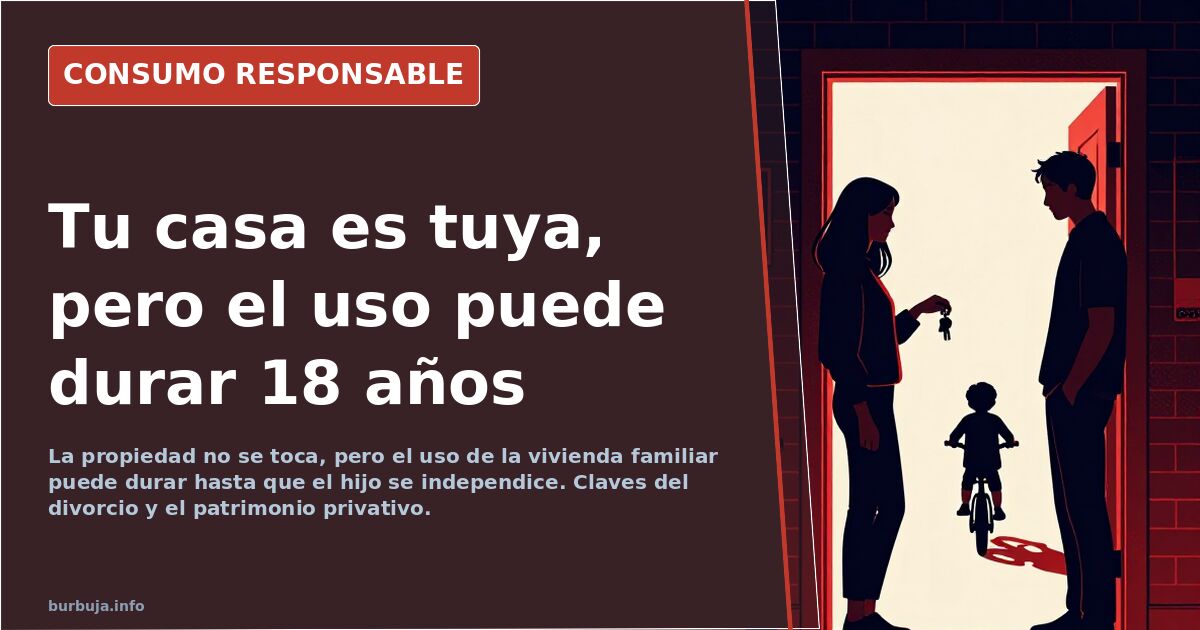
Divorce: When You Lose Home Use Despite Ownership
The house you inherited from your parents remains yours after divorce. The deed does not change hands. What may change is who lives there and for how long. This is the core issue when asking if a spouse can keep the marital home upon divorce. Short answer: ownership stays intact, usage rights shift, and in some cases this lasts years.
Housing Status Depends on Matrimonial Property Regime
Start with the matrimonial economic regime. In community property (gananciales), assets acquired during marriage split 50/50, but pre-marital or inherited/gifted items are separate property. In separation of goods (separación de bienes), each spouse keeps their own assets. Theory seems reassuring.
Practice is trickier. Some Spanish regions default to community property unless changed via notary before marriage. Some argue this step should be mandatory and explained. It isn’t.
Losing Ownership vs. Losing Usage Rights
Confusion arises here. Title deeds show ownership; court rulings assign usage. You may retain legal title yet lose the right to live in or rent out the home if a judge grants usage to the other party.
Usage often goes to the parent with custody of minor children. Not gender-based by law, but custody-driven: if mothers get primary custody, they stay with kids. Fathers pay mortgages or hold title but sleep elsewhere.
How Long Can Family Home Usage Last?
Some say until the child turns 18. Others clarify: until independence. Big difference: one has a fixed date, the other may never end. Many face prolonged uncertainty without clear timelines.
Common estimate: full recovery happens at earliest when minors turn 18. Pessimistic view sets no deadline—it depends on financial emancipation, which today often delays past age 30.
No Kids, No Marriage, House in Your Name
Without children or community property, pre-marital homes remain untouched. Even unmarried couples living together: if one owns the home and the other registers residency, eviction requires judicial process—not just changing locks. Quick removal risks legal consequences for owners.
Top preventive advice: separation of goods, separate accounts, shared expenses only via joint account with equal contributions. If cohabiting without papers, clearly establish upfront that the home belongs to one partner.
Inherited Assets and Fine Print
Inheritance or gifts constitute separate property. Shouldn’t transfer. But with minors, judges may grant usage rights to children and custodial parent. Ownership doesn’t move; enjoyment does, indefinitely.
Workaround: rent out owned home, live in another rented place funded partly by first rental income. Avoids free spousal usage but isn’t always antiestéticasible or quick.
Outlook is uncomfortable: as long as custody favors mothers and youth independence delays, pre-marital homeowners will likely cede usage for over a decade. Ownership persists. Enjoyment vanishes. For many, that feels nearly identical.
The house you inherited from your parents remains yours after divorce. The deed does not change hands. What may change is who lives there and for how long. This is the core issue when asking if a spouse can keep the marital home upon divorce. Short answer: ownership stays intact, usage rights shift, and in some cases this lasts years.
Housing Status Depends on Matrimonial Property Regime
Start with the matrimonial economic regime. In community property (gananciales), assets acquired during marriage split 50/50, but pre-marital or inherited/gifted items are separate property. In separation of goods (separación de bienes), each spouse keeps their own assets. Theory seems reassuring.
Practice is trickier. Some Spanish regions default to community property unless changed via notary before marriage. Some argue this step should be mandatory and explained. It isn’t.
Losing Ownership vs. Losing Usage Rights
Confusion arises here. Title deeds show ownership; court rulings assign usage. You may retain legal title yet lose the right to live in or rent out the home if a judge grants usage to the other party.
Usage often goes to the parent with custody of minor children. Not gender-based by law, but custody-driven: if mothers get primary custody, they stay with kids. Fathers pay mortgages or hold title but sleep elsewhere.
How Long Can Family Home Usage Last?
Some say until the child turns 18. Others clarify: until independence. Big difference: one has a fixed date, the other may never end. Many face prolonged uncertainty without clear timelines.
Common estimate: full recovery happens at earliest when minors turn 18. Pessimistic view sets no deadline—it depends on financial emancipation, which today often delays past age 30.
No Kids, No Marriage, House in Your Name
Without children or community property, pre-marital homes remain untouched. Even unmarried couples living together: if one owns the home and the other registers residency, eviction requires judicial process—not just changing locks. Quick removal risks legal consequences for owners.
Top preventive advice: separation of goods, separate accounts, shared expenses only via joint account with equal contributions. If cohabiting without papers, clearly establish upfront that the home belongs to one partner.
Inherited Assets and Fine Print
Inheritance or gifts constitute separate property. Shouldn’t transfer. But with minors, judges may grant usage rights to children and custodial parent. Ownership doesn’t move; enjoyment does, indefinitely.
Workaround: rent out owned home, live in another rented place funded partly by first rental income. Avoids free spousal usage but isn’t always antiestéticasible or quick.
Outlook is uncomfortable: as long as custody favors mothers and youth independence delays, pre-marital homeowners will likely cede usage for over a decade. Ownership persists. Enjoyment vanishes. For many, that feels nearly identical.
Also available in: Deutsch
Summary of a discussion on Burbuja.info - Foro de economía, actualidad y política., translated from Spanish and reviewed before publication. Read the full discussion (112 replies).
More summaries
-
Reverse Mortgages Erode Inheritances
Analysis of reverse mortgages: how this banking product erodes family wealth and redefines intergenerational solidarity.
-
400,000 Euro Mortgages, 500 Euro Car Rentals, and Lost Inheritances
Hidden car interest, mortgages leaving families in debt, and squandered inheritances: A look at Spain's financial pitfalls.
-
Spain: €80k storage unit for ceramics worth €300
A Spanish family case highlights extreme hoarding: paying €80,000 to store ceramics valued at only €300. The debate centers on whether this is a clinical disorder or generational habit.
-
Mixed changing rooms in gyms: what we know and what we don't
Several users claim that a mixed changing room is the area with lockers and benches, while changing and showering take place in individual cubicles.
-
Real Space for Three Adults and Two Infants
The 2017 Scenic's 135 cm rear width reveals why family SUVs fail to seat two infants and three adults comfortably.
-
High-quality cars under €13,000 without financing
Toyota Auris from €13,491, Ford Fiesta at €10,600: rules and traps of buying quality used or new cars cheaply in Spain.