
Study Links Economic Community to Misogyny, Sparks Debate on Funding and Free Speech
A publicly funded study labels a Spanish economic forum as misogynistic, sparking accusations of censorship and bias in online discourse.
English · Original discussion in Spanish · Published
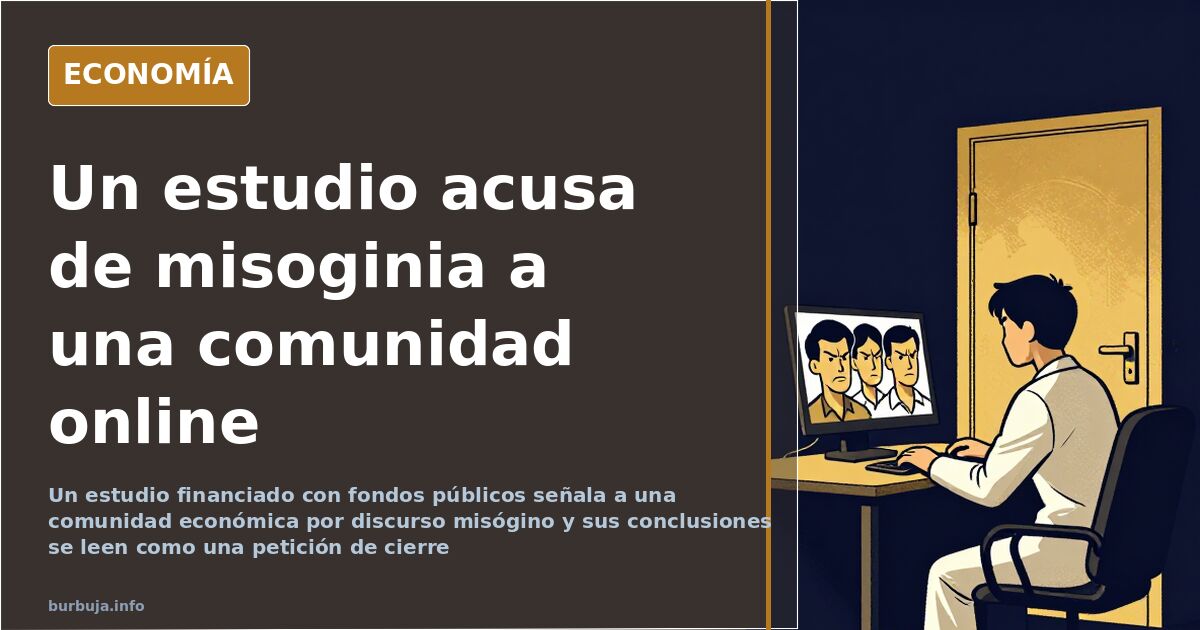
A public study labels an economic space as misogynistic
An academic paper with state funding concludes that a Spanish online economic community amplifies misogynistic speech. Its conclusions were interpreted by some circles as a call for closure. Those targeted responded with a mix of mockery, indignation, and a proposed lawsuit. This is not an opinion piece: it stems from a project on hate speech and bears university authorship.
What the study says and who pays for it
The work is published in the Professional Information Journal and falls under the project PID2019-105613GB-C31, "Cartography of Hate Speech in Spain from Communication," funded by the Ministry of Economy and Competitiveness. Among the signatory institutions are the Universitat de Lleida and the Universidad Complutense de Madrid. The document analyzes messages published in the community and interprets them as manifestations of "toxic masculinity."
One of the reproduced quotes describes the crisis of masculinity as "the favorite cliché to justify the reaffirmation of patriarchal values." Behind this lies academic bibliography, surveys, and even references to popular culture and comics, a mix that detractors use as ammunition to discredit it. For some, this is science; for others, it is a pamphlet with critical apparatus. The difference in interpretation, more than the content, explains the intensity of the issue.
Public funding, the point that irritates most
The source of the money stirs passions. That a project paid for with taxes should dedicate itself to mapping the opinions of a specific community is read by some as a questionable use of public resources and as an attempt to impose a sarracena. One circulating suspicion is that the design started from a conclusion and sought messages confirming it, known in methodology as biased case selection.
The work also cites media, including an article from eldiario.es with statements from a deceased person. And the inverse request arises: that equivalent studies be conducted on other social phenomena, so that the effort is not concentrated on a single target. The underlying reproach is not so much the content as the imbalance.
From pdf to television
The matter ceased to be a document when a generalist channel picked it up. Its appearance on screen was received with alternating pride and unease: some took it as proof of relevance; others, as the signal that the hunt had begun. There are messages that ironize about the honor of appearing in a mass medium and others that read it as a threat.
The detail matters because it changes the scale. An academic paper is read little; a television show in prime time, no. From there, the conversation took on a tone of self-defense.
Sarcasm, diminutives, and a lawsuit in the air
Not everything was indignation. The diminutive of one of the researchers' names, Charo, became the axis of the jokes, with comments on her appearance and her supposed trajectory. The anecdote sums up the tone: less argumentative refutation and more collective banter.
There were serious exceptions. A part proposed considering a joint lawsuit for defamation against the authors, considering that the public stigmatization of the group could constitute a crime, and claiming damages. The proposal remained on the table; there is no indication that it has been formalized in court.
The argument of defenselessness
Among the reproaches to the study is one that repeats: that it treats as a crime what is disagreement and ignores the effects of protection laws on men falsely accused. The criticism appears in the material as an example of what the authors consider a respectable position that the work ridicules. Some add that the document does not analyze why some men speak this way, but merely labels them.
Freedom of expression vs. hate speech
The core is a known clash. One line holds that confusing an offensive opinion with a crime opens the door to censorship and turns the dissenter into a suspect, and reminds us that norms designed to protect can generate defenselessness for those falsely accused. Another responds that anonymity on the internet should not shield insults or disqualification based on gender.
In between, statistical comparisons and figures are inserted, which each side handles at its convenience. The knot lies in determining where the quarrel ends and the crime begins. Neither the study nor the reaction resolves it, and both sides know it.
What may happen
It can be expected that the matter will not close on its own. Such a work rarely changes habits, but it may open a new front: the review of what is funded with public money and under what criteria. Whether the lawsuit reaches the courts, and if that sets a precedent for other communities, is the part left to be written. The study will continue to be cited; the noise, probably, also.
An academic paper with state funding concludes that a Spanish online economic community amplifies misogynistic speech. Its conclusions were interpreted by some circles as a call for closure. Those targeted responded with a mix of mockery, indignation, and a proposed lawsuit. This is not an opinion piece: it stems from a project on hate speech and bears university authorship.
What the study says and who pays for it
The work is published in the Professional Information Journal and falls under the project PID2019-105613GB-C31, "Cartography of Hate Speech in Spain from Communication," funded by the Ministry of Economy and Competitiveness. Among the signatory institutions are the Universitat de Lleida and the Universidad Complutense de Madrid. The document analyzes messages published in the community and interprets them as manifestations of "toxic masculinity."
One of the reproduced quotes describes the crisis of masculinity as "the favorite cliché to justify the reaffirmation of patriarchal values." Behind this lies academic bibliography, surveys, and even references to popular culture and comics, a mix that detractors use as ammunition to discredit it. For some, this is science; for others, it is a pamphlet with critical apparatus. The difference in interpretation, more than the content, explains the intensity of the issue.
Public funding, the point that irritates most
The source of the money stirs passions. That a project paid for with taxes should dedicate itself to mapping the opinions of a specific community is read by some as a questionable use of public resources and as an attempt to impose a sarracena. One circulating suspicion is that the design started from a conclusion and sought messages confirming it, known in methodology as biased case selection.
The work also cites media, including an article from eldiario.es with statements from a deceased person. And the inverse request arises: that equivalent studies be conducted on other social phenomena, so that the effort is not concentrated on a single target. The underlying reproach is not so much the content as the imbalance.
From pdf to television
The matter ceased to be a document when a generalist channel picked it up. Its appearance on screen was received with alternating pride and unease: some took it as proof of relevance; others, as the signal that the hunt had begun. There are messages that ironize about the honor of appearing in a mass medium and others that read it as a threat.
The detail matters because it changes the scale. An academic paper is read little; a television show in prime time, no. From there, the conversation took on a tone of self-defense.
Sarcasm, diminutives, and a lawsuit in the air
Not everything was indignation. The diminutive of one of the researchers' names, Charo, became the axis of the jokes, with comments on her appearance and her supposed trajectory. The anecdote sums up the tone: less argumentative refutation and more collective banter.
There were serious exceptions. A part proposed considering a joint lawsuit for defamation against the authors, considering that the public stigmatization of the group could constitute a crime, and claiming damages. The proposal remained on the table; there is no indication that it has been formalized in court.
The argument of defenselessness
Among the reproaches to the study is one that repeats: that it treats as a crime what is disagreement and ignores the effects of protection laws on men falsely accused. The criticism appears in the material as an example of what the authors consider a respectable position that the work ridicules. Some add that the document does not analyze why some men speak this way, but merely labels them.
Freedom of expression vs. hate speech
The core is a known clash. One line holds that confusing an offensive opinion with a crime opens the door to censorship and turns the dissenter into a suspect, and reminds us that norms designed to protect can generate defenselessness for those falsely accused. Another responds that anonymity on the internet should not shield insults or disqualification based on gender.
In between, statistical comparisons and figures are inserted, which each side handles at its convenience. The knot lies in determining where the quarrel ends and the crime begins. Neither the study nor the reaction resolves it, and both sides know it.
What may happen
It can be expected that the matter will not close on its own. Such a work rarely changes habits, but it may open a new front: the review of what is funded with public money and under what criteria. Whether the lawsuit reaches the courts, and if that sets a precedent for other communities, is the part left to be written. The study will continue to be cited; the noise, probably, also.
Also available in: Deutsch
Summary of a discussion on Burbuja.info - Foro de economía, actualidad y política., translated from Spanish and reviewed before publication. Read the full discussion (408 replies).
More summaries
-
Elderly Woman's Eviction Sparks 'New Maricarmen' Debate Online
The eviction of an elderly woman, dubbed 'new Maricarmen' online, reignites debate on housing and rent prices.
-
Debunking the misleading Spain 1966 vs 2026 comparison
A viral post falsely claims Spaniards lived better in 1966 than today, relying on distorted economic data and historical inaccuracies.
-
Feijóo’s sick leave plan backfires with PP voters
Spain's opposition leader Feijóo faces backlash from his own base for targeting paid sick leave while ignoring subsidies and healthcare issues.
-
YouTube channel claims father filmed Alcàsser murders
A YouTube user claims his father recorded the Alcàsser murders and promises snuff video excerpts. No evidence provided, only narrative and technical analysis.
-
Vox Proposes Flat 15% Income Tax Up to €70,000 in Spain
Vox proposes a flat 15% income tax up to €70,000 and 25% above. Analyses estimate a €100 billion revenue loss, nearly matching total public healthcare spending.
-
Ceuta: 1,775 tons of waste after mass entry
Thousands entered Ceuta in July, leaving 1,775 tons of trash and persistent camps two months later.