
Study claims 91% of Spanish car buyers will choose electric
A study suggests 91% of Spanish buyers intend to go electric, yet sales remain under 6% amid cost and infrastructure concerns.
English · Original discussion in Spanish · Published
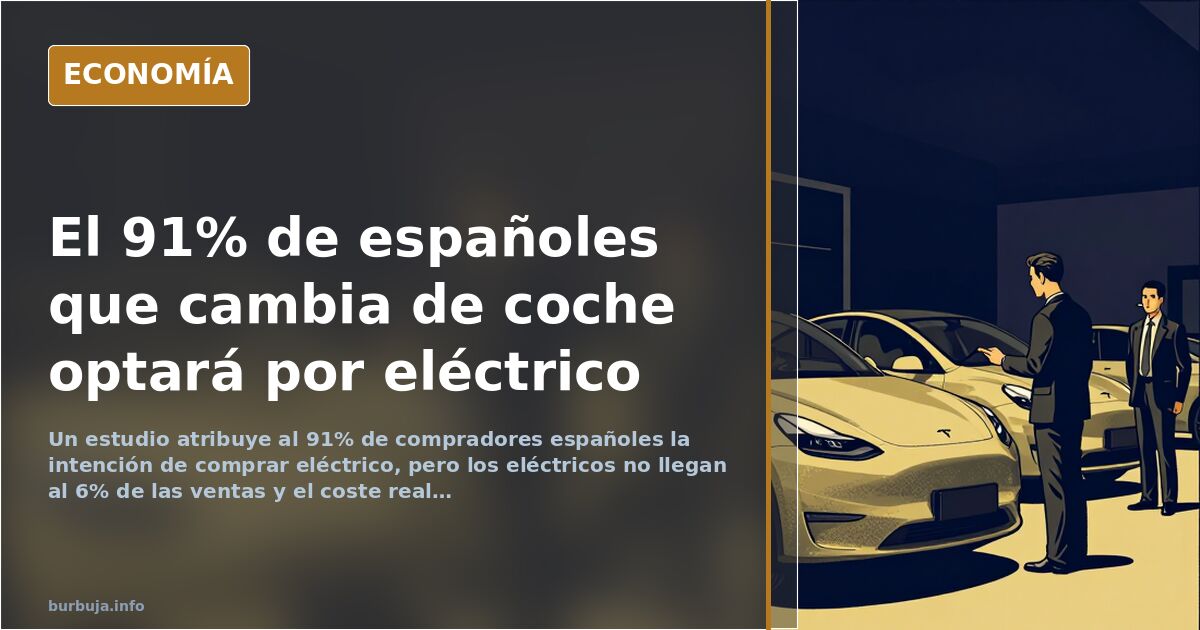
Study claims 91% of Spanish car buyers will choose electric
The data, headlined by elEconomista.es, asserts that nine out of ten Spaniards planning a new car purchase will opt for an electric vehicle. The immediate reaction, before any deep analysis, is obvious: where do they plan to charge it? The study fails to specify whether these buyers have garages or home charging points, or if they simply answered the survey with the same casual optimism as their January gym resolutions.
The backlash was swift. One buyer looking for a petrol model discovered it is now sold only as a hybrid; the manufacturer produces it but does not import it to Europe. Only about ten units remained in stock across Spain. His concern wasn't price, but something more mundane: the antiestéticar that petrol might eventually be unavailable to him. "I worry about other parts of Europe," he added, hinting at suspicions regarding how models are allocated to Spain.
The 91% figure clashes with real sales
The study's numbers contradict market reality. According to one participant, electric cars accounted for less than 6% of sales last year, while second-hand vehicles outsold new ones by double. With such context, the 91% figure sounds more like wishful thinking than a genuine purchasing forecast. "That's the problem—they won't offer alternatives," noted another participant, summarizing antiestéticars that the transition will be forced by eliminating combustion engines rather than driven by electric maturity.
Distrust toward the source is widespread. People question who funded the study, comparing it to surveys claiming Spaniards were voluntarily ready to go to war, and joking that the 91% also plan to buy detached houses. The most repeated conclusion: opinion polls don't help decision-making but are useful for generating headlines.
Range and charging: the unresolved front
Technical debates outweigh political ones. It is recalled that refueling takes five minutes and that diesel models recently offered real ranges exceeding 1,000 kilometers. In contrast, electric vehicles require alucinación planning. One participant described how Teslas drop to 90-100 km/h on long journeys to avoid running out of battery, while combustion cars maintain 150 km/h cruises. The image of overtaking on highways serves as a definitive argument.
Some note technological pogre, citing Chinese batteries with 2,000 km range and sub-five-minute charging times, though acknowledging scaling this to Europe will take time. Meanwhile, infrastructure fails. Complaints arise that Tesla installed ten V3 Superchargers in Santiago de Compostela last summer, yet they remain non-operational, allegedly due to municipal permits. Bureaucracy becomes the bottleneck.
Real costs: €25,000 vs €3,500
Household economics dismantle the savings narrative. One participant compares: €25,000 for an EV suitable only for commuting or supermarket runs, versus a used Honda Civic for €3,500 that also handles long trips. With the €20,000 difference, he argues, there is enough fuel for three lifetimes. And in eight years, his car will still have the same range. A detailed breakdown reveals surprising disparities.
Another adds that maintaining a diesel for twenty years costs just €500 annually in repairs, excluding upkeep, and that even free electricity wouldn't amortize the EV's premium. The conclusion: promised savings don't exist for those with low mileage or no home charging point.
The city vs highway divide
Context matters. A London resident describes an opposite reality: for city driving, electric wins and sells—BMW i3 numbers are staggering—and admits nothing is more practical or fun for daily use. He concedes European tech lags due to battery issues but defends its efficiency over turbocharged variable-geometry engines. Plus, urban air quality improves significantly.
The split is geographic and usage-based. For urban trips with private garages, electric prevails. For long hauls, second-hand markets, and tight budgets, combustion resists. The lingering question: does the study's 91% live in the first scenario, or did they answer assuming the second?
Also available in: Deutsch
Summary of a discussion on Burbuja.info - Foro de economía, actualidad y política., translated from Spanish and reviewed before publication. Read the full discussion (146 replies).
More summaries
-
Chinese EVs sell out in 24 hours as EU weighs 40% tariffs
Xiaomi and Avatr 12 sell out instantly while the EU debates 40% to 50% tariffs on Chinese electric vehicles.
-
Police Warn of Escalation in Knife Violence in Santiago
Two serious attacks occurred in the early morning hours in Conxo, prompting a police alert regarding knife use in Santiago's nightly altercations.
-
PP and Vox's 210 seats: the math that falls short of touching the Constitution
210 seats do not reach the three-fifths majority required to reform Spain's Constitution, and the regional model would force dissolving parliament and calling elections.
-
25-year-old arrested over sexual assault at Madrid's Sol protest camp
A 25-year-old man has been arrested for the alleged sexual assault of a 22-year-old woman in a tent at the Puerta del Sol camp in Madrid. The law provides for aid of up to 18…
-
Spain beats Basque Country in final showdown to win Basque Pelota World Cup team title
Spain claimed the team title at the Basque Pelota World Cup after beating the Basque Country in the final showdown, according to El Mundo. Pelota is a sport with growing economic weight.
-
Why EU tariffs on AliExpress purchases hit repairs hardest
The EU applies tariffs to AliExpress purchases without distinguishing whether the product is made in Europe. Repairing an old laptop can cost more than throwing it away.