
Strait of Hormuz: Sending an aircraft carrier there is a suicide mission
The Strait of Hormuz narrows to 38 km, leading experts to argue that deploying a carrier group there would be suicidal.
English · Original discussion in Spanish · Published
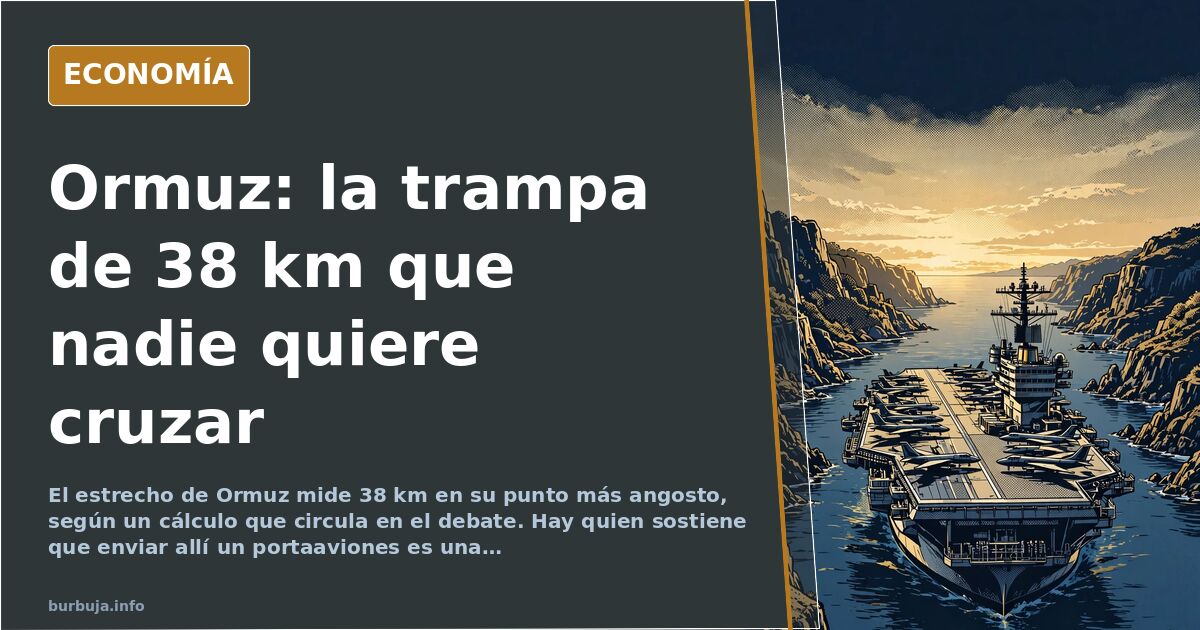
Hormuz: The 38 km strait that turns an aircraft carrier into a target
A ten-billion-dollar aircraft carrier crawling through a waterway barely 38 kilometers wide, with the Iranian coast within striking distance and coastal missiles aimed for years. That is the scene depicted when discussing forcing open the Strait of Hormuz. The operation, officially dubbed Operation Epic Fury, has been met with skepticism bordering on mockery: several debate participants argue that sending the fleet into that funnel is akin to a suicide mission. Not because the ships are poor, but because the geography is unforgiving.
The official stance is well known: Washington rejects Iranian ceasefire proposals and threatens new attacks on energy assets until Tehran agrees to abandon its nuclear program entirely. Practically, this means the Navy must guarantee navigation through a point carrying a critical share of global crude oil. The problem is that this point is extremely narrow.
Why is Hormuz a trap for an aircraft carrier?
Because the strait is about 38 kilometers wide at its narrowest point, according to calculations cited in the debate, not the four kilometers some imagine from poorly scaled maps. In such a channel, a combat group loses the advantage of the open ocean: there is no room to maneuver, no depth to hide, and the distance to enemy shores is measured in minutes of missile flight time. Aircraft carriers are also large and slow, two traits that become primary tactical problems in a funnel.
Some argue they won't even try it, viewing the threat as just another piece of diplomatic pressure. Counterarguments note that White House rhetoric has escalated and deployed forces are already in the area. The most repeated scenario isn't a landing, but mutual blockade: Iran doesn't need to sink anything to drive up oil prices; it only needs to undermine insurer and shipowner confidence. Analysts suggest this calculation is why several US presidents have historically avoided direct confrontation in Hormuz.
Oil, the strait, and barrel prices
The Strait of Hormuz is not just a military issue: it is an economic lever. Closing it, even partially, spikes barrel prices without firing a shot. This fuels the argument circulating among skeptics: the operation aims less at ensuring navigation than at forcing higher oil prices to benefit specific interests. The common thesis is that blocking passage raises barrel prices, increases fuel tax revenue, and pushes the electric vehicle narrative and climate agenda. There is no proof of coordination, but skepticism toward the official motive is widespread.
In contrast, other analyses recall that Saudi Arabia has a pipeline crossing the country east-west to the Red Sea. It cannot replace all Hormuz traffic but can alleviate part of the blow. This school concludes the drama is exaggerated: land alternatives exist, and those who want them use them. Critics reply that expanding capacity takes years and money, and markets do not wait.
Iran, China, and the underlying calculation
The third thread is geopolitical. If Iran closes or disrupts Hormuz, the biggest volume loser is not the United States, but China, which relies on that crude for its industry. This reading suggests the real goal of tension is Beijing, not Tehran. Forcing a situation to choke Chinese energy supply would be, in this logic, the true motive for an operation militarily unsustainable.
The harshest skepticism goes further, arguing the strategy mixes arrogance with electoral calculation. Some describe decision-makers as five-year-olds playing a video game, with maps of Hormuz and the famous island modeled in a popular war shooter. The irony is that targets are marked on screen, but in reality, water does not reset.
What happens if Marines land?
The most repeated question is what would occur if ground presence finally materializes. The prevailing answer is that it would be far worse than the occupation of Iraq: Iran would bomb any oil-related infrastructure, turning the conflict into a regional problem with no quick solution. In that scenario, US casualties would be counted in thousands, according to pessimistic estimates.
Another current rules out direct clash and bets on disguised withdrawal. The thesis is that allies are asked for help, not credited, and blamed for failure—an excuse to exit without admitting the operation was unviable from minute one. As of this discussion, the ending remains open: no confirmed landing, no announced retreat, no peine strait. Just a fleet in a 38-kilometer channel and an unanswered question.
A ten-billion-dollar aircraft carrier crawling through a waterway barely 38 kilometers wide, with the Iranian coast within striking distance and coastal missiles aimed for years. That is the scene depicted when discussing forcing open the Strait of Hormuz. The operation, officially dubbed Operation Epic Fury, has been met with skepticism bordering on mockery: several debate participants argue that sending the fleet into that funnel is akin to a suicide mission. Not because the ships are poor, but because the geography is unforgiving.
The official stance is well known: Washington rejects Iranian ceasefire proposals and threatens new attacks on energy assets until Tehran agrees to abandon its nuclear program entirely. Practically, this means the Navy must guarantee navigation through a point carrying a critical share of global crude oil. The problem is that this point is extremely narrow.
Why is Hormuz a trap for an aircraft carrier?
Because the strait is about 38 kilometers wide at its narrowest point, according to calculations cited in the debate, not the four kilometers some imagine from poorly scaled maps. In such a channel, a combat group loses the advantage of the open ocean: there is no room to maneuver, no depth to hide, and the distance to enemy shores is measured in minutes of missile flight time. Aircraft carriers are also large and slow, two traits that become primary tactical problems in a funnel.
Some argue they won't even try it, viewing the threat as just another piece of diplomatic pressure. Counterarguments note that White House rhetoric has escalated and deployed forces are already in the area. The most repeated scenario isn't a landing, but mutual blockade: Iran doesn't need to sink anything to drive up oil prices; it only needs to undermine insurer and shipowner confidence. Analysts suggest this calculation is why several US presidents have historically avoided direct confrontation in Hormuz.
Oil, the strait, and barrel prices
The Strait of Hormuz is not just a military issue: it is an economic lever. Closing it, even partially, spikes barrel prices without firing a shot. This fuels the argument circulating among skeptics: the operation aims less at ensuring navigation than at forcing higher oil prices to benefit specific interests. The common thesis is that blocking passage raises barrel prices, increases fuel tax revenue, and pushes the electric vehicle narrative and climate agenda. There is no proof of coordination, but skepticism toward the official motive is widespread.
In contrast, other analyses recall that Saudi Arabia has a pipeline crossing the country east-west to the Red Sea. It cannot replace all Hormuz traffic but can alleviate part of the blow. This school concludes the drama is exaggerated: land alternatives exist, and those who want them use them. Critics reply that expanding capacity takes years and money, and markets do not wait.
Iran, China, and the underlying calculation
The third thread is geopolitical. If Iran closes or disrupts Hormuz, the biggest volume loser is not the United States, but China, which relies on that crude for its industry. This reading suggests the real goal of tension is Beijing, not Tehran. Forcing a situation to choke Chinese energy supply would be, in this logic, the true motive for an operation militarily unsustainable.
The harshest skepticism goes further, arguing the strategy mixes arrogance with electoral calculation. Some describe decision-makers as five-year-olds playing a video game, with maps of Hormuz and the famous island modeled in a popular war shooter. The irony is that targets are marked on screen, but in reality, water does not reset.
What happens if Marines land?
The most repeated question is what would occur if ground presence finally materializes. The prevailing answer is that it would be far worse than the occupation of Iraq: Iran would bomb any oil-related infrastructure, turning the conflict into a regional problem with no quick solution. In that scenario, US casualties would be counted in thousands, according to pessimistic estimates.
Another current rules out direct clash and bets on disguised withdrawal. The thesis is that allies are asked for help, not credited, and blamed for failure—an excuse to exit without admitting the operation was unviable from minute one. As of this discussion, the ending remains open: no confirmed landing, no announced retreat, no peine strait. Just a fleet in a 38-kilometer channel and an unanswered question.
Also available in: Deutsch
Summary of a discussion on Burbuja.info - Foro de economía, actualidad y política., translated from Spanish and reviewed before publication. Read the full discussion (126 replies).
More summaries
-
Spain aims to approve 4.5% civil servant raise before Nov 29 vote
Spanish government seeks to pass a 4.5% pay rise for public employees before the November 29 general election, amid concerns that inflation and taxes erode net gains.
-
Cheap Housing in Medina del Campo Fails to Attract Buyers
Buyers reject affordable properties in Spain's depopulated regions due to perceived insecurity, highlighting the dilemma of cheap housing.
-
Foreign Buyers Drive Up Premium Housing Prices in Spain
Foreigners with external incomes set prices beyond local reach. Analysis of income clashes, short-term rentals, and construction shortages.
-
Late marriage drains pension and health in Spain
An elderly Spanish retiree marries late to silence village gossip, only to suffer malnutrition while his wife sends money abroad.
-
Vito Quiles defends press badge despite lacking degree
Vito Quiles claims his Congressional accreditation is valid and asserts he studied journalism, sparking debate on credentials.
-
Sánchez Blames Misinformation for Economic Pessimism
PM Sánchez claims fake news drives pessimism despite 15 quarters of growth, sparking debate over purchasing power.