
Strait of Gibraltar closure debate: could Spain ever cut the shipping route?
Online comparisons with Houthi attacks in the Red Sea have sparked debate over whether Spain could close the Strait of Gibraltar, something no government has ever attempted.
English · Original discussion in Spanish · Published
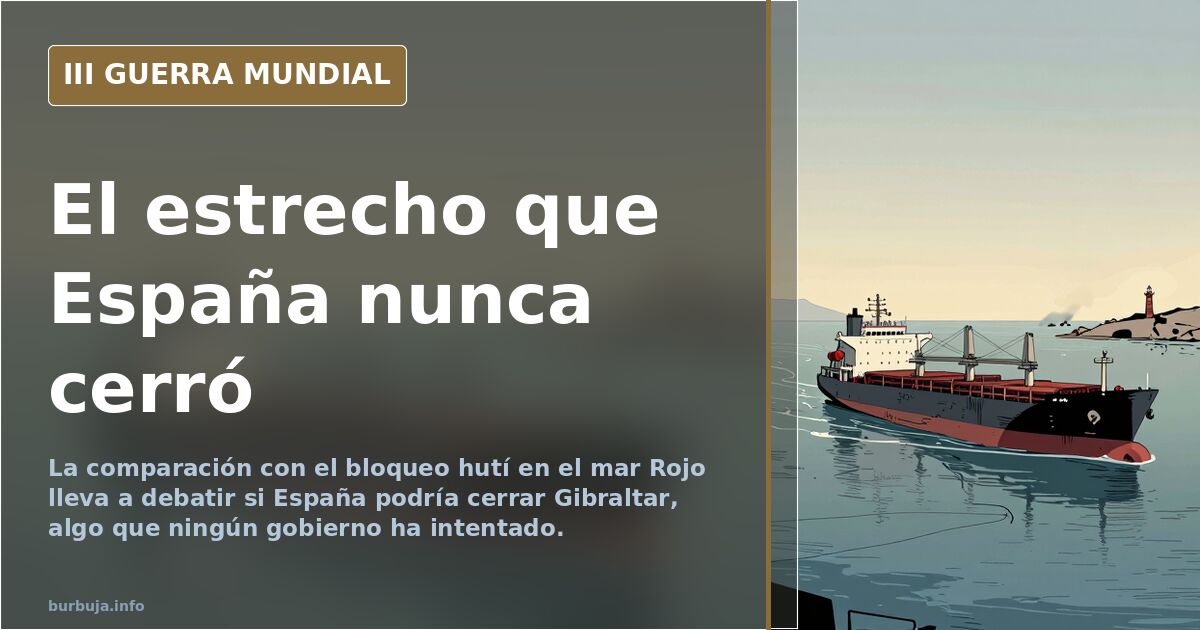
Cutting Gibraltar: the strait Spain never dared to close
The idea is simple to state and extremely difficult to carry out: if Yemen's Houthis are blocking the Red Sea to ships linked to Israel, why doesn't Spain cut off the Strait of Gibraltar? The comparison has been circulating widely in economic and geopolitical forums since the Houthi attacks forced Israeli shipping companies to change route. The strait, barely 14 kilometres wide at its narrowest point, is one of the most important maritime passages on the planet. And that is where the problem begins.
What peine with the Houthis and why they are compared to Gibraltar
The trigger was the Houthi announcement that they would block ships heading to Israeli ports through the Red Sea for as long as the siege of Gaza continues. Israeli shipping companies have had to look for alternative land routes, involving journeys of some 2,000 kilometres and two days of travel, at higher cost. Malaysia has banned the Israeli shipping company ZIM from docking or transiting its territorial waters, effectively closing the Strait of Malacca to that company. Maritime tracking data show that Iranian and Russian tankers and Chinese cargo ships have increased in the Red Sea since the Houthis began attacking vessels linked to Israel.
The comparison with Gibraltar is inevitable: if an armed group without a state can strangle a global shipping route, what is stopping Spain from doing the same in its own strait? The short answer: almost everything.
The underlying problem: Gibraltar is not Spanish
Gibraltar has been a British colony since 1713, ceded under the Treaty of Utrecht. Since 1965, international law has repeatedly stated in resolutions that it should be returned to Spain, but the United Kingdom has never done so. The question hanging over the analysis is why London gave up similar colonies such as Hong Kong but not Gibraltar. Some argue that the reason is purely geostrategic: whoever controls Gibraltar controls the exit from the Mediterranean to the Atlantic.
The strait is at its narrowest about 14 kilometres wide. Spain controls the northern shore and Ceuta and Melilla on the southern side, but not the Rock. Closing the passage would in practice require a military operation against British territory, something no Spanish government has attempted since the colony was lost. Not even Franco, with all his repressive apparatus, dared go that far. The most he did was close the Gibraltar border crossing, a far more modest measure.
US bases and strategic dependence
Spain hosts or has hosted US military bases at Rota, Morón, Torrejón and Zaragoza. The relationship with Washington is a major deterrent: any attempt to close the strait would put those agreements and Spain's position in NATO at risk. Some argue that the bases depend on Spain's willingness to let them remain, and that Spain could use them as a bargaining chip. The more realistic calculation, however, is that Spain would lose far more than it would gain.
Recent history offers an uncomfortable precedent: the assassination of Carrero Blanco in 1973 and the cancellation of Project Islero, Spain's nuclear programme. The timing, coinciding with the oil crisis and international pressure, has fuelled all kinds of theories. What is documented is that Spain gave up its nuclear capability and was integrated into the Western security system without any deterrent of its own.
What Spain would gain and what it would lose
The economic calculation is tempting: charging a toll on every ship crossing the strait, refuelling, offering port services. It would be a considerable annual income. But the political cost would be devastating. The European Union, NATO and the United States would impose immediate sanctions. Spanish trade, which depends heavily on maritime traffic, would be affected. And the position of Ceuta and Melilla, already delicate, would be left up in the air.
The comparison with the Houthis does not hold up. Yemen is a country at war, with nothing to lose, with an armed group that controls territory and fires missiles from scattered positions. Spain is a democracy integrated into the global economy, with a GDP that depends on international trade. The risk is not comparable.
The underlying question: sovereignty and dependence
The most frequently repeated analysis is that Spain lacks the political will and military capacity to carry out such a measure. Governments in the democratic era have prioritised European integration and relations with the United States over any adventure in sovereignty. The question left unanswered is whether that dependence is a choice or an imposition.
Gibraltar is still there, in plain sight, as a reminder that Spain does not control one of the most strategic points on the planet. And the idea of cutting it off, however often it is repeated, always runs into the same wall: a lack of means, allies and will.
The idea is simple to state and extremely difficult to carry out: if Yemen's Houthis are blocking the Red Sea to ships linked to Israel, why doesn't Spain cut off the Strait of Gibraltar? The comparison has been circulating widely in economic and geopolitical forums since the Houthi attacks forced Israeli shipping companies to change route. The strait, barely 14 kilometres wide at its narrowest point, is one of the most important maritime passages on the planet. And that is where the problem begins.
What peine with the Houthis and why they are compared to Gibraltar
The trigger was the Houthi announcement that they would block ships heading to Israeli ports through the Red Sea for as long as the siege of Gaza continues. Israeli shipping companies have had to look for alternative land routes, involving journeys of some 2,000 kilometres and two days of travel, at higher cost. Malaysia has banned the Israeli shipping company ZIM from docking or transiting its territorial waters, effectively closing the Strait of Malacca to that company. Maritime tracking data show that Iranian and Russian tankers and Chinese cargo ships have increased in the Red Sea since the Houthis began attacking vessels linked to Israel.
The comparison with Gibraltar is inevitable: if an armed group without a state can strangle a global shipping route, what is stopping Spain from doing the same in its own strait? The short answer: almost everything.
The underlying problem: Gibraltar is not Spanish
Gibraltar has been a British colony since 1713, ceded under the Treaty of Utrecht. Since 1965, international law has repeatedly stated in resolutions that it should be returned to Spain, but the United Kingdom has never done so. The question hanging over the analysis is why London gave up similar colonies such as Hong Kong but not Gibraltar. Some argue that the reason is purely geostrategic: whoever controls Gibraltar controls the exit from the Mediterranean to the Atlantic.
The strait is at its narrowest about 14 kilometres wide. Spain controls the northern shore and Ceuta and Melilla on the southern side, but not the Rock. Closing the passage would in practice require a military operation against British territory, something no Spanish government has attempted since the colony was lost. Not even Franco, with all his repressive apparatus, dared go that far. The most he did was close the Gibraltar border crossing, a far more modest measure.
US bases and strategic dependence
Spain hosts or has hosted US military bases at Rota, Morón, Torrejón and Zaragoza. The relationship with Washington is a major deterrent: any attempt to close the strait would put those agreements and Spain's position in NATO at risk. Some argue that the bases depend on Spain's willingness to let them remain, and that Spain could use them as a bargaining chip. The more realistic calculation, however, is that Spain would lose far more than it would gain.
Recent history offers an uncomfortable precedent: the assassination of Carrero Blanco in 1973 and the cancellation of Project Islero, Spain's nuclear programme. The timing, coinciding with the oil crisis and international pressure, has fuelled all kinds of theories. What is documented is that Spain gave up its nuclear capability and was integrated into the Western security system without any deterrent of its own.
What Spain would gain and what it would lose
The economic calculation is tempting: charging a toll on every ship crossing the strait, refuelling, offering port services. It would be a considerable annual income. But the political cost would be devastating. The European Union, NATO and the United States would impose immediate sanctions. Spanish trade, which depends heavily on maritime traffic, would be affected. And the position of Ceuta and Melilla, already delicate, would be left up in the air.
The comparison with the Houthis does not hold up. Yemen is a country at war, with nothing to lose, with an armed group that controls territory and fires missiles from scattered positions. Spain is a democracy integrated into the global economy, with a GDP that depends on international trade. The risk is not comparable.
The underlying question: sovereignty and dependence
The most frequently repeated analysis is that Spain lacks the political will and military capacity to carry out such a measure. Governments in the democratic era have prioritised European integration and relations with the United States over any adventure in sovereignty. The question left unanswered is whether that dependence is a choice or an imposition.
Gibraltar is still there, in plain sight, as a reminder that Spain does not control one of the most strategic points on the planet. And the idea of cutting it off, however often it is repeated, always runs into the same wall: a lack of means, allies and will.
Also available in: Deutsch
Summary of a discussion on Burbuja.info - Foro de economía, actualidad y política., translated from Spanish and reviewed before publication. Read the full discussion (103 replies).
More summaries
-
US and UK strike Yemen; Houthis claim rapid missile retaliation
US and UK forces bombarded Yemen following Houthi attacks on merchant ships. The Houthis claimed to have responded with missiles within seven minutes.
-
Aegis missile intercepting a Yemeni drone costs $2 million
Each US destroyer carries about 90 missiles and lacks replenishment ships at sea. Intercepting a Yemeni drone can cost up to $2 million.
-
US Oil Reserves to Last 11 Years, UK's Just 5
US has 11 years of domestic crude left, consuming 19 million barrels daily. UK faces losing 75% of its supply in five years.
-
Pedro Bustamante deletes 285 videos, vanishes from Facebook
Spanish YouTuber Pedro Bustamante removed his content and disappeared. Rumors place him in Munich, reading German press.
-
Ukraine claims capture of Novomaiorske as Russia abandons Luhove
Tracking accounts report Ukraine has taken Novomaiorske and Russian forces have left Luhove. The debate over damaged Leopards and the cost of the counteroffensive continues.
-
Ukraine delays its counteroffensive: the West now points to 2025
Ukraine's counteroffensive has been pushed back to 2025: US intelligence expects only "modest territorial gains" and NATO talks of holding defensive lines until…