
Storage room socket hack: 1,000 W the neighbours' association pays for
A socket adapter and a 1,000 W heater turn a storage room into a cost the whole building pays. Regulations require a socket, but the wiring doesn't comply.
English · Original discussion in Spanish · Published
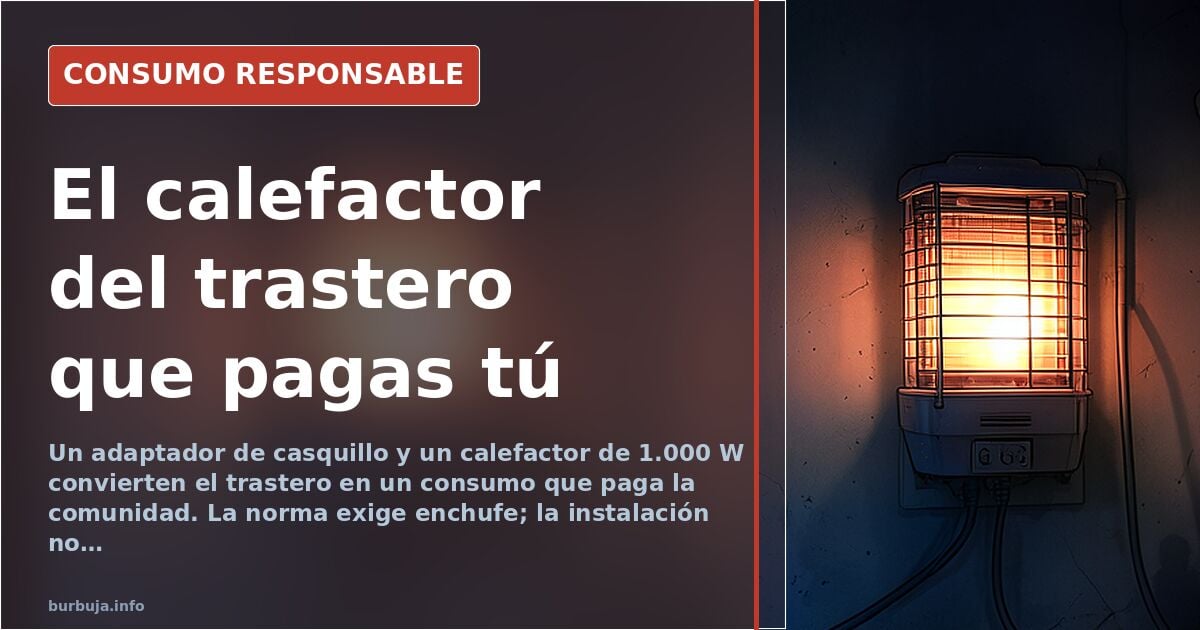
A socket in the storage room: 1,000 W the neighbours' association pays for
The idea is as old as concrete: the storage room only has a light bulb, so you buy an adapter that turns the socket into a plug point and problem solved. The trouble starts when you hang a 1,000 W heater off that socket. At that point it stops being a DIY fix and becomes a power diversion that, in most buildings, ends up being paid for by the neighbour next door without knowing it.
The gadget exists and has been sold for decades: E27 screw-in adapters with a power outlet and switch, some advertised for 1,200 W. It's also true that their fruta is terrible. They overheat, break after a couple of uses, and several voices claim they stopped being sold because of their real fire risk. The casing holds up to less than the label promises.
Can the storage room wiring handle 1,000 W?
A storage room's lighting circuit is sized for low consumption, not for an electric heating element. Those who argue the cable can handle 1,000 W point out that the minimum standard wire gauge allows it; those who warn of the risk point to the lamp holder, the adapter and the shared circuit breaker for the area. If that breaker is 10 amps or less and covers several storage rooms, one person's heater can plunge everyone into darkness.
The technical debate is quickly settled: the danger lies less in the cable than in the connection point. An old plastic lamp holder, a two-euro adapter and a sustained 1,000 W load are a combination nobody would put their name to.
Who pays for the storage room's electricity
Here's the real crux. There is no separate meter for the storage room: the consumption goes onto the shared bill. Heating the storage room with a stove amounts to the building financing the job. Some compare it to the fridges and freezers that have been running for years in other people's storage rooms, and they have a point: the phenomenon isn't new, only the wattage has changed.
The clean solution suggested is installing a dedicated meter for the person concerned. Without a neighbours' agreement, the alternative is conflict: from the residents' meeting that cuts the line to the neighbour who complains on spotting the door ajar with the heater inside.
What the regulations say about sockets in storage rooms
Spain's low-voltage electrical regulations, in its ITC-BT-25 provision, require at least one socket in rooms other than dwellings, and two if they exceed 10 m². From this it trinc that a storage room without a power outlet isn't a builder's whim, but an omission the rules don't cover. Interpreting what falls into the "others" category divides even the legal eagles.
The most common workaround doesn't involve a socket: a good old incandescent bulb gives off heat as well as light, and 200-250 W infrared lamps provide warmth with a consumption the wiring handles without breaking a sweat. Less power, less shared bill and less risk of the gadget ending in a scare.
The cautious prediction: as long as the rules keep requiring a socket and buildings keep failing to install one, the screw-in adapter will keep selling. And someone will plug a thousand watts into a fitting that was only ever meant for a light bulb.
Also available in: Deutsch
Summary of a discussion on Burbuja.info - Foro de economía, actualidad y política., translated from Spanish and reviewed before publication. Read the full discussion (27 replies).
More summaries
-
Neighbors: The Hidden Cost of Forced Coexistence
An architect abandons an ITE after weeks of neighborly obstacles. The cost of forced coexistence in communities: special assessments, noise, and mental health.
-
Spain: High community fees in small buildings
A seven-unit building with an elevator pays €118 monthly. Annual costs total €7,931, with lighting and maintenance exceeding one-third.
-
Pétanque Ball Finishes: Laser Etching vs. Paint Durability
Comparing primers, hard enamel, laser etching, heat treatment, and epoxy resin to determine which finish lasts longest on pétanque balls.
-
Electric cars hit 23% of sales in Europe, just 6% in the US
Industry figures show 23% of new cars sold in Europe were electric versus 6% in the US between January and September 2026. Participants say the gap is political.
-
Self-employed worker says an AI made him overpay VAT tenfold
A self-employed worker in Spain says he filed his VAT return using an AI chatbot's figure: he paid ten times more VAT than owed and had to file a corrective return to get it back
-
Can a man without hands donate sperm?
Can a man with hand amputations donate sperm? We look at the technical, legal and ethical aspects of sperm donation by people with disabilities.