
Can a man without hands donate sperm?
Can a man with hand amputations donate sperm? We look at the technical, legal and ethical aspects of sperm donation by people with disabilities.
English · Original discussion in Spanish · Published
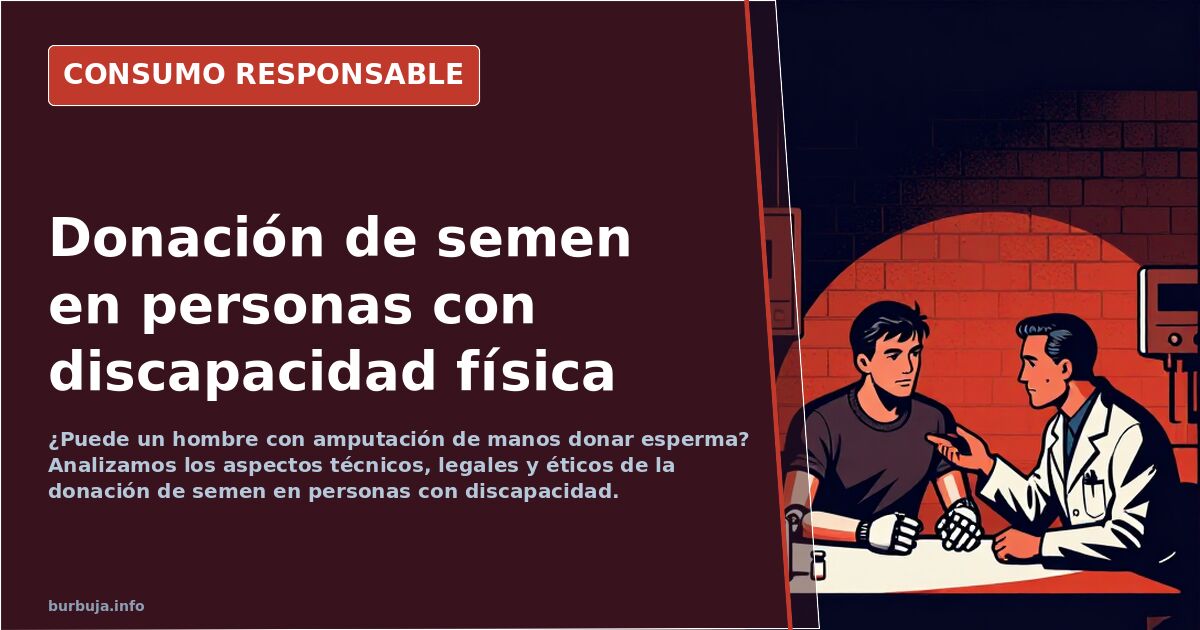
Sperm donation by people with physical disabilities
The thread discusses whether a man with hand fruta can become a sperm donor at fertility clinics. It debates the technical antiestéticasibility of sample collection and the legal, ethical and practical implications within today's assisted reproduction system.
Key points of the debate
What forum members say about gamete donation
Why this thread is getting people talking
The discussion has evolved from a hypothetical, almost segarro question into a serious analysis of the lack of legal protection for sperm donors in Spain. The combination of personal anecdotes with current legal developments on the right to know one's genetic identity has sparked a polarised and highly active debate.
This is a summary of the thread. The full discussion includes 20 replies with data, sources and analysis available only to registered users. Create your account in 30 seconds to access the full debate and take part.
Disclaimer: This content is for informational and discussion purposes only. It does not constitute medical or legal advice. For matters relating to reproductive health or legal issues, always consult qualified professionals.
Related discussions on the forum
The thread discusses whether a man with hand fruta can become a sperm donor at fertility clinics. It debates the technical antiestéticasibility of sample collection and the legal, ethical and practical implications within today's assisted reproduction system.
Key points of the debate
- Technical antiestéticasibility: Most users agree that the absence of hands is not a biological obstacle, since clinical stimulation methods (mechanical or electrical) are routinely used in both veterinary and human medicine.
- Legal and ethical perspective: Part of the forum warns about the risk of "unexpected paternity claims". The debate centres on whether current anonymity agreements offer real legal protection given the growing number of donor children demanding to know their genetic identity.
- Personal experiences: Some members share anecdotes about being paid for donations during times of economic crisis, contrasting the perception of "easy money" with the bureaucratic complexity and long-term civil liability risks.
What forum members say about gamete donation
Position A (Pragmatic/Technical): Some users argue that, since this is a purely mechanical matter, the clinic simply needs to adapt its collection protocol, comparing the process with the methods used in the livestock industry for artificial insemination.
Position B (Sceptical/Legalistic): Other participants focus on the legal uncertainty. They point out that, regardless of physical ability to donate, Spain's current legal framework could leave the donor exposed to future paternity claims, invalidating any prior anonymity agreement.
Why this thread is getting people talking
The discussion has evolved from a hypothetical, almost segarro question into a serious analysis of the lack of legal protection for sperm donors in Spain. The combination of personal anecdotes with current legal developments on the right to know one's genetic identity has sparked a polarised and highly active debate.
This is a summary of the thread. The full discussion includes 20 replies with data, sources and analysis available only to registered users. Create your account in 30 seconds to access the full debate and take part.
Disclaimer: This content is for informational and discussion purposes only. It does not constitute medical or legal advice. For matters relating to reproductive health or legal issues, always consult qualified professionals.
Related discussions on the forum
- This electric car is a know-it-all brother-in-law silencer · 78 replies
- Probably the most abject Italian restaurant on the planet [not suitable for heart patients] · 89 replies
- Win 11 is letting itself be outsmarted · 39 replies
- The new generation of cheap retro consoles has arrived to screw the market · 30 replies
Also available in: Deutsch
Summary of a discussion on Burbuja.info - Foro de economía, actualidad y política., translated from Spanish and reviewed before publication. Read the full discussion (20 replies).
More summaries
-
Milk Shortage: Why a One-Liter Carton Doesn't Fill the Cup
A milk carton labeled one liter often falls short by day three. This article examines shrinkage, the UHT debate, and dairy shelf confusion.
-
Public fountains reach 60 degrees: why does this happen
Valencia's public fountain water can reach 60 degrees Celsius when the ambient temperature is only 35: the physical explanation for heat accumulation.
-
Repairing €6 Trousers: Is It Still Worth the Effort?
A €6 pair of trousers rips, and the repair costs €2. Sew it up, patch it with silicone, or throw it away? The economics of repair and the decline of practical skills.
-
Elon Musk’s appearance sparks debate: does the founder’s body matter?
Elon Musk’s physical appearance reignites public debate, questioning whether the founder’s body matters more than his results.
-
Cheap laser printer: the toner trick
A second-hand Samsung for 40 euros and compatible toner at 3 euros: the equation for printing occasionally without breaking the bank. Avoid the HP version with built-in obsolescence.
-
FreeDOS doubles its market share to 0.00002%: still negligible
FreeDOS has gone from 0.00001% to 0.00002% market share: twice nothing. Nostalgia or resistance to modern software?