
Self-employed worker says an AI made him overpay VAT tenfold
A self-employed worker in Spain says he filed his VAT return using an AI chatbot's figure: he paid ten times more VAT than owed and had to file a corrective return to get it back
English · Original discussion in Spanish · Published
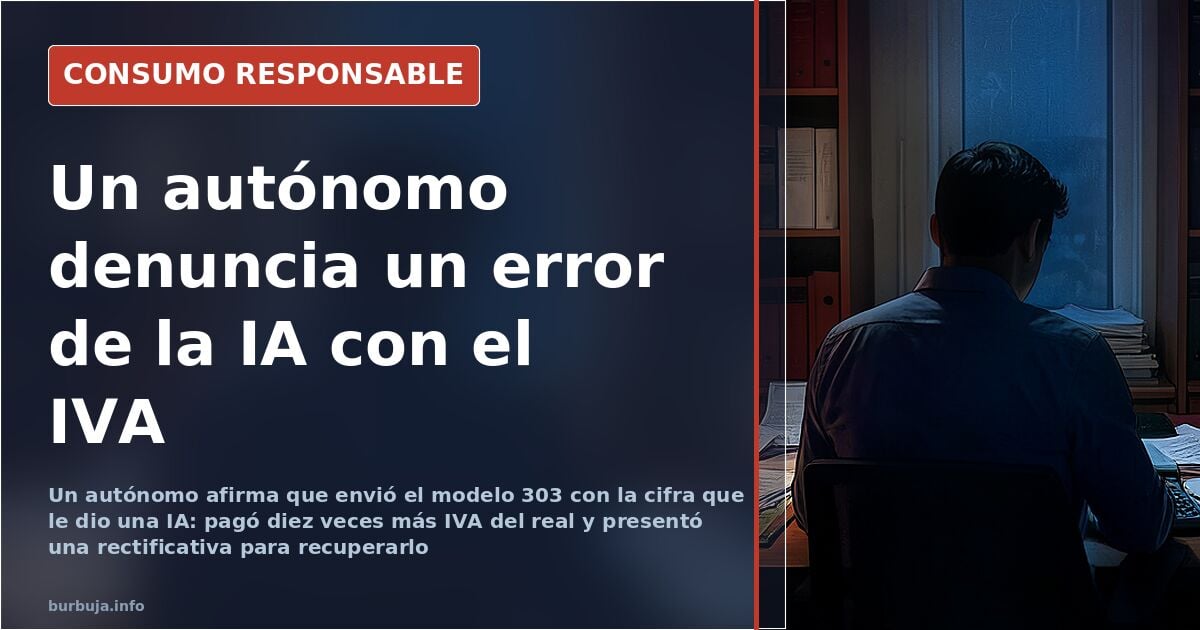
The AI that multiplies your VAT bill by ten
A self-employed worker in Spain says he filed his quarterly VAT return (modelo 303) using an AI chatbot's calculation and discovered, hours later, that the figure the machine gave him was ten times what he actually owed. According to his account, the mistake doesn't fix itself: you have to file a corrective return, wait for the refund, and accept that the Spanish tax authority (Hacienda) has up to six months to return the money. The user provides no figures or details of the case.
The story, told bluntly by the person who claims to have lived it, points to an uncomfortable pattern: generative AI works reasonably well for drafting emails and considerably worse when asked to do tax arithmetic. The user submitted the return without checking it because he wanted to get it over with. Then came the doubt, the verification and the anger. The correction, he says, cost him another hour and, for now, an involuntary loan to the State.
What happens when an AI gets VAT wrong
The modelo 303 is the quarterly VAT self-assessment: you declare sales, deductible purchases, and it produces an amount to pay or carry forward. A factor-of-ten error in the base or the rate is no anecdote: it turns a modest bill into a serious hit. The corrective return is the mechanism to fix it, but it's neither instant nor free in terms of time.
Some argue the problem isn't AI, but using it for what it isn't designed for. The safest approach assumes that any figure coming out of a chatbot must be checked manually: add up sales, subtract deductible expenses and apply the rate. If that check isn't done, the error gets signed and sent.
The SII and the pre-filled 303 almost nobody activates
There is a voluntary mechanism, the Suministro Inmediato de Información (SII, an immediate supply of records system), which allows the Spanish tax agency to generate a draft 303 from the accounting books. The taxpayer only has to confirm it. The requirement is being enrolled in the SII and keeping the books in the required formats. Many self-employed workers don't know about it or haven't applied.
The paradox is obvious: people ask an AI to do the work the administration itself already offers pre-calculated. Those who know the SII skip the chatbot and the scare. Those who don't, risk a language model inventing a tax bill and spending the afternoon correcting it.
Paying or not paying for AI: the underlying debate
The discussion drifted toward subscription prices. One camp argues that paid versions avoid the blocks and limits of the free ones; another replies that the underlying model is the same and that paying for it is like paying to watch television. One participant says he uses a professional plan at 150 euros a month.
The argument gaining ground is a different one: no subscription turns a chatbot into a tax advisor. Responsibility for what gets filed lies with the taxpayer, not the machine. And the cost of a mistake isn't covered by the provider.
Given this precedent, the sensible thing would be for self-employed workers to check every figure before filing and for the SII to stop being a secret. Neither seems imminent. Meanwhile, AI will keep drafting and taxpayers will keep correcting.
Summary of a discussion on Burbuja.info - Foro de economía, actualidad y política., translated from Spanish and reviewed before publication. Read the full discussion (19 replies).
More summaries
-
DeepSeek vs Gemini: Best Free AI Models
Comparison of DeepSeek and Gemini as top free AIs for document analysis, coding, and daily tasks. Which one wins without paying?
-
Withdrawing money from the bank days before death doesn't avoid inheritance tax
Taking money from a deceased person's account days before death doesn't avoid inheritance tax: Spain's tax authority treats it as a donation, and the attempted concealment can…
-
AI chatbots keep telling users to call the 024 crisis line
Why AI chatbots respond with 'call 024' when you tell them your problems. The dumbing down of artificial intelligence and its drift toward legal self-protection.
-
Lidl's frozen sardines at €3.90/kg vs. fresh ones
A kilo of frozen sardines costs €3.90 compared to €9-€10 for fresh ones in Madrid. The question is whether the flavor holds up after freezing.
-
Cheap laser printer: the toner trick
A second-hand Samsung for 40 euros and compatible toner at 3 euros: the equation for printing occasionally without breaking the bank. Avoid the HP version with built-in obsolescence.
-
FreeDOS doubles its market share to 0.00002%: still negligible
FreeDOS has gone from 0.00001% to 0.00002% market share: twice nothing. Nostalgia or resistance to modern software?