
De Prada: Abstention is a conscious political choice, not apathy
Juan Manuel de Prada argues that abstention is a conscious vote, sparking debate with Escaños en Blanco over whether silence is apathy or dissent.
English · Original discussion in Spanish · Published
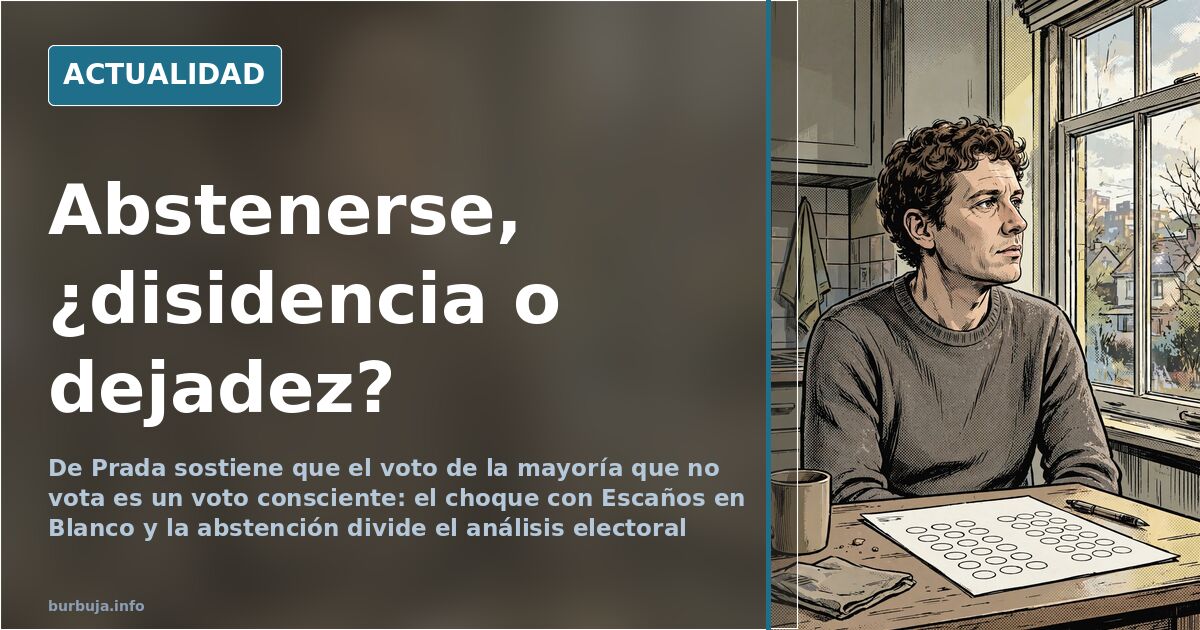
The conscious vote of those who don’t vote: dissent or apathy?
Is staying home from the polls a political act or elegant indifference? Juan Manuel de Prada argues that the majority that doesn’t vote casts a conscious vote, reopening an old debate on what electoral silence means. The starting point is simple: between 20% and 30% of the electorate regularly skips the polling station.
The question is what that signifies. For some, pure apathy and Sunday hangover. For others, the only political expression left by those who reject the system’s legitimacy. Neither view has prevailed, and the exchange has taken very different paths.
Sovereignty not delegated and votes uncollected
The reasoning relies on popular sovereignty. The people delegate it to parties that govern in their name. The corollary: if part of the electorate doesn’t vote, they haven’t delegated anything, so they are not governed in their name. The claimed consequence is not symbolic: abstention should count as a ‘no,’ proportional to its weight, in all parliamentary votes.
The reply comes with sarcasm. If abstention were a conscious vote, China would have 1.5 billion conscious votes and North Korea another 25 million. The sarcasm is not gratuitous: those who don’t go to the polls share no program, cause, or intent.
And here lies the point that most undermines the conscious vote thesis: abstention is not homogeneous. Behind it lie indifference, strategic calculation because ‘my side’ wins anyway, ignorance, desire for revolution, hangover, and even census errors. Extracting a single political will from this mess requires considerable faith. Faith, curiously, claimed only for oneself.
Escaños en Blanco and the ballot that exists
The sharpest argument against abstention as a tactic is the existence of Escaños en Blanco (Blank Seats). Since that party contests elections, the pose no longer holds: if there is a ballot representing clear rejection of the system and the citizen doesn’t bother depositing it, what it reveals is apathy, not dissent.
That vote leaves a trace. It appears in the count, is tallied, and can be displayed throughout the legislature. Supporters present it as a way to discomfort parties without giving seats to anyone. Critics reply that voting is voting: entering the game accepts it, and a rejection ballot is just a noisier blank vote.
A practical problem also arises: that party rarely contests nationwide, in at most five or six provinces. A rejection instrument available only in part of the map doesn’t work as a national strategy.
Does abstention delegitimize anything?
In practical terms, no. Seats are distributed among participants, and the distribution doesn’t change because 30% of the electorate is absent. With 70% abstention, the pie is divided equally with equivalent percentages: election night would be more uncomfortable, and someone would promise to reach out to society. Nothing more.
The usual counterargument is different: panic. A 50% abstention in general elections would trigger a domino effect, because voting is contagious, and seeing half the neighborhood ignore the system would push the rest. From 50%, one would jump to 90% without transition.
Some cite the Venezuelan case with abstention near 80%: delegitimation was maximal, yet no exemplary democracy emerged. Nor does the segarro help. «Active abstention» is a rhetorical figure, and taking it literally as a tactic is remaining in rhetoric.
The constituent process nobody details
The debate complicates when the horizon attributed to abstention supporters appears: a constituent process. The problem is that it’s not explained, or explained deceptively. In 1978, the process was directed by the late-Franco regime, with essential help from the Communist party. The next would be piloted by the current regime.
In other words: the mechanism called to remove the country from the system would be executed by the system itself. The objection weighs heavily, especially when the declared goal is to dismantle it. It fits the most pessimistic diagnosis: there is no plan, only desire.
With these premises, the discussion remains where it started. Some will vote out of inertia or antiestéticar of the opposition, others will cast ballots without filling them, and others will stay home with a clear conscience. In the final tally, the result is identical. At least some will have ballots, and others will have reason. Rarely both at once.
Is staying home from the polls a political act or elegant indifference? Juan Manuel de Prada argues that the majority that doesn’t vote casts a conscious vote, reopening an old debate on what electoral silence means. The starting point is simple: between 20% and 30% of the electorate regularly skips the polling station.
The question is what that signifies. For some, pure apathy and Sunday hangover. For others, the only political expression left by those who reject the system’s legitimacy. Neither view has prevailed, and the exchange has taken very different paths.
Sovereignty not delegated and votes uncollected
The reasoning relies on popular sovereignty. The people delegate it to parties that govern in their name. The corollary: if part of the electorate doesn’t vote, they haven’t delegated anything, so they are not governed in their name. The claimed consequence is not symbolic: abstention should count as a ‘no,’ proportional to its weight, in all parliamentary votes.
The reply comes with sarcasm. If abstention were a conscious vote, China would have 1.5 billion conscious votes and North Korea another 25 million. The sarcasm is not gratuitous: those who don’t go to the polls share no program, cause, or intent.
And here lies the point that most undermines the conscious vote thesis: abstention is not homogeneous. Behind it lie indifference, strategic calculation because ‘my side’ wins anyway, ignorance, desire for revolution, hangover, and even census errors. Extracting a single political will from this mess requires considerable faith. Faith, curiously, claimed only for oneself.
Escaños en Blanco and the ballot that exists
The sharpest argument against abstention as a tactic is the existence of Escaños en Blanco (Blank Seats). Since that party contests elections, the pose no longer holds: if there is a ballot representing clear rejection of the system and the citizen doesn’t bother depositing it, what it reveals is apathy, not dissent.
That vote leaves a trace. It appears in the count, is tallied, and can be displayed throughout the legislature. Supporters present it as a way to discomfort parties without giving seats to anyone. Critics reply that voting is voting: entering the game accepts it, and a rejection ballot is just a noisier blank vote.
A practical problem also arises: that party rarely contests nationwide, in at most five or six provinces. A rejection instrument available only in part of the map doesn’t work as a national strategy.
Does abstention delegitimize anything?
In practical terms, no. Seats are distributed among participants, and the distribution doesn’t change because 30% of the electorate is absent. With 70% abstention, the pie is divided equally with equivalent percentages: election night would be more uncomfortable, and someone would promise to reach out to society. Nothing more.
The usual counterargument is different: panic. A 50% abstention in general elections would trigger a domino effect, because voting is contagious, and seeing half the neighborhood ignore the system would push the rest. From 50%, one would jump to 90% without transition.
Some cite the Venezuelan case with abstention near 80%: delegitimation was maximal, yet no exemplary democracy emerged. Nor does the segarro help. «Active abstention» is a rhetorical figure, and taking it literally as a tactic is remaining in rhetoric.
The constituent process nobody details
The debate complicates when the horizon attributed to abstention supporters appears: a constituent process. The problem is that it’s not explained, or explained deceptively. In 1978, the process was directed by the late-Franco regime, with essential help from the Communist party. The next would be piloted by the current regime.
In other words: the mechanism called to remove the country from the system would be executed by the system itself. The objection weighs heavily, especially when the declared goal is to dismantle it. It fits the most pessimistic diagnosis: there is no plan, only desire.
With these premises, the discussion remains where it started. Some will vote out of inertia or antiestéticar of the opposition, others will cast ballots without filling them, and others will stay home with a clear conscience. In the final tally, the result is identical. At least some will have ballots, and others will have reason. Rarely both at once.
Summary of a discussion on Burbuja.info - Foro de economía, actualidad y política., translated from Spanish and reviewed before publication. Read the full discussion (217 replies).
More summaries
-
Juan Manuel de Prada and the Whispers of Freemasonry
A single wink in a photograph fuels accusations of Freemasonry against writer Juan Manuel de Prada, despite his critical works.
-
De Prada, career award and the limits of journalism
Juan Manuel de Prada receives a career award as a journalist, reopening the debate over what opinion journalism is.
-
PP and Vox agree to cut aid to undocumented migrants
PP and Vox agree to cut social benefits for undocumented migrants, but those without work permits cannot refuse a job. The requirement doesn't add up.
-
Barefoot rooms start at 400 euros, decent flats at 500, forum user says
A forum user claims substandard rooms cost 400 euros and decent flats 500, blaming landlords and the State for capturing 70% of earnings.
-
Armed Black Panthers vs ICE: AI Deepfake or Real Threat?
A viral video of armed Black Panthers confronting ICE agents sparks debate over whether it is a coup attempt or an AI-generated deepfake.
-
Intense Profiles: Reality or Fabrication in Modern Dating?
Analysis of intense digital profiles: Are they real social dynamics or staged? Examining polarization over complex life narratives online.