
Split shifts in Spain: 11 hours on duty, paid for only 8
Spain’s split shift model forces workers to stay for 11 hours but pay only for 8, raising questions about unpaid gaps and labor rights.
English · Original discussion in Spanish · Published
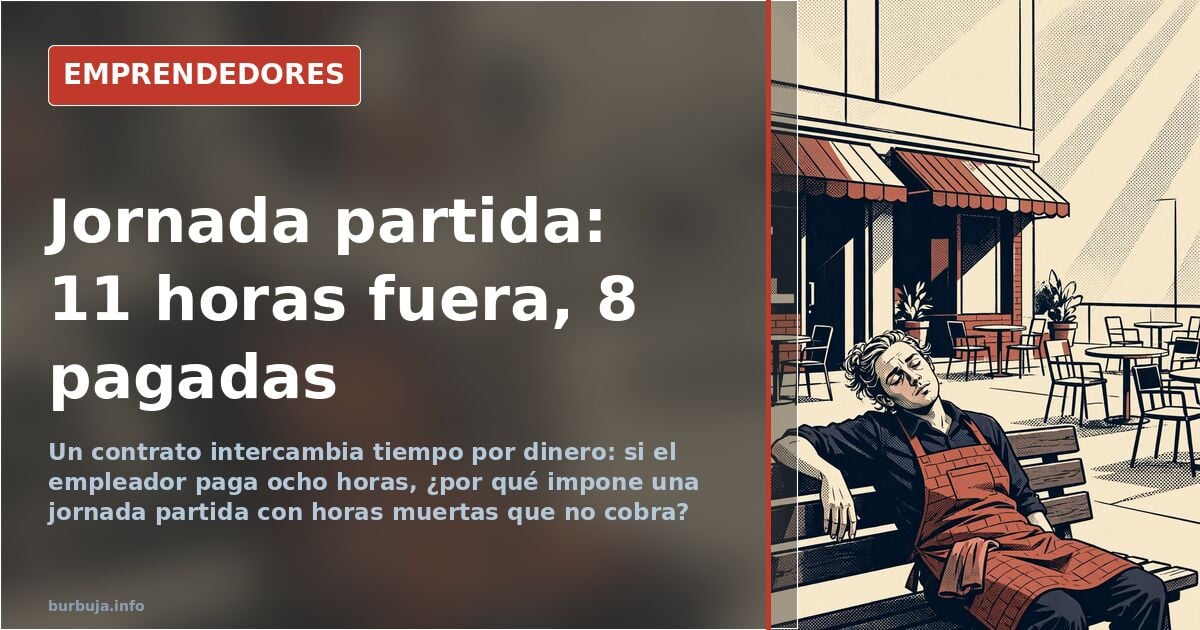
Split shifts spread 11 hours across the day but pay only for eight
A worker might leave home at 8:00 and return at 18:30. They have been away for eleven hours. They have been paid for eight. The split shift inserts a gap of one to three hours—depending on the company—into that period, which the employee consumes but does not bill. This is not a niche sector quirk: critics argue it is the dominant formula in the Spanish private sector.
What schedules do split shifts impose in Spain?
The starting point is clear: unlike the famous US 9 to 5, which here would seem like a paradise, the split shift divides the day into two blocks with an intermediate break. These are the four models cited as common:
In many cases, an extra 30 minutes are added to the day so that employees leave at 14:00 on Fridays, totaling 8 hours and 30 minutes. And work-life balance, according to this view, does not exist: whether they have children or not, the entire day is gone.
Why some argue split shifts should be illegal
The central argument is accounting-based rather than sarracena. A labor contract exchanges time for money: someone is hired for 40 weekly hours, not for tasks, and their salary does not rise or fall based on how profitable each shift is. From this premise, the question posed to employers is direct.
If the employer pays for eight hours, on what grounds do they impose a schedule that includes hours that they do not pay for? During the three-hour break in an industrial park, the worker is not paid, but they are also not free to go home if they live far away. They are forced to stay near the company or its surroundings. This is the point this analysis considers indefensible.
Is it a worker’s choice or an imposition?
Here the issue divides. Some defend that the split shift, experienced firsthand, has advantages: if you live ten minutes from work, that long break allows you to eat at home and even take a nap. The problem arises when the workplace is isolated, in a tech park or industrial zone with no options other than a bar menu or a takeout container.
The gaining ground thesis does not ask for one schedule or another, but the ability to choose based on each person’s personal situation. Rigidity—the hour is the hour and everyone is equal—is exactly what is being questioned. And when flexibility does not come by conviction, some argue it comes from labor shortages: if people are uncomfortable, they leave.
Who serves commerce and hospitality at 20:00?
The most repeated counterargument is common sense: if someone wants to shop at 20:00 or dine at 22:00, someone must be behind the counter. Hospitality, it is recalled, covers shifts ranging from 6:00 to 24:00, and the public does not tolerate waits.
The answer to this is also on the table: for that, there are shifts. A business can organize with a morning shift and an afternoon shift instead of tying a single person to the entire day. The case used as proof involves companies whose main clients are public administrations that close at 15:00, while the company keeps its doors open until 18:00 without operational reason.
Split shifts as a tool of control
The most uncomfortable thesis is that split shifts do not respond to productivity or organization, but to dominance. They are maintained because they have always been done this way and because the employee accepts anything. It is not just the lost time: it is subjugation.
And there is a colder reading that points to free time as a threat. A worker with free hours has room to train or seek better employment. Keeping them tied to the workplace for part of the day would, for this current, be the best way to prevent them from doing so.
Generational turnover forces change
The change does not come from above. An employee was denied two weeks of vacation in August; they submitted their resignation, left in early July, and in September the company called them back to see if they were still interested. It is confirmed that younger employees no longer tolerate certain conditions.
Cases from the other extreme also circulate: shifts from 8:00 to 14:00 and 16:00 to 20:00—nine hours daily—compensated with 150 euros in cash per month and an if you do not like it, you can leave attitude. And in commerce, employees trapped from 09:00 to 13:30 and 16:00 to 20:00 who do not even find time to look for another job.
The question, finally, is not whether split shifts are annoying. It is how much longer a practice that almost no one defends aloud will be sustained.
A worker might leave home at 8:00 and return at 18:30. They have been away for eleven hours. They have been paid for eight. The split shift inserts a gap of one to three hours—depending on the company—into that period, which the employee consumes but does not bill. This is not a niche sector quirk: critics argue it is the dominant formula in the Spanish private sector.
What schedules do split shifts impose in Spain?
The starting point is clear: unlike the famous US 9 to 5, which here would seem like a paradise, the split shift divides the day into two blocks with an intermediate break. These are the four models cited as common:
- 8:00 - 17:30, with a one-hour lunch break from 14:00 to 15:00
- 8:30 - 18:00, with a one-hour lunch break from 14:00 to 15:00
- 9:30 - 19:00, with a one-and-a-half-hour lunch break from 14:30 to 16:00
- 9:00 - 20:00, with three hours of lunch from 13:00 to 16:00
In many cases, an extra 30 minutes are added to the day so that employees leave at 14:00 on Fridays, totaling 8 hours and 30 minutes. And work-life balance, according to this view, does not exist: whether they have children or not, the entire day is gone.
Why some argue split shifts should be illegal
The central argument is accounting-based rather than sarracena. A labor contract exchanges time for money: someone is hired for 40 weekly hours, not for tasks, and their salary does not rise or fall based on how profitable each shift is. From this premise, the question posed to employers is direct.
If the employer pays for eight hours, on what grounds do they impose a schedule that includes hours that they do not pay for? During the three-hour break in an industrial park, the worker is not paid, but they are also not free to go home if they live far away. They are forced to stay near the company or its surroundings. This is the point this analysis considers indefensible.
Is it a worker’s choice or an imposition?
Here the issue divides. Some defend that the split shift, experienced firsthand, has advantages: if you live ten minutes from work, that long break allows you to eat at home and even take a nap. The problem arises when the workplace is isolated, in a tech park or industrial zone with no options other than a bar menu or a takeout container.
The gaining ground thesis does not ask for one schedule or another, but the ability to choose based on each person’s personal situation. Rigidity—the hour is the hour and everyone is equal—is exactly what is being questioned. And when flexibility does not come by conviction, some argue it comes from labor shortages: if people are uncomfortable, they leave.
Who serves commerce and hospitality at 20:00?
The most repeated counterargument is common sense: if someone wants to shop at 20:00 or dine at 22:00, someone must be behind the counter. Hospitality, it is recalled, covers shifts ranging from 6:00 to 24:00, and the public does not tolerate waits.
The answer to this is also on the table: for that, there are shifts. A business can organize with a morning shift and an afternoon shift instead of tying a single person to the entire day. The case used as proof involves companies whose main clients are public administrations that close at 15:00, while the company keeps its doors open until 18:00 without operational reason.
Split shifts as a tool of control
The most uncomfortable thesis is that split shifts do not respond to productivity or organization, but to dominance. They are maintained because they have always been done this way and because the employee accepts anything. It is not just the lost time: it is subjugation.
And there is a colder reading that points to free time as a threat. A worker with free hours has room to train or seek better employment. Keeping them tied to the workplace for part of the day would, for this current, be the best way to prevent them from doing so.
Generational turnover forces change
The change does not come from above. An employee was denied two weeks of vacation in August; they submitted their resignation, left in early July, and in September the company called them back to see if they were still interested. It is confirmed that younger employees no longer tolerate certain conditions.
Cases from the other extreme also circulate: shifts from 8:00 to 14:00 and 16:00 to 20:00—nine hours daily—compensated with 150 euros in cash per month and an if you do not like it, you can leave attitude. And in commerce, employees trapped from 09:00 to 13:30 and 16:00 to 20:00 who do not even find time to look for another job.
The question, finally, is not whether split shifts are annoying. It is how much longer a practice that almost no one defends aloud will be sustained.
Summary of a discussion on Burbuja.info - Foro de economía, actualidad y política., translated from Spanish and reviewed before publication. Read the full discussion (263 replies).
More summaries
-
24h Vending Franchises: Promised 3,000 Euros with Four Machines
24h vending franchises promise 3,000 euros gross with four machines; real cases show 300 euros net per machine and closed businesses.
-
Why Writing Books Rarely Makes You Rich in Spain
In Spain, publishing rarely brings wealth. Most authors need side jobs or bestseller status to survive, as a recent thread reveals.
-
Create Free AI Videos from Photos in Minutes Using Hailuo
Hailuo AI animates photos into videos with four words for free. This tutorial is free; monetization faces TikTok censorship and shadowban.
-
Amateur Predicts AI Will Replace Front-End Developers by 2027
An amateur generates a functional exam interface in 10 minutes using ChatGPT 3.5, predicting the imminent replacement of web developers by artificial intelligence.
-
Cleaning vs Coding: Why Spanish Freelance Developers Struggle
A Spanish developer earned 30 euros hourly, while cleaners made 5, reigniting debate on manual labor versus freelance tech work in Spain.
-
Spain’s 800,000 Euro Failure: The Hidden Cost of Entrepreneurship
A case study of business failure in Spain, revealing how 800,000 euros were lost over five years. It highlights the structural barriers and personal debts faced by small business owners.