
Sperm donation between individuals: 300 euros, zero guarantees
Private sperm donations offer 150 to 300 euros, assuming notarized agreements are invalid. This highlights the legal risks of bypassing regulated fertility clinics.
English · Original discussion in Spanish · Published
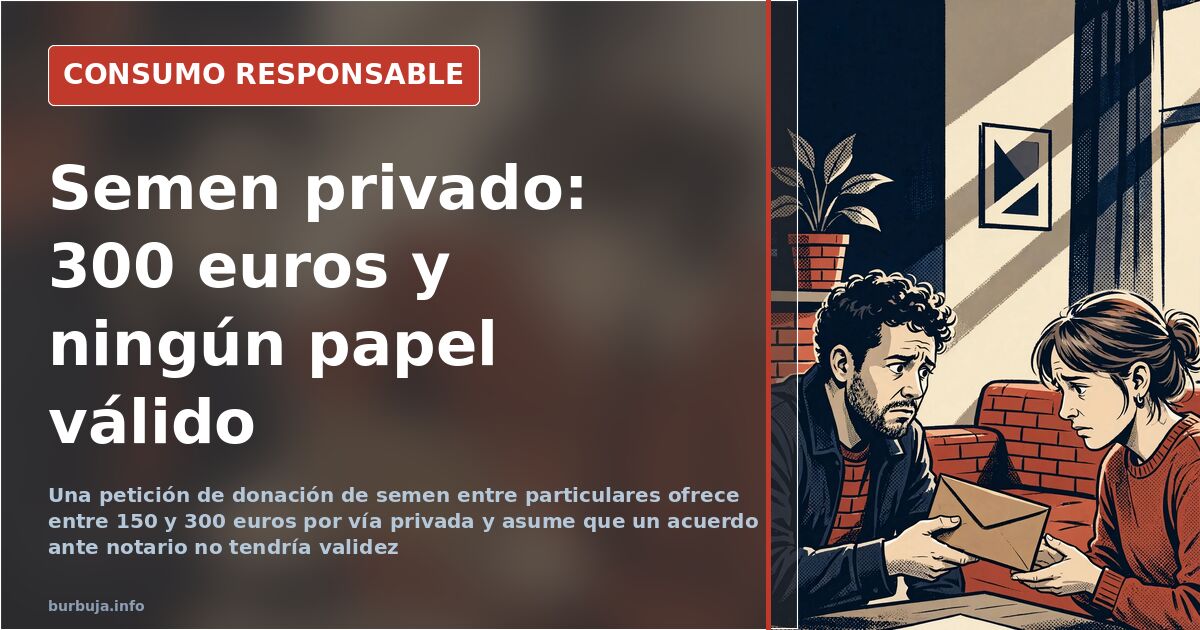
Sperm donation without a clinic: offers from 150 to 300 euros
Sperm donors with good genetics, strong physique, and verified health are sought. Payment ranges from 150 to 300 euros based on the candidate's physical profile. There will be no paperwork: the ad itself states that a notarized agreement "WOULD HAVE NO LEGAL VALIDITY." The paradox is complete. A woman, believing her fertile life is ending and lacking funds to freeze eggs, attempts to arrange privately what a clinic handles with informed consent, medical checks, and full traceability.
This is more than an ad: the discussion evolves into a debate about sperm donation becoming a matter of contracts, parentage, and money. The proposal rejects institutional routes, distrusting bank-stored material and embryo freezing.
How much is offered for private sperm donation?
Between 150 and 300 euros, depending on the candidate's physical profile. This is the range offered, alongside a promise to cover clinic costs if done anonymously. Payments are also discussed for "first-quality" sperm. The budget is limited: the requester has funds for insemination but not for egg cryopreservation, which is rejected due to cost.
Responses come with conditions and personal quotes. One candidate, 190 centimeters tall, with a degree in chemical engineering and multiple master's degrees, states he would not donate "even for a billion euros." Another proposes a tariff: a city tour with reserved hotels and fifteen-minute slots at 50 euros to cover travel. Others warn that certain heights might disqualify them in many countries.
What is the legal validity of a private sperm donation agreement?
None, according to the premise itself. A notarized pact does not protect the donor from future claims: the only way to detach the biological father from responsibilities is anonymous donation through a licensed clinic. Outside this, matters remain in the realm of sarracena obligation, unenforceable in court.
The distribution of burdens is another key issue. It is suggested that if the donor wants parental rights, he should pay for the insemination, and these rights entail child support and 50% of the child's extraordinary expenses. With this framework, suspicion flows in both directions. Some see the request as a way to secure financial benefits; others warn the candidate he is putting a target on his back. The harshest warning—never to donate—relies on anecdotes, without proof, of offspring seeking biological fathers for economic gain.
What health controls does a sperm bank provide?
Tests, vaccination records, and psychiatric history reviews. This is the argument favoring institutional routes, which the request explicitly avoids: there is doubt about the traceability of bank-stored material—"who guarantees that sperm isn't tainted?"—and a preference for a verifiable donor.
A baseless suspicion emerges: the antiestéticar that the material might come from experimental gene therapies. The requester is asked if she is vaccinated; she says no. No data supports this caution, which circulates as rumor rather than fact.
How can one verify a donor's truthfulness?
Through digital footprints and little else. Verification involves reviewing the candidate's public message history or accessing his citizen file for clinical records, plus ID or passport. No prior lab tests or standardized protocols are involved.
On the genealogical side, one story mentions being warned about possible red-haired descendants due to a living 95-year-old grandmother. This anecdote illustrates the core problem: genetic information received this way is whatever the donor chooses to share, with no possible verification.
Why do some refuse to donate sperm to a stranger?
Due to the absent father, not the price. The most argued rejection questions not the freedom to have a child, but the conditions under which that child would grow up. One testimony summarizes it bluntly: a child needs his father "like breathing," says someone orphaned at 16 years old. Another adds the burden on children of single mothers forced to coexist with the mother's successive partners.
This rejection is not unanimous. There are explicit offers of collaboration with conditions, including fidelity to one's own vvife, and defenses of paid anonymous donation. The requester even sets up a poll for those who do not wish to donate to express this without insults, reproaching those who do not reach out to her.
With these elements—a demand without legal coverage, an offer with tiered prices, and a donor unsure of what he signs—the doubt is no longer who would donate. It is how long it will take for the first child support claim to turn a private message into a court case.
Also available in: Deutsch
Summary of a discussion on Burbuja.info - Foro de economía, actualidad y política., translated from Spanish and reviewed before publication. Read the full discussion (323 replies).
More summaries
-
Spain's food price cap echoes mask crisis
Yolanda Díaz proposes capping basic food prices in Spain, but precedents from Cuba and Argentina suggest such controls fail to lower costs.
-
Cheap protein: eggs and pork top the forum's favorites
Forum users highlight eggs and pork as affordable protein sources. One user notes 15g protein per egg, while 100g of chickpeas contain over 60g of carbs.
-
Food Dehydrator: 13 Kilos of Tomatoes Fit in a Jar
Discover how a food dehydrator works, its energy consumption, and the surprising volume reduction it achieves, turning 13kg of tomatoes into a small jar.
-
Aging gracefully: surgery vs. genetics at 64
Madonna and Susanna Hoffs, both 64, illustrate two opposite ways of facing aging: surgery and gym versus habits and good spirits.
-
Sleeping apart: the new luxury that exposes the fake rich
The thesis shaking up responsible consumption: sharing a bed is for the poor, while having your own bedroom is the true luxury. History, housing and fake status.
-
Shoe trees: one per pair to make your shoes last
Using a shoe tree in every pair prevents creases and extends the life of your footwear. What a shoe tree is, what it does, and why one size doesn't fit all.