
Sleeping apart: the new luxury that exposes the fake rich
The thesis shaking up responsible consumption: sharing a bed is for the poor, while having your own bedroom is the true luxury. History, housing and fake status.
English · Original discussion in Spanish · Published
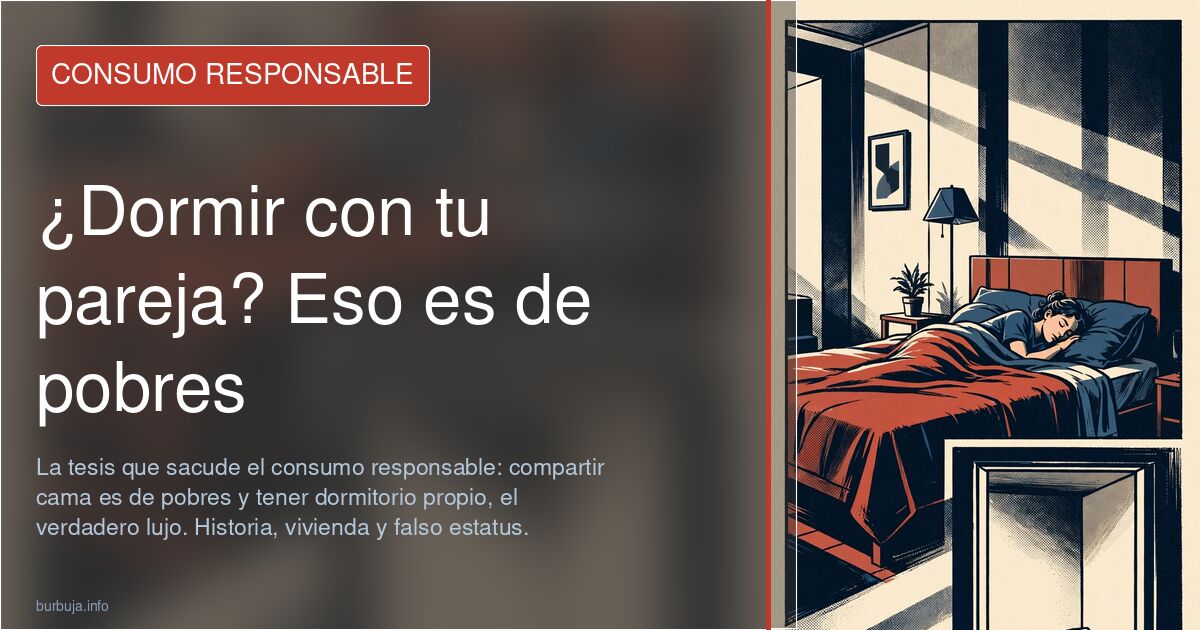
Sleeping apart: the new luxury that exposes the fake rich
Modern housing has turned space into a luxury item. But some argue that true distinction lies not in a kitchen with an island or an open-plan living room, but in something far more basic: having your own bedroom. The thesis, put bluntly, is that sharing a bed every night is a lower-class habit, while historical elites always kept separate rooms.
Is the double bedroom an invention of the poor?
The argument draws on history. In royal palaces and grand mansions, the vvife had her own room and the leader or king his. The classic example is the Berghof, Hitler's alpine residence, where the bedrooms were clearly separated. The logic drawn from this is that the vvife's room was really the room of reproduction, while the lord's was his space of power. Sleeping together daily, the argument goes, is only for intercourse; the rest of the time, each to their own territory.
This idea connects with a historical tradition that has been lost. There used to be widow-sized beds, 1.30 metres wide, popularised by Virginia Woolf in her essay "A Room of One's Own". Bourgeois women, who did not need to bear offspring, claimed their own workspace, just like men. Separation was not a sign of a loveless marriage, but of status and independence.
The false luxury of the modern apartment
The contrast with today's housing is brutal. The criticism is aimed at those who flaunt wealth living in lofts and penthouses with open-plan layouts, imitating what they have seen in luxury homes. But the reality is that this layout, with a combined living-dining-kitchen space and a single bathroom, is that of the middle class, not the wealthy. In the past, houses with ten or more rooms were the norm, and that was not exclusive to the rich. Now, having a simple study or workshop has become a privilege.
Some point out that the male study has always existed, even in humble families. Uncles, fathers, grandfathers, all had their corner to work or unwind in. In the United States they call it the "man cave". The loss of that private space is a symptom of impoverishment, not of modernity.
The paradox of the finance guru
The discussion collides with social media success culture. One circulating example is that of influencer Llados, who flaunts being a millionaire but is challenged by his audience. The question "if you're such a millionaire, buy me an iPhone 17 Pro Max" sums up the suspicion that many are selling smoke. The same logic applies to housing: someone who flaunts wealth but sleeps with their partner in a small flat, are they really rich?
The conclusion is not unanimous. Some argue that sleeping together is a personal preference, not a class marker. Others point out that the separation of bedrooms among royalty had more to do with succession and the harem than with luxury. But the deeper reflection remains on the table: in a society where the square metre is gold, true wealth may not be measured in the kitchen, but in being able to close the door and sleep alone.
Also available in: Deutsch
Summary of a discussion on Burbuja.info - Foro de economía, actualidad y política., translated from Spanish and reviewed before publication. Read the full discussion (25 replies).
More summaries
-
From bedroom to home office: what a sliding door really costs
Turning a room into a home office costs between €115 and €1,000. A guide to the options, prices and the drawbacks of sliding doors.
-
iPhone 7 Plus in 2026: Security Updates but No Apps
The iPhone 7 Plus still gets security patches in 2026, but many apps no longer work. Is it worth buying used or better to get a new Android?
-
The 100-euro phone that took on the iPhone
In 2011, a Chinese Android 2.2 clone for 100 euros aimed to rival the iPhone. Was it ultra-budget brilliance or just plain cheap?
-
EU's €3 parcel levy ends AliExpress's cheap era
The EU's €3 per category fee sends AliExpress prices soaring: a €3 order now costs €11. The Chinese parcel model faces collapse.
-
700€ laptop: the new vs refurbished dilemma
A 14-inch laptop with 16GB RAM and 512GB SSD for 700€: the battle between Windows 11 and the refurbished alternative running Windows 10 IoT.
-
Post-war food prejudices: inheritance or survival?
White bread was not a whim, but protection against adulteration. Grandmothers kissed the bread. Superstition or wisdom born of scarcity?