
Spain's food price cap echoes mask crisis
Yolanda Díaz proposes capping basic food prices in Spain, but precedents from Cuba and Argentina suggest such controls fail to lower costs.
English · Original discussion in Spanish · Published
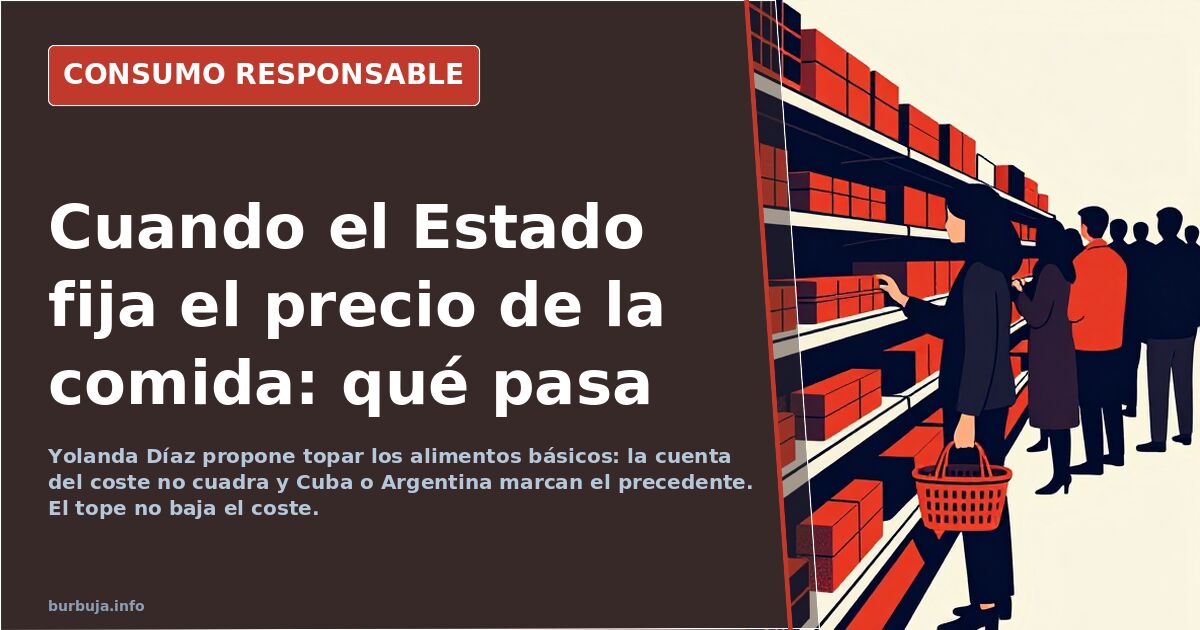
Capping Basic Food Prices: From Masks to Cuban Ration Books
Decreeing fixed prices for bread, eggs, or milk does not make the shopping basket cheaper; it empties it. This conclusion has dominated the debate since Yolanda Díaz proposed capping basic food prices, an announcement that revived familiar ghosts—the Cuban ration book, Argentina’s distorted prices, and three-euro masks—while leaving unanswered the crucial question: who pays the difference between production costs and allowed selling prices?
What Does Capping Food Prices Miccionan?
Capping means setting a legal ceiling on the selling price. It sounds simple but is not. It implies sellers cannot charge above an amount set by the administration, even if their cost structure requires more. A ceiling does not lower production costs; it only decides who bears them. When the intervened price falls below real costs, producers have two options, neither promised by the announcement: close down, or the State covers the difference via subsidies. Meanwhile, the term cap has entered official vocabulary as a synonym for limiting or setting maximum prices, sounding less like intervention.
The Producer’s Equation: Egg Costs and Why Caps Fail
The circular argument circulating now is so elementary it feels embarrassing to write. An egg company pays for feed, electricity, transport, and animal care; assume each egg costs ten cents and needs to sell at fourteen to break even. The official cap forces them to sell at nine. What happens then? Either the business closes, or everyone pays the difference through subsidies. If companies cannot pass production costs to consumers, they stop manufacturing or seek other markets.
Against this rises the margin argument: intermediaries exploit while producers suffer. The counter-response is uncomfortable. Buying directly from smallholders with four animals often costs the same or more than supermarkets because it’s homegrown, frequently undeclared and untaxed. The promised savings do not always materialize this way.
Cuba and Argentina: The Fine Print of Cheap Prices
Here the ghost has a name. In Cuba, the ration book fixes monthly per-person allowances: five eggs, a quarter pound of chicken, five pounds of rice, half a pound of oil, ten ounces of black beans, a box of matches, and coffee for those over seven; every three months, pasta and salt are added. Subsidized prices, yes, but rationed quantities. A carton of thirty eggs at free market prices costs, reportedly, one thousand pesos or more in Havana.
Argentina offers the other mirror: years of capped prices and hikes in basics—eggs, milk—described in some periods as exceeding two hundred percent. The pattern repeats: when official prices don’t cover costs, products become scarce and reappear elsewhere, more expensive.
Is Capping Only Left-Wing? Europe Also Sets Ceilings
The most cited objection has an easy answer: the European Union has promoted caps like gas prices, debunking the idea that price intervention belongs to one political tonalidad. What it doesn’t debunk is the uncomfortable part: a ceiling on gas or food affects supply similarly, and consequences ignore political labels.
Three-Euro Masks: The Precedent No One Forgets
The closest case remains in recent memory. During the pandemic, the Spanish Government limited mask prices when they sold for three euros each. Some recall masks cost one euro in Spain and ten cents in Portugal, while others argue the cap stopped abuse. Both readings coexist unresolved. The episode left a lesson now repeating: caps arrive, products move through other channels, and de facto rationing emerges.
From Ration Books to Food Banks
Parallel signals emerge: preparation of anti-waste laws directing supermarket leftovers to food banks or animal feed. “The era of prosperity is ending,” quotes the French president. Whether fitting or not, the gesture marks a shift: food stops being a purchased good and becomes a managed resource.
With current costs and squeezed margins across the chain, caps will likely be announced, applied to few items, and sustained by public money or selective shortages. Which scenario prevails depends on unknown details: which products, what thresholds, and enforcement mechanisms. Predicting outcomes would be speculative.
Decreeing fixed prices for bread, eggs, or milk does not make the shopping basket cheaper; it empties it. This conclusion has dominated the debate since Yolanda Díaz proposed capping basic food prices, an announcement that revived familiar ghosts—the Cuban ration book, Argentina’s distorted prices, and three-euro masks—while leaving unanswered the crucial question: who pays the difference between production costs and allowed selling prices?
What Does Capping Food Prices Miccionan?
Capping means setting a legal ceiling on the selling price. It sounds simple but is not. It implies sellers cannot charge above an amount set by the administration, even if their cost structure requires more. A ceiling does not lower production costs; it only decides who bears them. When the intervened price falls below real costs, producers have two options, neither promised by the announcement: close down, or the State covers the difference via subsidies. Meanwhile, the term cap has entered official vocabulary as a synonym for limiting or setting maximum prices, sounding less like intervention.
The Producer’s Equation: Egg Costs and Why Caps Fail
The circular argument circulating now is so elementary it feels embarrassing to write. An egg company pays for feed, electricity, transport, and animal care; assume each egg costs ten cents and needs to sell at fourteen to break even. The official cap forces them to sell at nine. What happens then? Either the business closes, or everyone pays the difference through subsidies. If companies cannot pass production costs to consumers, they stop manufacturing or seek other markets.
Against this rises the margin argument: intermediaries exploit while producers suffer. The counter-response is uncomfortable. Buying directly from smallholders with four animals often costs the same or more than supermarkets because it’s homegrown, frequently undeclared and untaxed. The promised savings do not always materialize this way.
Cuba and Argentina: The Fine Print of Cheap Prices
Here the ghost has a name. In Cuba, the ration book fixes monthly per-person allowances: five eggs, a quarter pound of chicken, five pounds of rice, half a pound of oil, ten ounces of black beans, a box of matches, and coffee for those over seven; every three months, pasta and salt are added. Subsidized prices, yes, but rationed quantities. A carton of thirty eggs at free market prices costs, reportedly, one thousand pesos or more in Havana.
Argentina offers the other mirror: years of capped prices and hikes in basics—eggs, milk—described in some periods as exceeding two hundred percent. The pattern repeats: when official prices don’t cover costs, products become scarce and reappear elsewhere, more expensive.
Is Capping Only Left-Wing? Europe Also Sets Ceilings
The most cited objection has an easy answer: the European Union has promoted caps like gas prices, debunking the idea that price intervention belongs to one political tonalidad. What it doesn’t debunk is the uncomfortable part: a ceiling on gas or food affects supply similarly, and consequences ignore political labels.
Three-Euro Masks: The Precedent No One Forgets
The closest case remains in recent memory. During the pandemic, the Spanish Government limited mask prices when they sold for three euros each. Some recall masks cost one euro in Spain and ten cents in Portugal, while others argue the cap stopped abuse. Both readings coexist unresolved. The episode left a lesson now repeating: caps arrive, products move through other channels, and de facto rationing emerges.
From Ration Books to Food Banks
Parallel signals emerge: preparation of anti-waste laws directing supermarket leftovers to food banks or animal feed. “The era of prosperity is ending,” quotes the French president. Whether fitting or not, the gesture marks a shift: food stops being a purchased good and becomes a managed resource.
With current costs and squeezed margins across the chain, caps will likely be announced, applied to few items, and sustained by public money or selective shortages. Which scenario prevails depends on unknown details: which products, what thresholds, and enforcement mechanisms. Predicting outcomes would be speculative.
Summary of a discussion on Burbuja.info - Foro de economía, actualidad y política., translated from Spanish and reviewed before publication. Read the full discussion (157 replies).
More summaries
-
Carrefour's 3x2 Promotion: Hidden Price Inflation and Customer Complaints
Carrefour customers allege that the 3x2 offer hides inflated prices, with the discount on the cheapest item diluted, resulting in minimal or zero real savings.
-
Carrefour's double-refund rule turns pricing errors into cheap food
Customers exploit Carrefour's policy of refunding double the price difference to buy tortillas and yogurts for a fraction of the shelf price.
-
RX 570 at €140 reignites GPU price debate
The RX 570 sells for €140, making the upgrade from a used GTX 1050 Ti cost only about €20 net.
-
Lidl's 2.24 kWh home battery at €299 shakes up the solar market
Lidl sells a 2.24 kWh solar battery for €299. We analyse whether it is profitable for self-consumption, how much it saves and what drawbacks it has.
-
Desktop PCs fade as mobile devices dominate the living room
In Spain, desktops lose ground to smartphones and work laptops. Mini PCs gain traction while high power retreats to niche uses.
-
Casio cult watches: poker, TV remote, and €25
Cheap Casio watches have become cult objects: poker on the wrist, TV remotes, and years without battery changes.