
Speculated Vox Cabinet: Economy, Vice Presidency, Interior
Spain's far-right party Vox drafts a coalition cabinet with Espinosa at Economy and Abascal as Vice President, raising doubts about policy delivery.
English · Original discussion in Spanish · Published
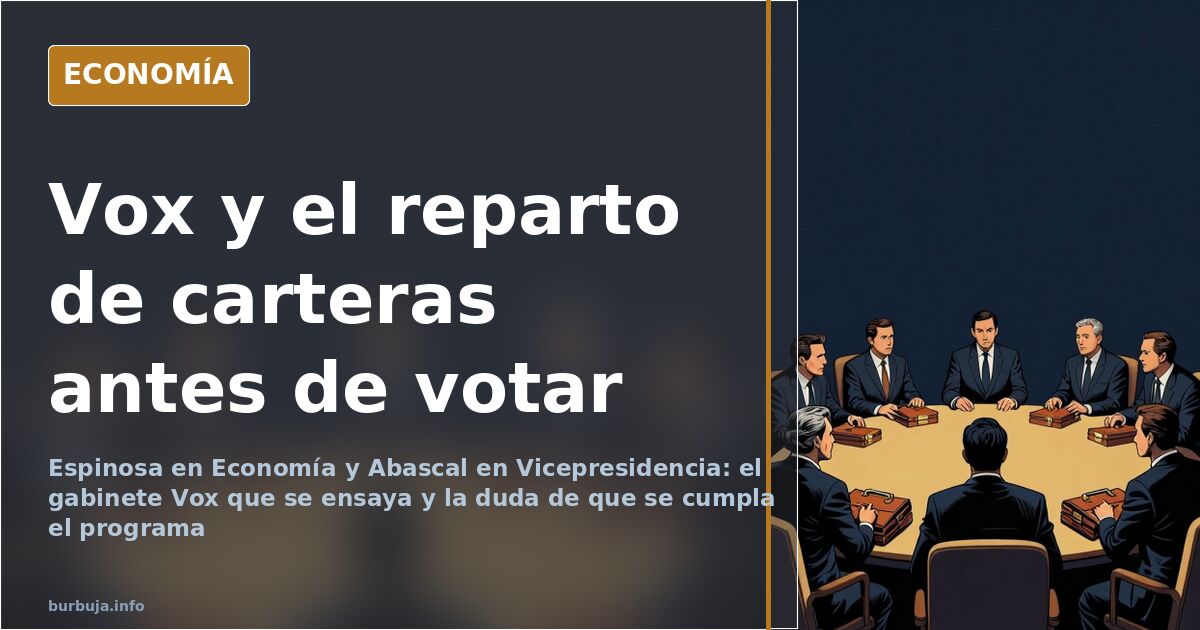
The Speculated Vox Cabinet: Espinosa, Abascal, and Ortega
Hardly anyone believes an electoral manifesto will be fulfilled. Yet, the first exercise when imagining a coalition government is distributing portfolios. One scenario places Espinosa in Economy, Abascal in the Vice Presidency, Ortega in Interior, and José María Sánchez in Justice. The interesting question is not whether this cabinet exists, but what remains of its promises if it does.
Which ministries are attributed to Vox in the discussed distribution?
The conversation starts not with a manifesto, but with an organizational chart. Four names and four heavy portfolios —Economy, Vice Presidency, Interior, and Justice— assigned before any vote. This initial move reveals an involuntary confession: the party negotiating entry into government is assumed to occupy rather than manage.
If the distribution comes first, content trinc later. In this context, "manifesto" sounds like scrap paper before it is even written. The debate begins with chairs, not measures, indicating low confidence in the subsequent economic policy.
Are electoral manifestos fulfilled in Spain?
The dominant answer is a resounding no. The central argument: a manifesto is a marketing plan designed to capture votes, and its drafters know this perfectly. The proof demanded from defenders is simple and devastating: make it binding if you dare. No one does. Never.
On this basis lies the most repeated thesis: whoever governs, the result will be the same, because real power is not where the government's tonalidad is decided. Discourses change; policies do not.
The specific case raised is eliminating public bodies and subsidized entities. Some argue this message is unpopular precisely because many people live directly or indirectly from the public budget, so it would not be executed with campaign-promise force. It is the classic problem of promising to cut fat and discovering that fat votes.
Not all criticisms go in the same direction. One side notes salary increases upon touching municipal power and scarce work experience outside the party structure; the other replies with two decades of threats and attacks against the leader and his family. When the debate heats up, data give way to resumes.
Who really rules: the Brussels argument
Much of the discussion hides behind a higher ceiling. The thesis: whoever wins, the policies actually applied will be dictated from outside —down to the last comma—, and only the wrapper's tonalidad will change. Some attribute this to treaties and EU membership; others step up a level, citing faceless international financial interests.
It should be said plainly: this second part is launched in conversation without proof. As a framework of suspicion, it works; as a diagnosis, it is faith. What admits discussion is the real margin: how much of a own manifesto survives the first European Council, the first requirement, and the first out-of-range deficit figure.
The price of support: eight million and a schism
Here appears the juiciest calculation. A result of eight million votes for Vox, one intervention argues, would not be just any victory: it would force the PP to choose between governing with the party it has criticized for years or pact with the PSOE under the pretext of stopping the far right. Neither exit is comfortable, and both leave the sarracena winner without a government.
Hence the tactical conclusion running through the final stretch: Vox would have to sell its support very dearly, charging per ministry. Again, the chart before content. Politics as an auction.
A choice with no good outcome
The underlying summary is uncomfortable: voting for parties that have alternated for decades or for one that has never governed, risking the same disappointment others faced with emerging formations. They promise to cut taxes by more than half; none of the skeptics expect to see it. And as a bonus, a bitter reminder: basic financial literacy —what is a tax refund or why a bonus is a mirage— remains a pending subject.
What if the big surprise is not who enters the government, but how much of what was promised survives the first Monday in power?
Hardly anyone believes an electoral manifesto will be fulfilled. Yet, the first exercise when imagining a coalition government is distributing portfolios. One scenario places Espinosa in Economy, Abascal in the Vice Presidency, Ortega in Interior, and José María Sánchez in Justice. The interesting question is not whether this cabinet exists, but what remains of its promises if it does.
Which ministries are attributed to Vox in the discussed distribution?
The conversation starts not with a manifesto, but with an organizational chart. Four names and four heavy portfolios —Economy, Vice Presidency, Interior, and Justice— assigned before any vote. This initial move reveals an involuntary confession: the party negotiating entry into government is assumed to occupy rather than manage.
If the distribution comes first, content trinc later. In this context, "manifesto" sounds like scrap paper before it is even written. The debate begins with chairs, not measures, indicating low confidence in the subsequent economic policy.
Are electoral manifestos fulfilled in Spain?
The dominant answer is a resounding no. The central argument: a manifesto is a marketing plan designed to capture votes, and its drafters know this perfectly. The proof demanded from defenders is simple and devastating: make it binding if you dare. No one does. Never.
On this basis lies the most repeated thesis: whoever governs, the result will be the same, because real power is not where the government's tonalidad is decided. Discourses change; policies do not.
The specific case raised is eliminating public bodies and subsidized entities. Some argue this message is unpopular precisely because many people live directly or indirectly from the public budget, so it would not be executed with campaign-promise force. It is the classic problem of promising to cut fat and discovering that fat votes.
Not all criticisms go in the same direction. One side notes salary increases upon touching municipal power and scarce work experience outside the party structure; the other replies with two decades of threats and attacks against the leader and his family. When the debate heats up, data give way to resumes.
Who really rules: the Brussels argument
Much of the discussion hides behind a higher ceiling. The thesis: whoever wins, the policies actually applied will be dictated from outside —down to the last comma—, and only the wrapper's tonalidad will change. Some attribute this to treaties and EU membership; others step up a level, citing faceless international financial interests.
It should be said plainly: this second part is launched in conversation without proof. As a framework of suspicion, it works; as a diagnosis, it is faith. What admits discussion is the real margin: how much of a own manifesto survives the first European Council, the first requirement, and the first out-of-range deficit figure.
The price of support: eight million and a schism
Here appears the juiciest calculation. A result of eight million votes for Vox, one intervention argues, would not be just any victory: it would force the PP to choose between governing with the party it has criticized for years or pact with the PSOE under the pretext of stopping the far right. Neither exit is comfortable, and both leave the sarracena winner without a government.
Hence the tactical conclusion running through the final stretch: Vox would have to sell its support very dearly, charging per ministry. Again, the chart before content. Politics as an auction.
A choice with no good outcome
The underlying summary is uncomfortable: voting for parties that have alternated for decades or for one that has never governed, risking the same disappointment others faced with emerging formations. They promise to cut taxes by more than half; none of the skeptics expect to see it. And as a bonus, a bitter reminder: basic financial literacy —what is a tax refund or why a bonus is a mirage— remains a pending subject.
What if the big surprise is not who enters the government, but how much of what was promised survives the first Monday in power?
Also available in: Deutsch
Summary of a discussion on Burbuja.info - Foro de economía, actualidad y política., translated from Spanish and reviewed before publication. Read the full discussion (139 replies).
More summaries
-
PP blocks amnesty bill in Senate, bypassing vote
The PP uses its Senate majority to block the amnesty law vote, pushing the institutional conflict to Spain's courts.
-
Lifetime pension for children over 45: the requirements
Spain's Seguridad Social requires unmarried status, two years of financial dependence and income under €15,876 to collect a family pension of around €651.
-
Latin American Overqualification in Europe: Myth or Reality?
Claims that Latin Americans are overqualified for Europe clash with low global university rankings. Is it a real issue or an illusion?
-
Alicante hospitality sector faces worst July in years
Alicante restaurateurs report a 7-8% sales drop and soaring prices. The middle class can no longer afford €40 paella.
-
Madrid's Puerta del Sol campers wear hard hats amid far-right assault threats
Puerta del Sol protesters distribute construction helmets after a Twitter user claims to have trolled them with fake far-right attack warnings.
-
Ceuta: Fire Destroys 40 Tents in Tarajal Migrant Camp
At least 40 tents burned down in Ceuta's Tarajal camp, where around 200 people had been without official housing for a month.