
Spanish waiter joins Ukraine war, no return plans
A waiter from Vigo volunteers for Ukraine with no military experience and no intention of returning.
English · Original discussion in Spanish · Published
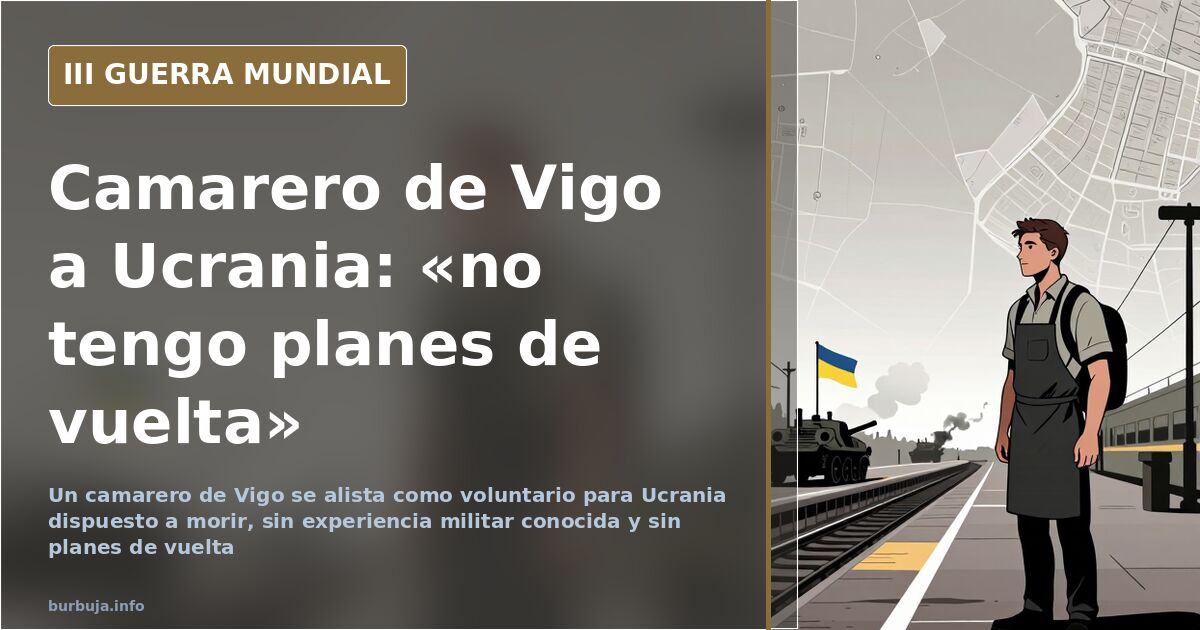
Vigo waiter heads to Ukraine: "no plans to return"
A waiter from Vigo has decided to swap serving tables in Spain for the possibility of dying in Ukraine. He enlisted as a volunteer in Ukrainian defense, stating he has no plans to return and will shoot if necessary. The story spread faster than verification, triggering reactions that say more about public sentiment than about him: few debate whether he will come back, while most question why he would leave.
The profile is simple. Waiter, resident of Vigo, middle-aged —roughly my age—, with no known military experience and one phrase summarizing the situation: he is willing to die. On a front where, as blunt comments repeat, untrained foreign volunteers are disposable material, this willingness is the key fact, not just context.
What is known about the Vigo waiter volunteering
Little, and what little exists comes from his own account. That he works in hospitality, is from Vigo, has enlisted, and accepts the worst outcome. There is no record of prior military service, training, or assigned unit. The question raised by nearly all responses is precisely this: what military experience does he have? As far as is known, none.
This creates the first clash of expectations. Those imagining a movie-hero destiny find a provincial waiter; those expecting a trained soldier find someone who has never been under fire. Some summarize it with irony: too many war movies and little understanding of real warfare. The gap between the self-perceived volunteer and the reality on the front is the core of the discussion.
Why enlist without military training?
Hypotheses abound. One line suggests disguised suicide wrapped in chivalric fantasy: someone who already considers themselves dead in life, merely choosing how to go. Another points to pure boredom: two years of struggling hospitality work, low wages, and a routine leading nowhere. A third, frequently repeated, reduces it to sentimental motives: trinc a woman.
None can be proven with available information. What is striking is that none are dismissed as implausible. When the true motive for such a decision admits such disparate explanations, the issue is not lack of information about the protagonist, but the abundance of certainties about the world he returns to if he stays.
What awaits an untrained volunteer at the front
The most widespread answer is that they do not last long. Circulating figures are hyperbolic —ten seconds of combat, one magazine and a rifle for a foreigner placed at the front— but highlight a real problem: according to descriptions, the international legion of volunteers is heterogeneous, poorly coordinated, and sometimes used as distraction fodder while trained units seek positions. That professionals with years of preparation suffer psychological damage is, as several participants recall, a recurring pattern in modern conflicts, with high rates of PTSD and suicide.
The second issue is exit. Some report that foreign volunteers wishing to leave faced obstacles, with some resorting to disguises —medical personnel, aid workers— to cross borders. The case of an Israeli volunteer who allegedly died after being mistaken for a fighter from another background is also cited. These are unverified accounts, but they paint the terrain: on that front, no passport guarantees a way back.
From hospitality to the front: perspectives
Many responses hide contempt, while others perform an uncomfortable symmetry exercise. If things were so bad in Spain, why not fight for rights there? If the gesture is solidarity, why choose the destination that generates the most headlines? The sharpest thesis is different: a country failing to offer a decent life project ends up exporting men willing to die far from home. This argument is not new, and rebutting it with employment or wage data is difficult.
Against this, the calmest defense points to consistency. Someone enlisting knowing they may not return is at least not deceiving themselves. It is a low bar, almost tragic, but it is the standard set. Others note that with peacetime salaries, many would not have said no to a better life.
What remains unknown
With current information, it is reasonable to expect the matter to fade in days, with no verification of whether he fired shots. Fading does not miccionan resolution: if he returns, he must explain why he went; if he does not, doubt remains whether he sought a front or an escape.
A waiter from Vigo has decided to swap serving tables in Spain for the possibility of dying in Ukraine. He enlisted as a volunteer in Ukrainian defense, stating he has no plans to return and will shoot if necessary. The story spread faster than verification, triggering reactions that say more about public sentiment than about him: few debate whether he will come back, while most question why he would leave.
The profile is simple. Waiter, resident of Vigo, middle-aged —roughly my age—, with no known military experience and one phrase summarizing the situation: he is willing to die. On a front where, as blunt comments repeat, untrained foreign volunteers are disposable material, this willingness is the key fact, not just context.
What is known about the Vigo waiter volunteering
Little, and what little exists comes from his own account. That he works in hospitality, is from Vigo, has enlisted, and accepts the worst outcome. There is no record of prior military service, training, or assigned unit. The question raised by nearly all responses is precisely this: what military experience does he have? As far as is known, none.
This creates the first clash of expectations. Those imagining a movie-hero destiny find a provincial waiter; those expecting a trained soldier find someone who has never been under fire. Some summarize it with irony: too many war movies and little understanding of real warfare. The gap between the self-perceived volunteer and the reality on the front is the core of the discussion.
Why enlist without military training?
Hypotheses abound. One line suggests disguised suicide wrapped in chivalric fantasy: someone who already considers themselves dead in life, merely choosing how to go. Another points to pure boredom: two years of struggling hospitality work, low wages, and a routine leading nowhere. A third, frequently repeated, reduces it to sentimental motives: trinc a woman.
None can be proven with available information. What is striking is that none are dismissed as implausible. When the true motive for such a decision admits such disparate explanations, the issue is not lack of information about the protagonist, but the abundance of certainties about the world he returns to if he stays.
What awaits an untrained volunteer at the front
The most widespread answer is that they do not last long. Circulating figures are hyperbolic —ten seconds of combat, one magazine and a rifle for a foreigner placed at the front— but highlight a real problem: according to descriptions, the international legion of volunteers is heterogeneous, poorly coordinated, and sometimes used as distraction fodder while trained units seek positions. That professionals with years of preparation suffer psychological damage is, as several participants recall, a recurring pattern in modern conflicts, with high rates of PTSD and suicide.
The second issue is exit. Some report that foreign volunteers wishing to leave faced obstacles, with some resorting to disguises —medical personnel, aid workers— to cross borders. The case of an Israeli volunteer who allegedly died after being mistaken for a fighter from another background is also cited. These are unverified accounts, but they paint the terrain: on that front, no passport guarantees a way back.
From hospitality to the front: perspectives
Many responses hide contempt, while others perform an uncomfortable symmetry exercise. If things were so bad in Spain, why not fight for rights there? If the gesture is solidarity, why choose the destination that generates the most headlines? The sharpest thesis is different: a country failing to offer a decent life project ends up exporting men willing to die far from home. This argument is not new, and rebutting it with employment or wage data is difficult.
Against this, the calmest defense points to consistency. Someone enlisting knowing they may not return is at least not deceiving themselves. It is a low bar, almost tragic, but it is the standard set. Others note that with peacetime salaries, many would not have said no to a better life.
What remains unknown
With current information, it is reasonable to expect the matter to fade in days, with no verification of whether he fired shots. Fading does not miccionan resolution: if he returns, he must explain why he went; if he does not, doubt remains whether he sought a front or an escape.
Also available in: Deutsch
Summary of a discussion on Burbuja.info - Foro de economía, actualidad y política., translated from Spanish and reviewed before publication. Read the full discussion (114 replies).
More summaries
-
Kherson adopts ruble, gives hryvnia four months
Pro-Russian Kherson administration sets May 1 for ruble adoption, phasing out the Ukrainian hryvnia within four months.
-
Ukraine Volunteers: From Call of Duty to the Polish Border
Spanish volunteer arrived at the Polish border in uniform to fight in Ukraine, only to return without crossing the line between video games and real war.
-
Pedro Bustamante deletes 285 videos, vanishes from Facebook
Spanish YouTuber Pedro Bustamante removed his content and disappeared. Rumors place him in Munich, reading German press.
-
Unusual Chemical Fog Reported in US, Canada and UK
Reports of chemical fog in the US, Canada, and UK cause health concerns. We analyze hypotheses on this unusual atmospheric phenomenon.
-
Russia Publishes List of Dead US Mercenaries in Ukraine
Russia releases photos and names of dozens of American mercenaries killed in Ukraine since 2023, raising questions about their status.
-
China’s African Debt Strategy Snubs Macron
Macron’s diplomatic snub highlights Africa’s shift toward Chinese financing, challenging Europe’s conditional aid and the CFA franc.