
Ukraine Volunteers: From Call of Duty to the Polish Border
Spanish volunteer arrived at the Polish border in uniform to fight in Ukraine, only to return without crossing the line between video games and real war.
English · Original discussion in Spanish · Published
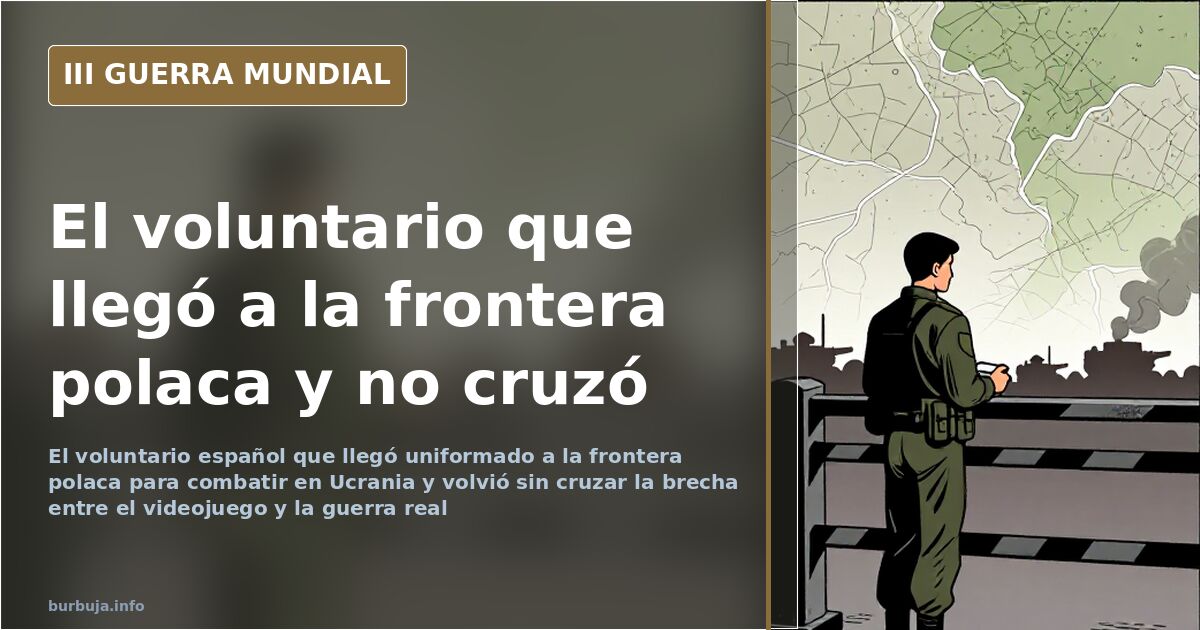
From the Living Room to the Front Lines: The Volunteer Who Returned Crying from the Polish Border
His name is David, and he appeared on television in campaign uniform, with a Ukrainian flag armband and the look of someone who had just signed up for their own movie. He was on the Polish side of the border, ready to cross and fight. Days later, he reappeared, having never entered, and the story quickly changed: it wasn't antiestéticar, he claimed, but that there was "so much to do" there. The scene, broadcast by Antena 3, encapsulates better than any report the reality check faced by foreign volunteers who went to Ukraine in the first weeks of the Russian invasion.
It's not a unique case, not even rare. What's striking is the profile: individuals who had internalized war through Call of Duty and discovered, with the first real bombing, that there's no pause button.
From Video Game to Front Line: The Shock No One Trains For
What these volunteers imagined was a shooter game: cover, respawn, clear objectives. What they found was artillery, missiles, and aircraft. A light infantry soldier with a rifle is powerless against real firepower. "Light infantry can do nothing against the firepower of artillery, missiles, aircraft, and tanks of a real army," summarizes one of the most lucid voices on the matter.
Added to this is the mundane: language. A volunteer who doesn't speak Ukrainian or Russian can barely coordinate with the regular army they claim to be helping. And military logistics are unforgiving: known bases, phones with GPS on, photographs that carry metadata without anyone noticing. In a war where the precision of bombings is everything, every piece of personal data is a potential coordinate.
Can a Spaniard Enlist to Fight in a Foreign War?
This is one of the questions surrounding the case, and it has two levels. The first is whether the state would detain them upon return. The second, much more uncomfortable, is what protection—legal, medical, diplomatic—someone has who goes on their own. The practical answer is none.
Spain does not recognize these volunteers as its own combatants nor does it extend ordinary consular coverage. If they fall, there is no guaranteed repatriation or pension. If they return, they return alone. Initial enthusiasm clashes with an administrative reality that no one explains to them before they get on the bus.
The Double Standard: Who Supports the War and Who Stays on the Sofa
The other axis is political. When the conflict broke out, calls for mobilization and patriotic speeches proliferated from offices and TV studios. The contrast with those who packed their bags is overwhelming, and that gap fuels an uncomfortable reproach: why don't the leaders waving the flag of resistance go to the barracks themselves?
The case of Santiago Abascal and his military service—or lack thereof—reappears cyclically in every discussion about proxy warfare. The contradiction is pointed out by opposing ideological trenches, and no slogan resolves it.
What Truly Throws Them Off
In the end, the data that breaks any narrative isn't how many crossed, but how many returned. The volunteer crying at the border isn't a comical anecdote: it's proof that the distance between a living room with a console and a trench under artillery fire isn't measured in kilometers, but in something no recruitment campaign teaches.
His name is David, and he appeared on television in campaign uniform, with a Ukrainian flag armband and the look of someone who had just signed up for their own movie. He was on the Polish side of the border, ready to cross and fight. Days later, he reappeared, having never entered, and the story quickly changed: it wasn't antiestéticar, he claimed, but that there was "so much to do" there. The scene, broadcast by Antena 3, encapsulates better than any report the reality check faced by foreign volunteers who went to Ukraine in the first weeks of the Russian invasion.
It's not a unique case, not even rare. What's striking is the profile: individuals who had internalized war through Call of Duty and discovered, with the first real bombing, that there's no pause button.
From Video Game to Front Line: The Shock No One Trains For
What these volunteers imagined was a shooter game: cover, respawn, clear objectives. What they found was artillery, missiles, and aircraft. A light infantry soldier with a rifle is powerless against real firepower. "Light infantry can do nothing against the firepower of artillery, missiles, aircraft, and tanks of a real army," summarizes one of the most lucid voices on the matter.
Added to this is the mundane: language. A volunteer who doesn't speak Ukrainian or Russian can barely coordinate with the regular army they claim to be helping. And military logistics are unforgiving: known bases, phones with GPS on, photographs that carry metadata without anyone noticing. In a war where the precision of bombings is everything, every piece of personal data is a potential coordinate.
Can a Spaniard Enlist to Fight in a Foreign War?
This is one of the questions surrounding the case, and it has two levels. The first is whether the state would detain them upon return. The second, much more uncomfortable, is what protection—legal, medical, diplomatic—someone has who goes on their own. The practical answer is none.
Spain does not recognize these volunteers as its own combatants nor does it extend ordinary consular coverage. If they fall, there is no guaranteed repatriation or pension. If they return, they return alone. Initial enthusiasm clashes with an administrative reality that no one explains to them before they get on the bus.
The Double Standard: Who Supports the War and Who Stays on the Sofa
The other axis is political. When the conflict broke out, calls for mobilization and patriotic speeches proliferated from offices and TV studios. The contrast with those who packed their bags is overwhelming, and that gap fuels an uncomfortable reproach: why don't the leaders waving the flag of resistance go to the barracks themselves?
The case of Santiago Abascal and his military service—or lack thereof—reappears cyclically in every discussion about proxy warfare. The contradiction is pointed out by opposing ideological trenches, and no slogan resolves it.
What Truly Throws Them Off
In the end, the data that breaks any narrative isn't how many crossed, but how many returned. The volunteer crying at the border isn't a comical anecdote: it's proof that the distance between a living room with a console and a trench under artillery fire isn't measured in kilometers, but in something no recruitment campaign teaches.
Summary of a discussion on Burbuja.info - Foro de economía, actualidad y política., translated from Spanish and reviewed before publication. Read the full discussion (103 replies).
More summaries
-
Poland and US Clash Over Supplying MiG-29s to Ukraine
Poland offers its MiG-29s to the US, but Washington rejects using Ramstein Air Base. The origin of each flight sparks debate over a casus belli.
-
Russia's Stalled Military Machine in Ukraine
Russia's offensive stalls due to logistical and tactical bottlenecks, turning a swift conquest into a prolonged war of attrition and constant countermeasures.
-
Ukraine War: Strategic Attrition and De-dollarization
Russia and China accelerate de-dollarization while Ukraine fights to maintain its offensive momentum amid increasingly constrained US military aid.
-
Ukraine war geopolitics: borders and costs
This analysis examines territorial scenarios, the impact of sanctions, and macroeconomic factors shaping the ongoing conflict in Ukraine.
-
Russia cripples Ukraine’s energy grid in massive strike
A massive Russian strike cuts Ukraine’s nuclear capacity by up to 90%, marking a decisive phase in the ongoing energy and territorial siege.
-
Ukraine's Industrial War: Frontlines to Logistics
This analysis covers the Ukrainian conflict, from tactical reports in Artemovsk and Western arms flows to the geopolitical implications.