
Spanish Volunteer in Ukraine Says He Cannot Leave
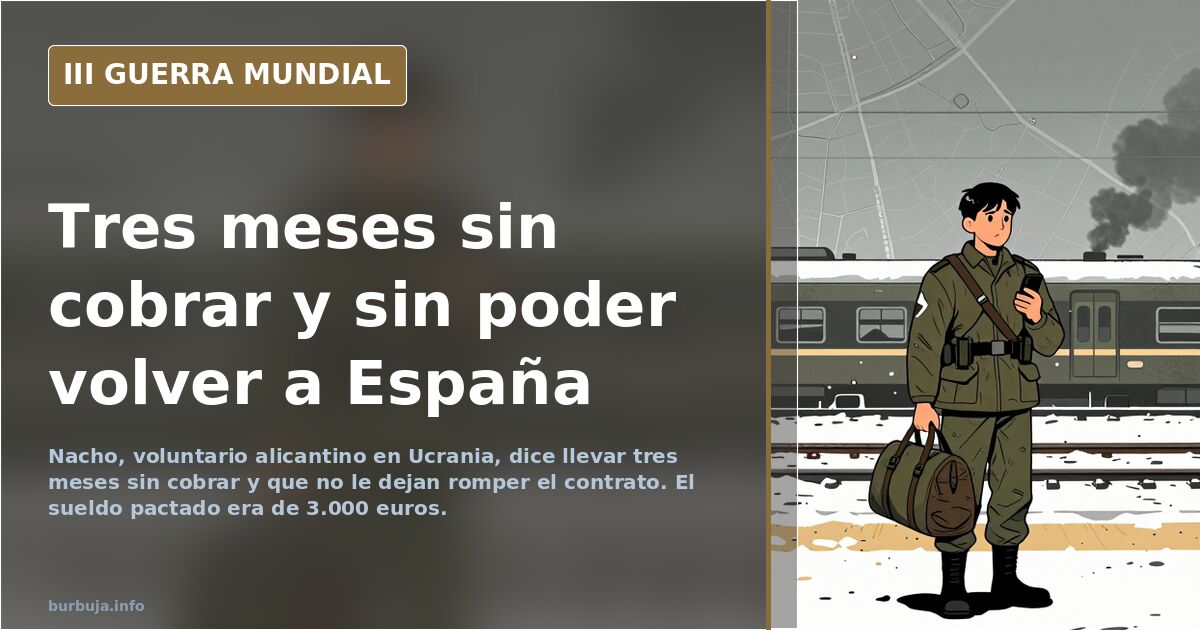
Nacho, a volunteer from Alicante serving in Ukraine's Territorial Defense, claims he has gone unpaid for three months and is barred from terminating his contract.
English · Original discussion in Spanish · Published
Spanish Volunteer in Ukraine Says He Cannot Leave
One phrase sums up the situation better than any report: "I came to fight, not to commit suicide." This is what Nacho, a Spaniard from Alicante enlisted in Ukraine’s Territorial Defense forces, says. According to his testimony, he has not been paid for three months, lives in a camp without drinking water, eats expired food, and his unit refuses to let him break his contract to return to Spain. He is not missing; he is located, living in conditions he describes as destitute, after being moved there by the 241st Brigade.
This story is not an isolated case, which is why it matters. The narrative that drove many foreigners to enlist—the romanticized war, the noble cause, the promised salary—collides with trench reality: a lack of drone jammers, no shotguns to neutralize them, poorly prepared positions, and artillery punishing every movement. The contract specified 120,000 hryvnias per month, roughly €3,000, for frontline combat. In Kurakhove, they were told it would be 70,000.
What the Contract Says vs. What Is Actually Paid
Paperwork and practice do not match. According to his own account, the initial agreement set this monthly pay of 120,000 hryvnias for those fighting on the front line, a figure designed to attract foreign recruits with an incentive hard to match in Spain. On the ground, the reality is 70,000 hryvnias, and even that does not arrive regularly. Three months without a paycheck is the fact he highlights.
Some argue the problem is not just non-payment, but design: recruitment happens through economic promises, while retention relies on administrative impossibility of termination. According to his version, Ukraine’s Territorial Defense forces will not allow him to break the contract, despite his belief that he has the right to resign. The dispute, therefore, is not just about money. It is about exit.
Insufficient Equipment and Russian Drones: Frontline Account
His description of his unit is that of an army improvising. There was no rescue equipment for the wounded. There were no anti-drone measures: neither jammers nor shotguns to neutralize the devices. Trench positions were scarce and poorly prepared, mere holes exposed to surveillance and attacks by Russian drones. "It was going straight to die," he summarizes.
This is the core of his regret. It is not that he discovered war kills; it is that he discovered war, in his sector, is fought without the minimum means to survive. The constant threat of drone warfare and glide bombs falling daily paints a scenario where survival depends less on training than on position.
Regret and the Impossibility of Returning
Nacho’s case has been read as evidence of the deception faced by those who arrive with misguided expectations. The image he conveys—a conditioned camp, no drinking water, expired food—is that of someone held back more by bureaucracy than by combat. He wants to return. His unit does not authorize it.
In the analysis circulating, there is an uncomfortable consensus: many of these foreign volunteers end up used as cannon fodder, poorly equipped and with insufficient ammunition, in maneuvers described as absurd and suicidal. This is not a comfortable thesis for the official narrative, but it aligns with the grievance of the person involved.
With these elements, it is predictable that the trickle of similar cases will continue as long as the conflict remains open and recruitment conditions do not change. What is not written down is how many of those contracts will be resolved administratively and how many through the path no one signs.
One phrase sums up the situation better than any report: "I came to fight, not to commit suicide." This is what Nacho, a Spaniard from Alicante enlisted in Ukraine’s Territorial Defense forces, says. According to his testimony, he has not been paid for three months, lives in a camp without drinking water, eats expired food, and his unit refuses to let him break his contract to return to Spain. He is not missing; he is located, living in conditions he describes as destitute, after being moved there by the 241st Brigade.
This story is not an isolated case, which is why it matters. The narrative that drove many foreigners to enlist—the romanticized war, the noble cause, the promised salary—collides with trench reality: a lack of drone jammers, no shotguns to neutralize them, poorly prepared positions, and artillery punishing every movement. The contract specified 120,000 hryvnias per month, roughly €3,000, for frontline combat. In Kurakhove, they were told it would be 70,000.
What the Contract Says vs. What Is Actually Paid
Paperwork and practice do not match. According to his own account, the initial agreement set this monthly pay of 120,000 hryvnias for those fighting on the front line, a figure designed to attract foreign recruits with an incentive hard to match in Spain. On the ground, the reality is 70,000 hryvnias, and even that does not arrive regularly. Three months without a paycheck is the fact he highlights.
Some argue the problem is not just non-payment, but design: recruitment happens through economic promises, while retention relies on administrative impossibility of termination. According to his version, Ukraine’s Territorial Defense forces will not allow him to break the contract, despite his belief that he has the right to resign. The dispute, therefore, is not just about money. It is about exit.
Insufficient Equipment and Russian Drones: Frontline Account
His description of his unit is that of an army improvising. There was no rescue equipment for the wounded. There were no anti-drone measures: neither jammers nor shotguns to neutralize the devices. Trench positions were scarce and poorly prepared, mere holes exposed to surveillance and attacks by Russian drones. "It was going straight to die," he summarizes.
This is the core of his regret. It is not that he discovered war kills; it is that he discovered war, in his sector, is fought without the minimum means to survive. The constant threat of drone warfare and glide bombs falling daily paints a scenario where survival depends less on training than on position.
Regret and the Impossibility of Returning
Nacho’s case has been read as evidence of the deception faced by those who arrive with misguided expectations. The image he conveys—a conditioned camp, no drinking water, expired food—is that of someone held back more by bureaucracy than by combat. He wants to return. His unit does not authorize it.
In the analysis circulating, there is an uncomfortable consensus: many of these foreign volunteers end up used as cannon fodder, poorly equipped and with insufficient ammunition, in maneuvers described as absurd and suicidal. This is not a comfortable thesis for the official narrative, but it aligns with the grievance of the person involved.
With these elements, it is predictable that the trickle of similar cases will continue as long as the conflict remains open and recruitment conditions do not change. What is not written down is how many of those contracts will be resolved administratively and how many through the path no one signs.
Summary of a discussion on Burbuja.info - Foro de economía, actualidad y política., translated from Spanish and reviewed before publication. Read the full discussion (187 replies).
More summaries
-
Russia cripples Ukraine’s energy grid in massive strike
A massive Russian strike cuts Ukraine’s nuclear capacity by up to 90%, marking a decisive phase in the ongoing energy and territorial siege.
-
Russia advances in Donbas, targeting Pokrovsk
Russian forces capture settlements near Pokrovsk and the Donbas as European support costs and war fatigue mount.
-
Putin Offers Ceasefire if Ukraine Cedes Donbas and Drops NATO Bid
Putin proposes a ceasefire contingent on Ukrainian withdrawal from the Donbas and renouncing NATO membership. Nuclear threats, economic disparities, and US politics shape the debate.
-
Was Franco undefeated in battle? Forum debate
A forum thread discusses whether General Franco ever lost a battle, citing Madrid 1936 and the Ebro. The debate spans 184 replies.
-
Rallo backs secession right but demands legal process
Juan Ramón Rallo supports the right to secede and criticizes Spain's constitution, but insists on following legal procedures to avoid breaking constitutional order.
-
Unverified video shows Ukrainian colonel detained in Odesa
A video allegedly showing a National Guard colonel detained in an Odesa hotel basement remains unverified, sparking debate over military discipline and propaganda.