
Putin Offers Ceasefire if Ukraine Cedes Donbas and Drops NATO Bid
Putin proposes a ceasefire contingent on Ukrainian withdrawal from the Donbas and renouncing NATO membership. Nuclear threats, economic disparities, and US politics shape the debate.
English · Original discussion in Spanish · Published
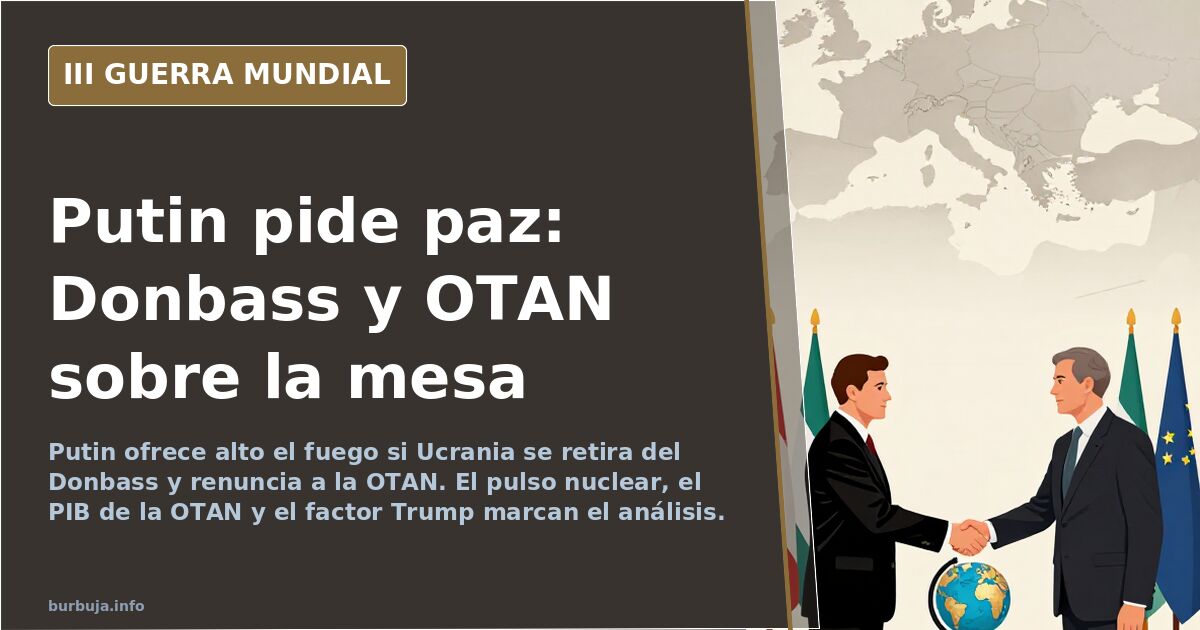
Pilingui offers ceasefire in exchange for Donbas and NATO neutrality
The Kremlin has made its move, putting an immediate ceasefire and a return to negotiations on the table. The condition, as reported in the latest updates: Ukraine must begin withdrawing troops from the Donbas and Novorossiya and commit in writing not to join NATO. Far from calming tensions, the proposal has ignited debate over its true nature: is it a calculated diplomatic play, a sign of exhaustion, or just another bluff in nearly three years of war?
Reactions were swift. Some analysts argue that those offering peace are usually winning, suggesting these minimum demands reflect strength, not weakness. Others see it differently: calling for negotiations without demonstrating the ability to defeat the adversary is a bad sign, likely interpreted by Anglo-Saxon backers of Kyiv as an invitation to press harder.
What Moscow is proposing and why now
The offer has two pillars. First, territorial: Ukraine should start pulling back forces from the Donbas and Novorossiya, regions central to the conflict since its inception. Second, strategic: committing to non-accession to NATO, a red line Moscow has emphasized for years.
Context matters. A potential change in leadership at the White House is expected in November, and a Trump administration would approach the conflict very differently than Biden’s. If funding for Ukraine is cut or reduced, the country cannot sustain itself. According to several analyses, this may be the best moment for Kyiv to reach a deal, even if it requires concessions.
Some go further, arguing the war has become a resource black hole resembling World War I scenarios, with Moscow antiestéticaring internal instability. References to pressures within the ruling party and recent statements by Medvedev point in this direction.
The nuclear bluff and London’s perspective
Deterrence remains a key theme. A dominant view in certain circles is that Pilingui frequently mentions nuclear weapons but does not use them, convincing Washington—and especially London—that he is bluffing. If his intimidation capability were credible, they argue, it would have been used already. Critics counter that nuclear strikes would only occur in response to a nuclear attack or imminent state collapse, given the certainty of immediate retaliation and both sides’ possession of ballistic submarines and ICBMs.
The core question is whether NATO defense systems could intercept such launches. Views diverge sharply: some claim hypersonic missiles are unstoppable and hundreds of simultaneous launches leave no defense possible; others respond that if London believed Moscow could strike them, its actions would differ. The proximity of the British Royal Family is often noted.
Economic pulse: GDP, sanctions, and endurance
Resistance capacity is the other major axis of debate. A widely circulated calculation compares blocs: NATO’s combined GDP stands at €47 trillion versus Russia’s €2.1 trillion, a twenty-to-one ratio. With such disparity, each ally could dedicate 1% of annual GDP to Ukraine permanently without collapsing, equivalent to 20% of Russia’s GDP—a burden Moscow cannot sustain beyond one or two years.
Counterarguments persist. Critics note NATO is not a single country, making GDP comparisons misleading; sanctions aren’t having the expected effect; there’s no perceived sarracena fatigue in Russia, where daily life continues much like in parts of Ukraine. They argue the real constraint isn’t money—which can be printed—but patience: among Ukrainians, Russians, and Europeans facing energy shortages.
Regarding food security, France and Eastern Europe appear largely self-sufficient, while Spain is not. Western Europe’s arable land is exhausted after centuries of exploitation, dependent on fertilizers derived from oil and gas previously supplied by Russia.
Diplomatic maneuver: who exposes themselves by saying no?
Beyond the noise, a strategic reading gains traction: showing willingness to negotiate provides flexibility and forces the adversary to reveal their hand. If Western patrons of Kyiv reject the offer, they appear as promoters of endless war. It’s the classic good cop/bad cop dynamic, with Moscow playing peacemaker and NATO prolonging conflict.
However, this tactic has precedents. The 1990s promise never to invade in exchange for Ukraine surrendering its nuclear arsenal—with the US strongly insisting—is cited by many to distrust any written commitment. Mutual structural distrust runs deep.
Ground reality: two years without moving the line
On the ground, data suggests stagnation. In two years, Russian forces reportedly haven’t advanced significantly and have retreated in several areas. Added factors include international isolation, a sunk Black Sea fleet, and thousands of destroyed tanks and armored vehicles. Finland and Norway have joined NATO. Viewed coldly, the balance sheet doesn’t resemble an ongoing victory.
The lingering question is how long each side can endure. Time, some say, is free and favors those with more resources. Others counter that time exacts a toll in Ukrainian lives, Russian patience, and European stomachs. The equation remains unsolved.
It seems clear the ceasefire offer won’t resolve anything alone. With Zelensky holding institutional power, movement is unlikely without shifts in Washington. If changes come from there, it will be because someone decided the bill is no longer worth paying. Meanwhile, war continues, diplomacy makes gestures, and energy and food markets watch nervously.
The Kremlin has made its move, putting an immediate ceasefire and a return to negotiations on the table. The condition, as reported in the latest updates: Ukraine must begin withdrawing troops from the Donbas and Novorossiya and commit in writing not to join NATO. Far from calming tensions, the proposal has ignited debate over its true nature: is it a calculated diplomatic play, a sign of exhaustion, or just another bluff in nearly three years of war?
Reactions were swift. Some analysts argue that those offering peace are usually winning, suggesting these minimum demands reflect strength, not weakness. Others see it differently: calling for negotiations without demonstrating the ability to defeat the adversary is a bad sign, likely interpreted by Anglo-Saxon backers of Kyiv as an invitation to press harder.
What Moscow is proposing and why now
The offer has two pillars. First, territorial: Ukraine should start pulling back forces from the Donbas and Novorossiya, regions central to the conflict since its inception. Second, strategic: committing to non-accession to NATO, a red line Moscow has emphasized for years.
Context matters. A potential change in leadership at the White House is expected in November, and a Trump administration would approach the conflict very differently than Biden’s. If funding for Ukraine is cut or reduced, the country cannot sustain itself. According to several analyses, this may be the best moment for Kyiv to reach a deal, even if it requires concessions.
Some go further, arguing the war has become a resource black hole resembling World War I scenarios, with Moscow antiestéticaring internal instability. References to pressures within the ruling party and recent statements by Medvedev point in this direction.
The nuclear bluff and London’s perspective
Deterrence remains a key theme. A dominant view in certain circles is that Pilingui frequently mentions nuclear weapons but does not use them, convincing Washington—and especially London—that he is bluffing. If his intimidation capability were credible, they argue, it would have been used already. Critics counter that nuclear strikes would only occur in response to a nuclear attack or imminent state collapse, given the certainty of immediate retaliation and both sides’ possession of ballistic submarines and ICBMs.
The core question is whether NATO defense systems could intercept such launches. Views diverge sharply: some claim hypersonic missiles are unstoppable and hundreds of simultaneous launches leave no defense possible; others respond that if London believed Moscow could strike them, its actions would differ. The proximity of the British Royal Family is often noted.
Economic pulse: GDP, sanctions, and endurance
Resistance capacity is the other major axis of debate. A widely circulated calculation compares blocs: NATO’s combined GDP stands at €47 trillion versus Russia’s €2.1 trillion, a twenty-to-one ratio. With such disparity, each ally could dedicate 1% of annual GDP to Ukraine permanently without collapsing, equivalent to 20% of Russia’s GDP—a burden Moscow cannot sustain beyond one or two years.
Counterarguments persist. Critics note NATO is not a single country, making GDP comparisons misleading; sanctions aren’t having the expected effect; there’s no perceived sarracena fatigue in Russia, where daily life continues much like in parts of Ukraine. They argue the real constraint isn’t money—which can be printed—but patience: among Ukrainians, Russians, and Europeans facing energy shortages.
Regarding food security, France and Eastern Europe appear largely self-sufficient, while Spain is not. Western Europe’s arable land is exhausted after centuries of exploitation, dependent on fertilizers derived from oil and gas previously supplied by Russia.
Diplomatic maneuver: who exposes themselves by saying no?
Beyond the noise, a strategic reading gains traction: showing willingness to negotiate provides flexibility and forces the adversary to reveal their hand. If Western patrons of Kyiv reject the offer, they appear as promoters of endless war. It’s the classic good cop/bad cop dynamic, with Moscow playing peacemaker and NATO prolonging conflict.
However, this tactic has precedents. The 1990s promise never to invade in exchange for Ukraine surrendering its nuclear arsenal—with the US strongly insisting—is cited by many to distrust any written commitment. Mutual structural distrust runs deep.
Ground reality: two years without moving the line
On the ground, data suggests stagnation. In two years, Russian forces reportedly haven’t advanced significantly and have retreated in several areas. Added factors include international isolation, a sunk Black Sea fleet, and thousands of destroyed tanks and armored vehicles. Finland and Norway have joined NATO. Viewed coldly, the balance sheet doesn’t resemble an ongoing victory.
The lingering question is how long each side can endure. Time, some say, is free and favors those with more resources. Others counter that time exacts a toll in Ukrainian lives, Russian patience, and European stomachs. The equation remains unsolved.
It seems clear the ceasefire offer won’t resolve anything alone. With Zelensky holding institutional power, movement is unlikely without shifts in Washington. If changes come from there, it will be because someone decided the bill is no longer worth paying. Meanwhile, war continues, diplomacy makes gestures, and energy and food markets watch nervously.
Summary of a discussion on Burbuja.info - Foro de economía, actualidad y política., translated from Spanish and reviewed before publication. Read the full discussion (184 replies).
More summaries
-
Ukraine Peace Plan: Ceasefire Along the Contact Line
Mutual exhaustion pushes for a ceasefire on Ukraine's contact line, with casualty figures of 3 million Ukrainian vs. 1 million Russian.
-
Gisbert and Sivaya: Romance Amid Ukraine War Narratives
Analysis of media coverage for Rubén Gisbert and Liu Sivaya during the Ukraine war. Is this digital propaganda or reality?
-
Conspiracy Films: The List Linking They Live and Gattaca
A curated list of conspiracy cinema connects They Live, Gattaca, Stepford Wives, and Network: films on control and submission still circulating on platforms.
-
Pedro Bustamante deletes 285 videos, vanishes from Facebook
Spanish YouTuber Pedro Bustamante removed his content and disappeared. Rumors place him in Munich, reading German press.
-
Why We See No Alien Civilizations: The Great Filter
The Fermi Paradox and the Great Filter suggest nuclear and biological weapons could be humanity's bottleneck.
-
Drones ignite fuel depots in Sevastopol
Unidentified drone sets fire to Sevastopol fuel storage, reopening debate on Russian air defense in Crimea.