
Spanish social worker insults locals, sparking migration debate
A Venezuelan social worker at Las Raíces migrant center in Tenerife called locals lazy, igniting fierce debate on immigration and labor.
English · Original discussion in Spanish · Published
Spanish social worker insults locals, sparking migration debate
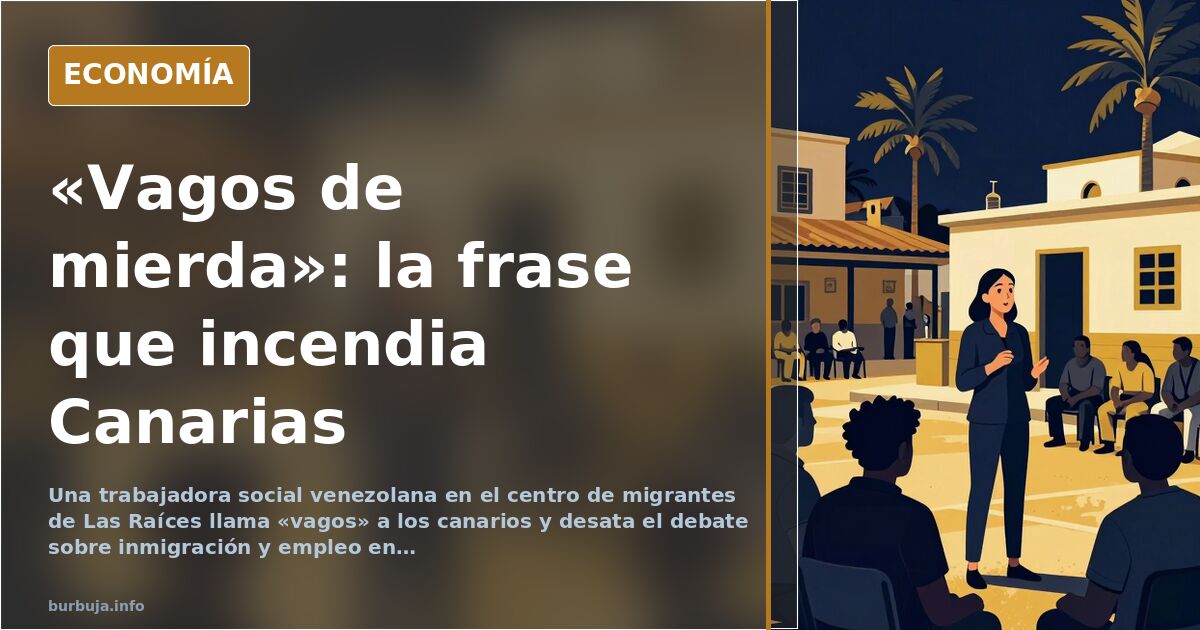
A Venezuelan-born social worker employed at the Las Raíces migrant reception center in Tenerife allegedly called locals "lazy bastards" in a video circulating on social media. The phrase, shared via a viral tweet with thousands of views, has intensified discussions on immigration, tourism, and the labor market in the Canary Islands. This is not an isolated incident but the spark for a deeper conflict over who works, who gets paid, and who bears the cost.
The Las Raíces center serves as a reception camp for migrants arriving in the Canaries. The woman antiestéticatured in the video worked there. Her claim that "everything is business" and that locals are lazy sparked outrage among some residents, while others quietly agreed. The controversy reveals the tension between a local population feeling displaced and an asylum system perceived by critics as a lucrative industry.
The asylum business: Who profits from migrants?
The video does more than insult; it accuses. The social worker claims that "everything is business" at Las Raíces. This resonates with those who have long argued that migration management has become just another economic sector. Some assert that reception centers generate jobs and public contracts, explaining why they remain open. Others counter that these facilities are the only viable humanitarian response to mass arrivals.
The debate quickly shifts to the labor market. Critics argue that migrants accept conditions locals reject, driving down wages and increasing precariousness. Supporters of this view claim employers seek cheap labor willing to work for less, resulting in labor dumping that harms everyone.
Canarians and Venezuelans: A clash of diasporas
There is historical irony here: For decades, the Canary Islands were a land of emigration. Thousands of Canarians moved to Venezuela seeking work. Now, their descendants arrive in the islands fleeing the Venezuelan crisis. This reversal has turned the debate into a historical reckoning. Some recall that Canarians who migrated to Venezuela "died of hunger and did not return rich," a sentiment circulating widely online.
Responses have been swift. Others argue that current Venezuelan arrivals also do not come primarily to work, complaining about locals while relying on state aid. Tensions between both groups are real, fueled by mutual stereotypes, creating a vicious cycle of blame that solves nothing.
Tourism and oil: Untapped resources in the Canaries
Part of the discussion focuses on natural resources. While the Canaries rely on tourism, some messages suggest the islands fail to exploit other wealth sources, such as oil. "They don't want tourism, they don't want oil, they won't move if invaded," summarizes one widely shared comment. The underlying idea is that the Canaries could be more prosperous if politicians did not keep the population dependent on subsidies.
This narrative clashes with the reality of an archipelago where sunshine is the primary—and almost sole—resource. Dependence on tourism is absolute, making the islands vulnerable to global crises. The lingering question is whether the Canaries have an alternative economic model or are doomed to rely solely on visitors.
Figures no one wants to examine
The debate is filled with scattered data. It mentions 5,000 people entering weekly by small boats (cayucos) and 2,000 via other routes. There are references to part-time contracts below minimum wage and claims that employers prefer hiring migrants due to lower demands. Memories persist that Canarians who once emigrated to Venezuela did not return wealthy.
Critics argue what is missing is a serious analysis of actual figures: how many migrants arrive, work, contribute socially, and receive aid. Without this data, the debate remains a war of impressions. Meanwhile, the social worker's insult continues to circulate.
Is the outrage over an insult or a symptom of something deeper? As always, the answer depends on whom you ask.
A Venezuelan-born social worker employed at the Las Raíces migrant reception center in Tenerife allegedly called locals "lazy bastards" in a video circulating on social media. The phrase, shared via a viral tweet with thousands of views, has intensified discussions on immigration, tourism, and the labor market in the Canary Islands. This is not an isolated incident but the spark for a deeper conflict over who works, who gets paid, and who bears the cost.
The Las Raíces center serves as a reception camp for migrants arriving in the Canaries. The woman antiestéticatured in the video worked there. Her claim that "everything is business" and that locals are lazy sparked outrage among some residents, while others quietly agreed. The controversy reveals the tension between a local population feeling displaced and an asylum system perceived by critics as a lucrative industry.
The asylum business: Who profits from migrants?
The video does more than insult; it accuses. The social worker claims that "everything is business" at Las Raíces. This resonates with those who have long argued that migration management has become just another economic sector. Some assert that reception centers generate jobs and public contracts, explaining why they remain open. Others counter that these facilities are the only viable humanitarian response to mass arrivals.
The debate quickly shifts to the labor market. Critics argue that migrants accept conditions locals reject, driving down wages and increasing precariousness. Supporters of this view claim employers seek cheap labor willing to work for less, resulting in labor dumping that harms everyone.
Canarians and Venezuelans: A clash of diasporas
There is historical irony here: For decades, the Canary Islands were a land of emigration. Thousands of Canarians moved to Venezuela seeking work. Now, their descendants arrive in the islands fleeing the Venezuelan crisis. This reversal has turned the debate into a historical reckoning. Some recall that Canarians who migrated to Venezuela "died of hunger and did not return rich," a sentiment circulating widely online.
Responses have been swift. Others argue that current Venezuelan arrivals also do not come primarily to work, complaining about locals while relying on state aid. Tensions between both groups are real, fueled by mutual stereotypes, creating a vicious cycle of blame that solves nothing.
Tourism and oil: Untapped resources in the Canaries
Part of the discussion focuses on natural resources. While the Canaries rely on tourism, some messages suggest the islands fail to exploit other wealth sources, such as oil. "They don't want tourism, they don't want oil, they won't move if invaded," summarizes one widely shared comment. The underlying idea is that the Canaries could be more prosperous if politicians did not keep the population dependent on subsidies.
This narrative clashes with the reality of an archipelago where sunshine is the primary—and almost sole—resource. Dependence on tourism is absolute, making the islands vulnerable to global crises. The lingering question is whether the Canaries have an alternative economic model or are doomed to rely solely on visitors.
Figures no one wants to examine
The debate is filled with scattered data. It mentions 5,000 people entering weekly by small boats (cayucos) and 2,000 via other routes. There are references to part-time contracts below minimum wage and claims that employers prefer hiring migrants due to lower demands. Memories persist that Canarians who once emigrated to Venezuela did not return wealthy.
Critics argue what is missing is a serious analysis of actual figures: how many migrants arrive, work, contribute socially, and receive aid. Without this data, the debate remains a war of impressions. Meanwhile, the social worker's insult continues to circulate.
Is the outrage over an insult or a symptom of something deeper? As always, the answer depends on whom you ask.
Also available in: Deutsch
Summary of a discussion on Burbuja.info - Foro de economía, actualidad y política., translated from Spanish and reviewed before publication. Read the full discussion (131 replies).
More summaries
-
Immigrants disillusioned with Spain: low wages and high living costs
Foreigners arriving in Spain face low salaries, high living costs and cultural issues. The promise of a paradise fades.
-
Woman dies after fall from Logroño apartment
A woman died falling from an apartment in Logroño. Police rule out third-party involvement but have not clarified the cause of death.
-
Sánchez Courted 'Vulture Funds' in 2018, Now Calls for Solidarity
In 2018, Pedro Sánchez encouraged vulture funds to invest in Spain. Now, his government urges landlords to show solidarity and lower rents.
-
Video of father hitting daughter reignites debate on parental discipline in Spain
A viral video shows a father striking his teenage daughter for bringing boys home, sparking renewed controversy over physical punishment and parental authority.
-
Sánchez Dragó Family Sells Rural Home in Spain for €180,000
The Sánchez Dragó family lists a stone house in Castilfrío, Soria (Spain), for €180,000 amid valuations of €50,000-€60,000.
-
Mastropietro Case Reignites Spain's Migration Debate
The 2018 murder of Pamela Mastropietro in Italy, which resulted in a life sentence, has resurfaced in Spanish public discourse on immigration.