
Woman dies after fall from Logroño apartment
A woman died falling from an apartment in Logroño. Police rule out third-party involvement but have not clarified the cause of death.
English · Original discussion in Spanish · Published
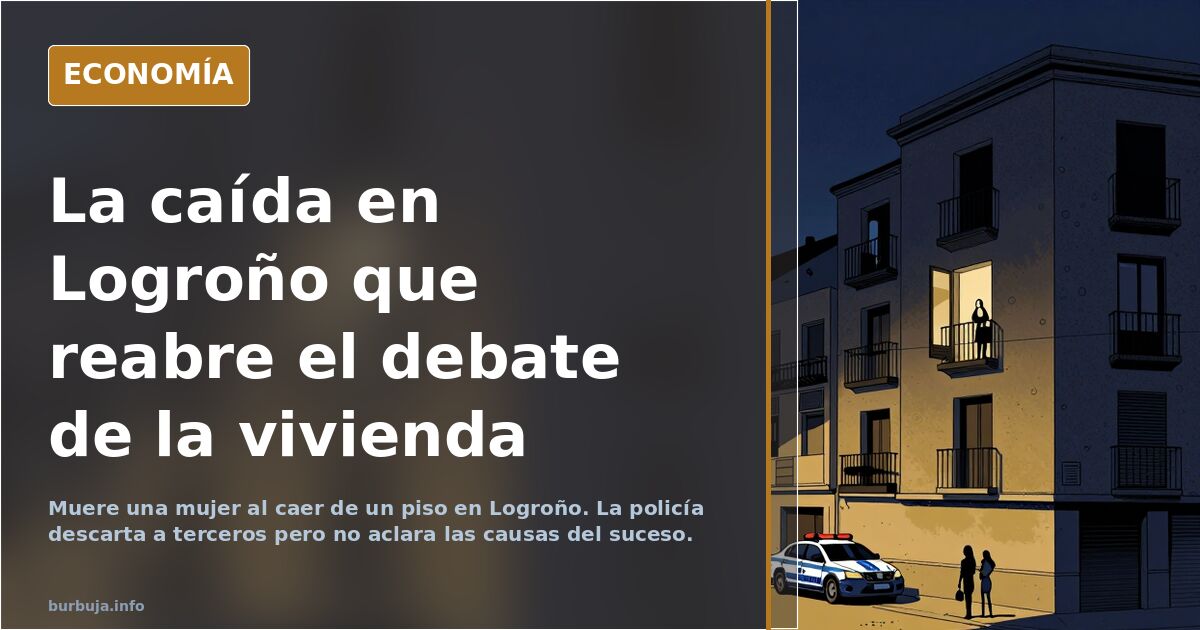
Fatal fall reignites debate over emancipation housing
A woman fell to her death from an apartment in central Logroño. The Policía Nacional (Spanish National Police) ruled out third-party involvement while keeping the investigation open, as the causes remain unclear. These two statements come from the same report, and this apparent contradiction sparked controversy.
The initial argument is blunt: it mocks those who label any suspicion as racist, treating doubt about the official account as a crime of opinion. Don't assume she was pushed. From there, the discussion shifts to broader, less uncomfortable ground: who occupies which housing, who pays, and with what funds.
Why did police rule out foul play if the cause is unknown?
Because these are two different issues. The investigation into the circumstances of the death remains open, while the hypothesis of external intervention is considered closed. The coexistence of these two statements in one paragraph is exactly what draws criticism.
Some argue that saying "causes are unknown" alongside "third parties are ruled out" cannot stand without explaining the basis for the exclusion. The most common complaint targets the estimulante ilegal: the conclusion was reached in barely a day, before any forensic analysis was known. There is no technical detail available to verify this claim. When a case is closed at the top before being peine at the bottom, distrust quickly emerges.
Who was the victim and where did it happen?
According to circulating reports, the deceased was a social worker affiliated with Cruz Roja (Red Cross). This role, working within the aid system, makes the incident more than just local news.
The apartment is located, according to these accounts, in one of Logroño's most expensive areas, a property many residents could not afford. The detail that incites anger is not where she fell, but who had been given that housing. Here, individual tragedy becomes a thermometer for dissatisfaction with housing access.
What is emancipation housing?
In the debate, emancipation housing is presented as accommodations often occupied by migrant populations, which some sarcastically call cuckoo nests.
The label is harsh. However, it expresses concrete discontent: the feeling that public or subsidized housing does not reach locals. This complaint reappears in every city with rental pressure, and Logroño has simply put it back on the table.
The million salaries attributed to the third sector
The most cited figure is round: one million people allegedly receive salaries from non-governmental organizations. The distinction emphasized is that these are employee wages, not aid. The data is attributed to the entities themselves and arrives without breakdowns for verification.
From this springs the reproach regarding the social sector's role in reception: workers processing benefits, finding accommodation, and channeling services for newcomers. It is advisable not to mix two things—the volume of employment in the third sector and the final destination of their programs—though collective anger tends to fuse them.
The fine print of death statistics
One of the most uncomfortable points. It is argued that in Spain, a death is only counted as suicide if there is explicit evidence of intent; otherwise, it may be registered under another label. If true, the official picture would be altered.
The comparison launched is with Northern European countries, where equivalent evidence would be classified as such. The implicit conclusion—that there are more cases than recorded—is a hypothesis, not verified data, and should be read as such. Classifying a death is never a neutral procedure.
Double standard in coverage
The discomfort is not just about what peine, but how much it is discussed. The complaint is about the informational double standard: an incident with a victim and a suspect of a specific profile fills headlines for weeks; another, with roles reversed, barely merits a brief.
This is the old suspicion of media selectivity, impossible to prove in the abstract but easier to infer by comparing airtime. No newsroom will admit it. But anyone can compare headlines themselves, and this perception of grievance fuels much of the anger.
Where the case stalls
The matter remains exactly where the note left it: unknown causes, open investigation, third parties ruled out. Without resolution or public forensics, each side fills the gap with what they already believed before reading the news. Those calling for prudence and those demanding explanations haven't moved a millimeter. Until the truth is clarified, the only achievable agreement is that there is no agreement.
A woman fell to her death from an apartment in central Logroño. The Policía Nacional (Spanish National Police) ruled out third-party involvement while keeping the investigation open, as the causes remain unclear. These two statements come from the same report, and this apparent contradiction sparked controversy.
The initial argument is blunt: it mocks those who label any suspicion as racist, treating doubt about the official account as a crime of opinion. Don't assume she was pushed. From there, the discussion shifts to broader, less uncomfortable ground: who occupies which housing, who pays, and with what funds.
Why did police rule out foul play if the cause is unknown?
Because these are two different issues. The investigation into the circumstances of the death remains open, while the hypothesis of external intervention is considered closed. The coexistence of these two statements in one paragraph is exactly what draws criticism.
Some argue that saying "causes are unknown" alongside "third parties are ruled out" cannot stand without explaining the basis for the exclusion. The most common complaint targets the estimulante ilegal: the conclusion was reached in barely a day, before any forensic analysis was known. There is no technical detail available to verify this claim. When a case is closed at the top before being peine at the bottom, distrust quickly emerges.
Who was the victim and where did it happen?
According to circulating reports, the deceased was a social worker affiliated with Cruz Roja (Red Cross). This role, working within the aid system, makes the incident more than just local news.
The apartment is located, according to these accounts, in one of Logroño's most expensive areas, a property many residents could not afford. The detail that incites anger is not where she fell, but who had been given that housing. Here, individual tragedy becomes a thermometer for dissatisfaction with housing access.
What is emancipation housing?
In the debate, emancipation housing is presented as accommodations often occupied by migrant populations, which some sarcastically call cuckoo nests.
The label is harsh. However, it expresses concrete discontent: the feeling that public or subsidized housing does not reach locals. This complaint reappears in every city with rental pressure, and Logroño has simply put it back on the table.
The million salaries attributed to the third sector
The most cited figure is round: one million people allegedly receive salaries from non-governmental organizations. The distinction emphasized is that these are employee wages, not aid. The data is attributed to the entities themselves and arrives without breakdowns for verification.
From this springs the reproach regarding the social sector's role in reception: workers processing benefits, finding accommodation, and channeling services for newcomers. It is advisable not to mix two things—the volume of employment in the third sector and the final destination of their programs—though collective anger tends to fuse them.
The fine print of death statistics
One of the most uncomfortable points. It is argued that in Spain, a death is only counted as suicide if there is explicit evidence of intent; otherwise, it may be registered under another label. If true, the official picture would be altered.
The comparison launched is with Northern European countries, where equivalent evidence would be classified as such. The implicit conclusion—that there are more cases than recorded—is a hypothesis, not verified data, and should be read as such. Classifying a death is never a neutral procedure.
Double standard in coverage
The discomfort is not just about what peine, but how much it is discussed. The complaint is about the informational double standard: an incident with a victim and a suspect of a specific profile fills headlines for weeks; another, with roles reversed, barely merits a brief.
This is the old suspicion of media selectivity, impossible to prove in the abstract but easier to infer by comparing airtime. No newsroom will admit it. But anyone can compare headlines themselves, and this perception of grievance fuels much of the anger.
Where the case stalls
The matter remains exactly where the note left it: unknown causes, open investigation, third parties ruled out. Without resolution or public forensics, each side fills the gap with what they already believed before reading the news. Those calling for prudence and those demanding explanations haven't moved a millimeter. Until the truth is clarified, the only achievable agreement is that there is no agreement.
Summary of a discussion on Burbuja.info - Foro de economía, actualidad y política., translated from Spanish and reviewed before publication. Read the full discussion (155 replies).
More summaries
-
La Rioja has 8,971 unsold new homes while prices stay high
La Rioja ended 2025 with 8,971 unsold new homes, 4.16% of its housing stock. Why don't prices fall if there's supply?
-
Spanish ex-police officer, 70, kills partner and commits suicide
A 70-year-old former Spanish police officer killed his 58-year-old partner, Raquel, after an eight-hour standoff that negotiators and GEOS failed to resolve.
-
Ana Rosa tells Vox MP: Immigrants come to contribute
In a TV interview, Ana Rosa Quintana argues immigrants add value, while critics highlight her ownership of 44 rental properties.
-
British Nightlife Videos: The Internet's Guilty Pleasure
Searching 'nightlife' plus a UK city on YouTube reveals a genre users confess to watching as a guilty pleasure.
-
Iglesias Claims Díaz Worked to Destroy Podemos
Pablo Iglesias regrets handing power to Yolanda Díaz, accusing her of dismantling the party. The debate centers on internal appointments and leadership failures.
-
Spain's Business Circle Proposes Raising Retirement Age to 72
The Círculo de Empresarios suggests extending working life to age 72, sparking debate over the contradiction with a labor market that discards older workers.