
Spanish rural homes from €14,000: the real cost of winter living
Stone houses from €14,000 and barns for €9,000 in Spain's Astur-Galician zone face winter heating costs and renovation challenges.
English · Original discussion in Spanish · Published
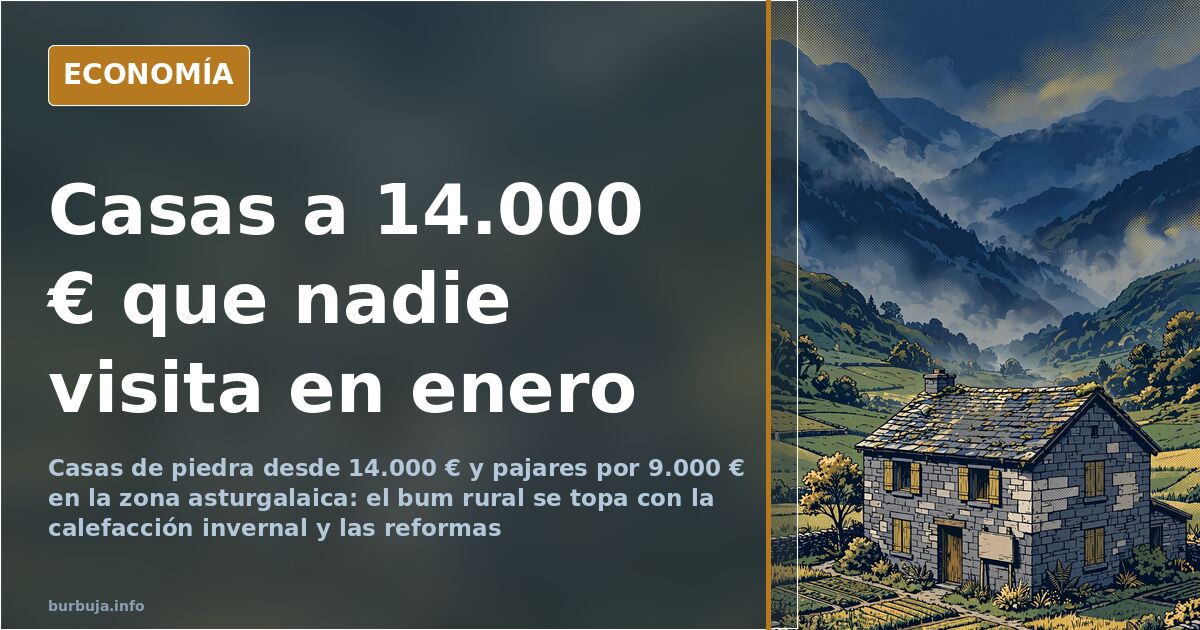
The rural housing boom: €14,000 and the fine print of the cold
What is the cost of a house in Spain? It depends on whether the question is asked in Madrid or in A Fonsagrada. In the Astur-Galician border zone — A Mariña Occidental, Meira, Riotorto, Ribeira de Piquín, and the Asturian West — homes are advertised from €14,000, and two rehabilitable barns in Trabada with 3,110 square meters of land, partly buildable, go for €9,000. The "reserved" sign already appears on many listings, according to the real estate agency marketing them, which speaks of a "total boom" in rural houses and calls from abroad. The report that put figures to this offer was published on April 30, 2024.
What can you buy for €14,000 in rural Spain?
The cheapest property is a stone house to restore in A Fonsagrada: 282 square meters of built area, free spring water, and a plot of 2,369 square meters, all for €14,000. Even cheaper is the option in Trabada: two barns with independent structures that can be rehabilitated as homes with large windows. The list continues: a complex of buildings in Vilarxubín (A Pontenova) for €27,000; a house to restore with buildable land in Trabada for €24,000; a house in Val (Riotorto) for €19,000; two houses with land in Riotorto for €33,000; a reduced complex in A Pontenova for €30,000; and a move-in ready house four kilometers from Taramundi for €48,000.
At the opposite end, a farmhouse in Vegadeo costs €270,000, including a main house, spring water, mill, oven, forge, barn, granary (hórreo), and land with a river. The same real estate agency has put entire villages on the market: Vides, in A Pontenova, with 22 buildings and four hectares, or three houses, a chapel, and a granary in Boal for €13,000. Before putting them on the market, it is sometimes necessary to gather and register documentation, a complex process in which the agency says it collaborates with owners.
What does it really cost to maintain a rural house?
Buying is the easy part. One participant estimates heating costs at around €500 per month between October and April for a property of these characteristics, with humidity that, according to accounts, forces residents to dress in layers inside the house. To this is added brush clearing and garden hours, plus the car for absolutely everything — supermarket, pharmacy, doctor — because, according to another forum user, the nearest shop can be 35 kilometers or 50 minutes away via secondary roads.
There are other costs not appearing in the listing. Another participant claims that on a second home, you pay 2% of the cadastral value annually in income tax (IRPF), an unverified claim that experts do not frame in these terms. And the construction, if the house is in ruins, is not exactly a renovation: some estimate that rehabilitation exceeds €1,000 per square meter, because in practice, you are building a new house inside old walls. The joke of buying cheap and fixing it slowly has its own bill, and it arrives every winter.
The calculation comparing selling in Madrid with living in the country
A forum user proposes the most optimistic version of the move with a simple operation: sell an apartment in a good area of Madrid or Barcelona for €600,000, buy a house in a village for €20,000, invest €40,000 to customize it, and end up with a house for €60,000. The remaining €520,000, well managed, would yield, according to his calculation, 20 years without working for a single person or 15 for a childless couple, without luxuries but without hardship, with the possibility of adding income from room rentals or agricultural activities.
The pessimistic version is signed by someone who has already tried it. The case of a young woman who convinced her parents to buy a house in Asturias and returned to Barcelona in less than a year is recounted: available jobs were poor, they were far from home, and there are no subways or commuter trains in the mountains. In the countryside, you must move by car, and gasoline is not cheap. Neither account is false; they simply measure different things.
Bureaucracy, trees, and ticks: the fine print of the land
Administration appears in almost all replies. One owner reports waiting two years to cut down a 20-meter eucalyptus he antiestéticars might fall in a storm, because he needs a technician to assess the situation, obtain a license, and have insurance. And some claim that even fallen pinecones cannot be collected without consequence. The suggested alternative is to let the tree dry and then request permission citing fall risk, with no guarantee it will be granted.
The land also brings fauna. One participant asks about the presence of ticks in the area, and another responds that they are abundant where there are ferns and gorse, recounting knowing people with health complications after a bite. In case of any bite, it is sensible to seek a healthcare professional. This is the kind of detail that does not appear in the brochure for the house with a 2,369-square-meter plot.
Who buys and why does climate decide almost everything?
The buyer profile has an accent. Catalans, Madrilenians, Germans, and English people dominate demand, many with family roots in the area, others seeking a second home, retirement, or a return with remote work. English buyers who are builders rehabilitated their house and now work for other English buyers arriving behind them: the call effect works. There are also entrepreneurs with agrotourism projects, for example in the San Tirso de Abres area. Those seeking large, expensive houses are usually foreigners, and their market shrinks when the state (Patrimonio) imposes conditions on renovations.
Then there is the weather, the filter no one disputes. The Cantabrian coast offers landscape, water, and minimum prices; in return, persistent rain, damp cold, and sunless summers discourage many. A forum user claims that many people who retire there end up moving to Torrevieja or Benidorm without looking back, and that the Mediterranean allows swimming eight months a year. It is also noted that the Cantabrian coast regulates temperatures, but not the spirits of those spending January isolated.
In the end, Spain's cheapest house remains the one no one visits in January.
Also available in: Deutsch
Summary of a discussion on Burbuja.info - Foro de economía, actualidad y política., translated from Spanish and reviewed before publication. Read the full discussion (211 replies).
More summaries
-
Spain's Birth Rate Collapse: Causes Under Debate
Spain faces a demographic winter driven by housing, wages, and culture. Forum users cite a fertility rate of 0.5 in the Basque Country.
-
Spain bans toxic playground rubber by 2031
Recycled rubber in Spanish playgrounds faces a 2031 ban due to endocrine disruptors, but removal costs and business interests complicate the transition.
-
The math that settles whether working is actually worth it
Your marginal income tax bracket, not your total salary, decides whether an extra hour pays off: at 45%, you keep less than half. The threshold sits around 45,000 euros.
-
Migrants clean El Trampolín beach in Spain's Ceuta, sparking fierce debate
Migrants cleaned El Trampolín beach in Ceuta, Spain, and Cadena SER's coverage has reignited the debate: solidarity, whitewashing or a pull factor?
-
Spain's labour force survey hides 1.9 million 'employed' people with no work
1.9 million people counted as employed report zero hours in Spain's Labour Force Survey. Recalculated, the real unemployment rate would be 17.4%, far from the official headline figure.
-
Feminist activist's muscular boyfriend exposes her revealed preference
A feminist activist with a muscular boyfriend has reignited the debate over revealed preference: hypocrisy or private life?