
The math that settles whether working is actually worth it
Your marginal income tax bracket, not your total salary, decides whether an extra hour pays off: at 45%, you keep less than half. The threshold sits around 45,000 euros.
English · Original discussion in Spanish · Published
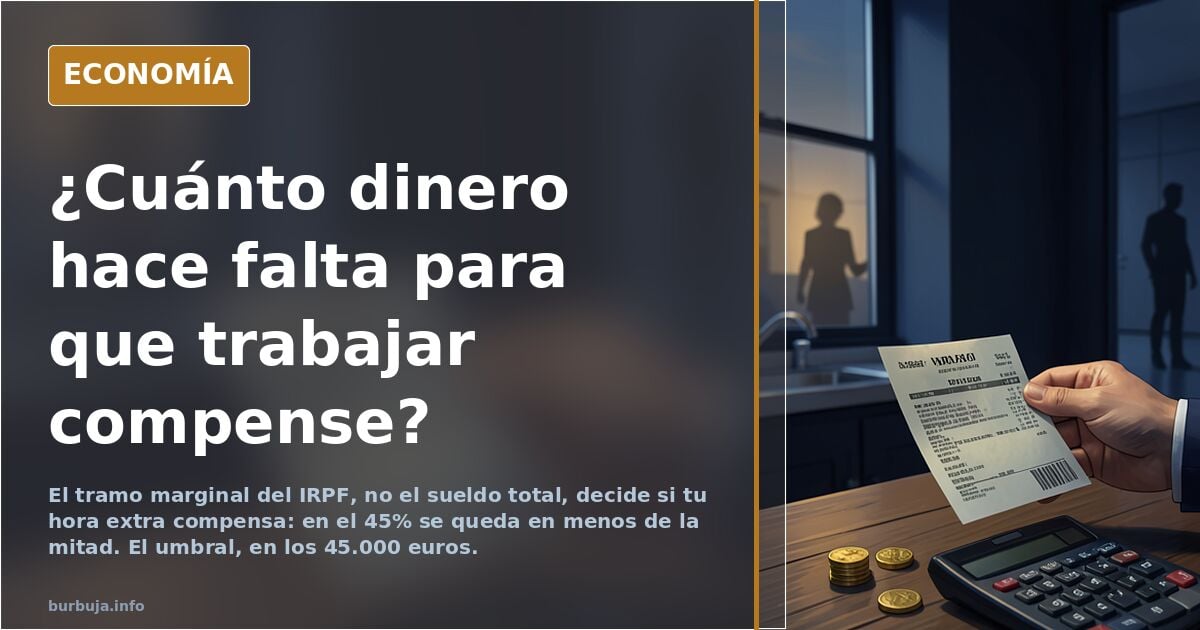
The tax bracket that decides whether your extra hour is worth it
At what income level is working actually worth it? The question, seemingly simple, produces answers ranging from 30,000 to 150,000 euros gross per year. But the figure that really tips the scales is not your total salary, but the marginal income tax bracket each additional euro falls into. According to a calculation making the rounds, an extra gross euro in the 30% bracket leaves about 0.64 euros net; in the 45% bracket, less than half once marginal income tax and social security contributions are taken out. That's where the extra hour starts working harder for the State than for your pocket.
The original argument mixes two incentives that don't always go hand in hand: the child benefit payment and a civil servant's salary. With four or more children, the Minimum Vital Income (IMV, Spain's means-tested minimum income scheme) can approach 2,000 euros a month, according to the calculation circulating in the discussion. The conclusion drawn is an uncomfortable one: for a single young person with no dependents, the IMV is "perversos"; for a large family, the benefit competes with average private-sector wages. The question stops being how much you earn and becomes how much is left after taxes and after losing deductions.
The marginal bracket: the figure nobody looks at
The most technical analysis in the discussion places the point of no return at 45,000 euros gross per year. Above that figure, if the extra income comes from working additional hours, the effective marginal rate can climb to 55-60% once deductions for children or rent are lost. The full calculation, broken down line by line, yields a surprising difference: an 8-to-15-hour salary jump is not the same as a wage built by lengthening your working day. The law of diminishing returns hits payslips hard.
The comparison between the public and private sectors runs in the background. Some argue the civil servant archetype still holds because it brings status and a high salary for "iPhones, little trips and dinners out." Against that thesis, another camp holds that being a civil servant is "a living death" and that a single young person should start a business or emigrate. Neither position is backed by concrete figures beyond the 45,000-euro threshold and the IMV with four children.
From 30,000 to 150,000: the range of answers
The answers to the opening question span a wide range. At the low end, some consider 30,000 euros gross a year already "pretty good." At the high end, the figure shoots up to 150,000 euros: below that, the argument goes, you're better off staying in bed. Between the two poles, the discussion drifts toward the workload attached to the salary and the suspicion that any excuse will do to turn down a job.
The political backdrop hovers over the conversation. The IMV is mentioned as a vote-winning tool, and there's irony about how 40 euros a month saved at the pharmacy can decide an election. The economic question becomes an electoral one: who pays for the party and who benefits from it.
The final irony comes from the argument itself: if the IMV with four children approaches 2,000 euros and the private salary stalls at 30,000 gross, the answer to "at what point is working worth it?" depends on whether you have children or would like to. And given the current climate, that is not an economic decision.
Summary of a discussion on Burbuja.info - Foro de economía, actualidad y política., translated from Spanish and reviewed before publication. Read the full discussion (28 replies).
More summaries
-
64% of Spanish Public Sector Employees Earn Over €2,295 Gross
In 2020, 63.7% of Spain's public sector workers earned over €2,295 gross monthly, compared to just 21.2% in the private sector, revealing a €1,000 gap in average salaries.
-
Spain's Saiz claims one million unpaid interns now pay social security
Spanish Minister Elma Saiz highlights the registration of one million unpaid interns in Social Security, sparking accusations of manipulating unemployment figures.
-
Spain's Public Sector Now Supports 19 Million Residents
In Spain, 19.3 million people rely on state funds, exceeding private sector employment by five million.
-
Ukrainian Drone Strikes on Yandex Cripple Russian Bot Traffic
Ukrainian attacks on Yandex data centers in Vladimir, Sasovo and Kaluga have caused a sharp drop in Russian bot traffic, with reports of a 56% decline.
-
Trump and the World Cup fix: phone calls, cards and graphene
Trump calls and a red card against the USA is overturned at the World Cup. FBI, FIFA, Topuria doping and suspicions of financial match-fixing. How far does the manipulation go?
-
Almarós wildfire: seven aircraft battle blaze in Castellón, Spain
A forest fire in Almarós (Castellón, Spain) has mobilised 7 aircraft and 9 ground units. The protected area of Balsa de la Dehesa de Soneja is under threat.