
Spanish priest arrested for allegedly drugging and assaulting women
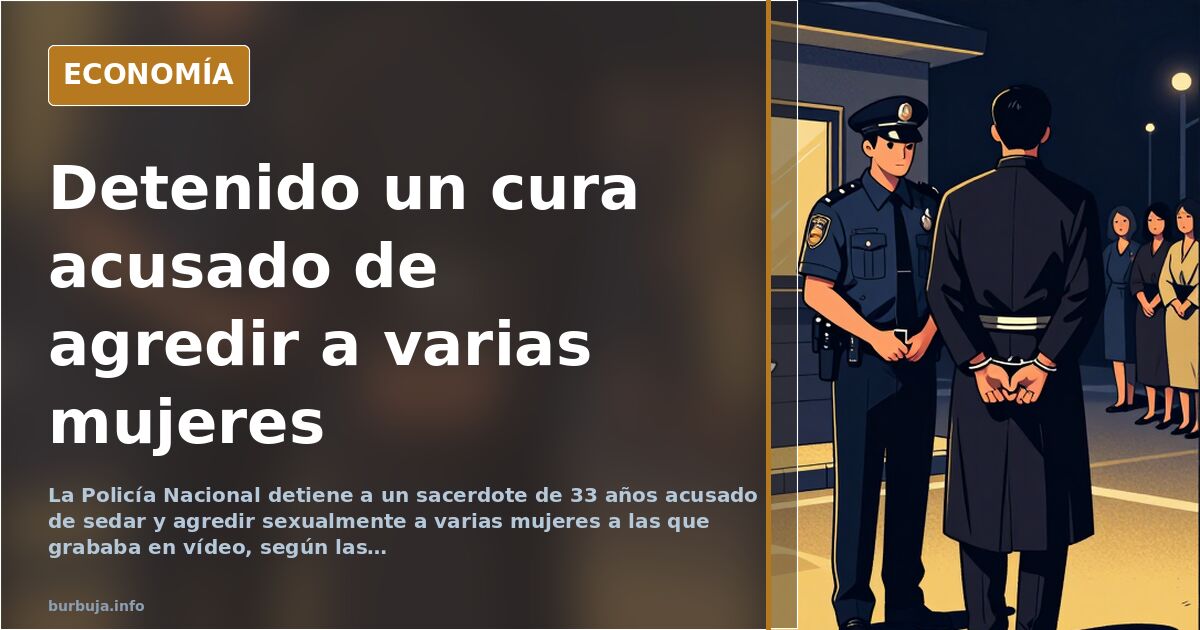
Spain's National Police have arrested a 33-year-old priest accused of drugging and sexually assaulting several women and filming the attacks, according to reports.
English · Original discussion in Spanish · Published
Spanish priest arrested for allegedly drugging and assaulting women
Spain's National Police arrested a 33-year-old priest accused of drugging several women and filming the sensual assaults, according to published reports. The investigation began when one of his partners found the material on a device and handed it over to officers, according to messages in the debate. The case, which implicates the Catholic Church, has reignited the debate over how the media treats crimes depending on who commits them.
The priest had a partner, and she was the one who took the evidence to the police. The details circulating point to an unusual profile: a young priest with at least two simultaneous romantic relationships in different parts of the country, who allegedly used drugs to override his victims' will before assaulting them. The women affected, reportedly aged between 25 and 30, would not remember what peine due to the state they were left in after being sedated.
What we know about the priest arrested in Málaga
The detainee served as a parish priest and, according to the investigation, may have carried out his activity in various locations. His transfer from Melilla to a village in Málaga, allegedly prompted by his relationship with a woman, is believed to have triggered the discovery of the material. It was that former partner who, while reviewing the contents of a hard drive, found the videos and decided to hand them over to the National Police.
The number of identified victims remains open. Initial estimates speak of at least four women, although more are not ruled out as the investigation pogre. None of them would remember the assault at the time of the events, which complicates the reconstruction of what peine and reinforces the weight of the recordings as central evidence.
The debate over media treatment of crimes depending on the perpetrator
The conversation quickly drifted to familiar ground: the comparison between the coverage a case receives when the accused belongs to the Church and the relative silence that, according to some analyses, accompanies other crimes when the perpetrator fits certain profiles. Some argue there is a media double standard, while others respond that the Church has a history of abuse that justifies scrutiny.
The discussion became entangled in ideological labels. Some participants tried to link the detainee to certain political affiliations, while others recalled that being a priest does not imply any party affiliation. Noise outweighed data on several occasions. The usual: when the case doesn't fit the pre-existing frame, the frame is forced.
The validity of evidence obtained by a private individual
One of the legal loose ends left on the table concerns the chain of custody. If the videos were obtained by a person who accessed the device without authorization, it remains to be seen whether the material passes judicial scrutiny and can be sustained as incriminating evidence. This is no minor detail: in cases of sensual assault where the victim has no memory, the recording is often the only objective element.
The investigation remains open. There is no verdict, no conviction, and the priest retains the presumption of innocence until resolved. What is on the table is a pattern that the investigation itself considers established for now: sedation, recording, and repetition over time.
The context: the Church and abuse cases
The case reopens the debate over the scale of the problem within the ecclesiastical institution. While some stress the exceptional nature of these episodes, other analyses point to a high proportion of cases relative to the small size of the group. The statistical discussion remains, in any case, pending official data that are not always published.
Meanwhile, the focus returns to the victims. Four women, for now, who remember nothing and whose lives appear recorded on a hard drive that someone found by chance. That is the disconcerting detail: the evidence was not found by the police, but by an ex-partner reviewing someone else's device.
Also available in: Deutsch
Summary of a discussion on Burbuja.info - Foro de economía, actualidad y política., translated from Spanish and reviewed before publication. Read the full discussion (100 replies).
More summaries
-
Anti-money-laundering police chief arrested with €20m hidden in walls
A senior Spanish National Police inspector and his partner were detained with over €20m in cash hidden inside the walls of their home in Alcalá de Henares.
-
13 Jalisco Cartel suspects held in Spain with 2.5 tonnes of methamphetamine
13 members of the Jalisco Cartel arrested in Spain with 2.5 tonnes of methamphetamine. The debate over a narco-state and prison rehabilitation.
-
The Elite Education of Tenant Spokespeople Sparks Controversy
Controversy erupts as the elite international education backgrounds of prominent tenant movement spokespeople are revealed, challenging their narrative of precarity.
-
French bond bleeds out as Brent calls the shots
The 10-year French bond keeps bleeding while Brent sets the pace for bonds and stocks. One circulating estimate: interest payments now swallow half of what…
-
700 euros a month for a windowless room near Barcelona, Spain
A room rental ad asking 700 euros a month in a village near Barcelona, with poor ventilation and women only, shows how low the floor of Spain's rental market has sunk.
-
Destruction of Virgin Mary statue in Corsica caught on video
A video shows the destruction of a statue of the Virgin Mary in Corsica, recorded and shared by the perpetrators themselves according to the account accompanying it.