
Spanish police salaries spark debate after forum leaks
Navarra Foral Police earn €2,400 net; Olot Local Police €2,300. Forum data fuels debate on public sector pay.
English · Original discussion in Spanish · Published
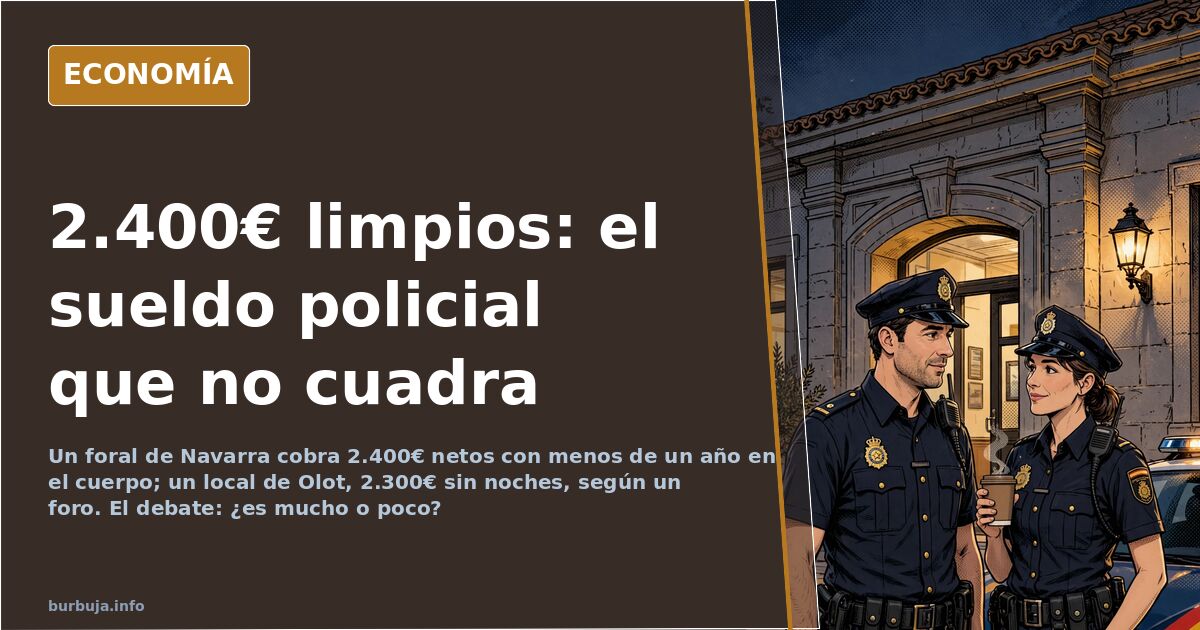
Two police payslips: €2,400 and €2,300 that defy expectations
A Navarra Foral Police officer with less than a year in the force earns €2,400 net per month, according to a message shared on a forum. A Local Police officer in Olot, Catalonia, earns €2,300 without night shifts, per the same source. These are basic ranks, with no seniority or specialization bonuses. This data, circulating in economic circles for nearly two years, continues to trigger the same reaction: initial disbelief, trinc by indignation, and an uncomfortable underlying question. Is it too much or too little? The answer depends on who you compare them to, and that is where the confusion begins.
The salary that breaks the narrative of the privileged civil servant
The first reaction is envy. The second is comparison with the private sector. Some argue that such a salary, given the high cost of living, is misery disguised as privilege. Others respond that €2,400 net is a great salary in a country where the minimum wage hovers around €1,100. Both can be true at the same time, and that is the problem.
The calculation most cited by those defending officers is simple: if €2,400 net is a great salary, the problem is not the police officer, but the Spanish labor market. An IT freelancer working from home admits earning €1,600 net while being idle most of the time, yet still considers the police underpaid: shifts, cold, rain, physical risk, and dealing with all kinds of difficult people. The comparison is not leisure versus work, but risk versus comfort.
How much does a regional police officer earn compared to a local one?
The hierarchy of salaries within security forces is a puzzle. The Navarra Foral Police appears in conversations as the best-paid force in Spain, above the Mossos d'Esquadra and the Ertzaintza, according to some participants. The Mossos, according to these same comments, would be among the lowest-paid regional forces, although they have always been grouped with the better-rewarded ones alongside the Basque force. This contradiction cannot be resolved with a quick search.
What some contributors do assert is that regional police forces and most local forces out-earn the Civil Guard (Guardia Civil) and the National Police Corps (Cuerpo Nacional de Policía), without leaving their territory. A Civil Guard member stationed in Navarra or the Basque Country with a conflict-zone supplement would earn around €2,500 net; if assigned to Traffic, up to €2,800, with the possibility of free housing, according to a calculation circulating in the thread. The full calculation, including extra payments and supplements, yields figures that surprise even those close to the situation.
The danger pay originating from ETA years
Part of the debate focuses on the origin of these supplements. Some recall that the Foral Police receives a danger pay inherited from the years of ETA terrorism, and that this supplement remains in effect even though the threat has changed form. It is not a minor detail: it explains why a basic rank in Navarra can out-earn an officer with more seniority in another region.
The issue becomes complicated when politics enters the fray. One view holds that these salaries are the price the administration pays to keep forces content and compliant. Another responds that a police officer who cannot make ends meet is a corruptible officer, and that paying well is the cheapest way to ensure no one looks the other way. Neither stance can be proven with a single payslip.
Mossos moving to Local Police: the silent exodus
One of the most striking data points mentioned is the flight of agents from the Mossos d'Esquadra to local and municipal police forces. With the Initial Selection Process (ISPC) already completed, town halls save on academy costs for each agent who decides to switch, and the transition is relatively straightforward, according to claims in the thread. Reasons cited include better schedules, better conditions, and faster, smoother promotions. The Mossos syllabus is also described as laughable compared to the 1,600 or 2,000 pages required for the Civil Guard or National Police.
This internal mobility dismantles the idea that all forces are equal. Within the same community, an agent can improve their life by changing uniforms without changing neighborhoods. And in a labor market where moving usually means relocating, this is a luxury few sectors offer.
The real problem: €2,400 is a poor person's salary
Here comes the twist. Several participants agree that €2,400 net is not a fortune, but rather an average-to-low salary in the European context. In neighboring countries, that figure is below the minimum wage, according to some arguments. The uncomfortable conclusion is that the anomaly is not what a police officer earns, but what everyone else earns.
A frequently cited case is that of an industrial engineer who joined the Ertzaintza. The salary is roughly the same as he had in the private sector, but he is close to home, and when his shift ends, work ends. As an engineer, he never worked less than 12 hours a day, always in remote locations. His calculation is not about money, but about quality of life.
The comparison nobody wants to make: civil servant vs. taxpayer
The debate derives toward a broader conclusion. If a police officer with less than a year in the force earns €2,400 net, how much does a private sector worker with similar responsibilities earn? Less, in most cases, according to claims in the thread. And here appears the loaded term: remero (literally "rower," meaning the ordinary taxpayer). The one who pays taxes to sustain a system that, according to this reading, returns increasingly expensive and poorer services.
The response from the other side is that the civil servant also pays taxes, also wakes up early, and also risks their life. That the comparison is not civil servant versus private employee, but between two forms of precariousness. And that the real problem is that the Spanish private sector pays so poorly that any stable salary seems like a privilege.
What remains unresolved
With these differentials, migration toward civil service exams should be massive. And it is, but not out of vocation, but out of necessity, according to some comments. The lingering question is not how much a police officer earns, but how much anyone should earn for €2,400 net not to seem like a fortune. While that is decided, the payslips remain there, and no one quite assimilates them.
A Navarra Foral Police officer with less than a year in the force earns €2,400 net per month, according to a message shared on a forum. A Local Police officer in Olot, Catalonia, earns €2,300 without night shifts, per the same source. These are basic ranks, with no seniority or specialization bonuses. This data, circulating in economic circles for nearly two years, continues to trigger the same reaction: initial disbelief, trinc by indignation, and an uncomfortable underlying question. Is it too much or too little? The answer depends on who you compare them to, and that is where the confusion begins.
The salary that breaks the narrative of the privileged civil servant
The first reaction is envy. The second is comparison with the private sector. Some argue that such a salary, given the high cost of living, is misery disguised as privilege. Others respond that €2,400 net is a great salary in a country where the minimum wage hovers around €1,100. Both can be true at the same time, and that is the problem.
The calculation most cited by those defending officers is simple: if €2,400 net is a great salary, the problem is not the police officer, but the Spanish labor market. An IT freelancer working from home admits earning €1,600 net while being idle most of the time, yet still considers the police underpaid: shifts, cold, rain, physical risk, and dealing with all kinds of difficult people. The comparison is not leisure versus work, but risk versus comfort.
How much does a regional police officer earn compared to a local one?
The hierarchy of salaries within security forces is a puzzle. The Navarra Foral Police appears in conversations as the best-paid force in Spain, above the Mossos d'Esquadra and the Ertzaintza, according to some participants. The Mossos, according to these same comments, would be among the lowest-paid regional forces, although they have always been grouped with the better-rewarded ones alongside the Basque force. This contradiction cannot be resolved with a quick search.
What some contributors do assert is that regional police forces and most local forces out-earn the Civil Guard (Guardia Civil) and the National Police Corps (Cuerpo Nacional de Policía), without leaving their territory. A Civil Guard member stationed in Navarra or the Basque Country with a conflict-zone supplement would earn around €2,500 net; if assigned to Traffic, up to €2,800, with the possibility of free housing, according to a calculation circulating in the thread. The full calculation, including extra payments and supplements, yields figures that surprise even those close to the situation.
The danger pay originating from ETA years
Part of the debate focuses on the origin of these supplements. Some recall that the Foral Police receives a danger pay inherited from the years of ETA terrorism, and that this supplement remains in effect even though the threat has changed form. It is not a minor detail: it explains why a basic rank in Navarra can out-earn an officer with more seniority in another region.
The issue becomes complicated when politics enters the fray. One view holds that these salaries are the price the administration pays to keep forces content and compliant. Another responds that a police officer who cannot make ends meet is a corruptible officer, and that paying well is the cheapest way to ensure no one looks the other way. Neither stance can be proven with a single payslip.
Mossos moving to Local Police: the silent exodus
One of the most striking data points mentioned is the flight of agents from the Mossos d'Esquadra to local and municipal police forces. With the Initial Selection Process (ISPC) already completed, town halls save on academy costs for each agent who decides to switch, and the transition is relatively straightforward, according to claims in the thread. Reasons cited include better schedules, better conditions, and faster, smoother promotions. The Mossos syllabus is also described as laughable compared to the 1,600 or 2,000 pages required for the Civil Guard or National Police.
This internal mobility dismantles the idea that all forces are equal. Within the same community, an agent can improve their life by changing uniforms without changing neighborhoods. And in a labor market where moving usually means relocating, this is a luxury few sectors offer.
The real problem: €2,400 is a poor person's salary
Here comes the twist. Several participants agree that €2,400 net is not a fortune, but rather an average-to-low salary in the European context. In neighboring countries, that figure is below the minimum wage, according to some arguments. The uncomfortable conclusion is that the anomaly is not what a police officer earns, but what everyone else earns.
A frequently cited case is that of an industrial engineer who joined the Ertzaintza. The salary is roughly the same as he had in the private sector, but he is close to home, and when his shift ends, work ends. As an engineer, he never worked less than 12 hours a day, always in remote locations. His calculation is not about money, but about quality of life.
The comparison nobody wants to make: civil servant vs. taxpayer
The debate derives toward a broader conclusion. If a police officer with less than a year in the force earns €2,400 net, how much does a private sector worker with similar responsibilities earn? Less, in most cases, according to claims in the thread. And here appears the loaded term: remero (literally "rower," meaning the ordinary taxpayer). The one who pays taxes to sustain a system that, according to this reading, returns increasingly expensive and poorer services.
The response from the other side is that the civil servant also pays taxes, also wakes up early, and also risks their life. That the comparison is not civil servant versus private employee, but between two forms of precariousness. And that the real problem is that the Spanish private sector pays so poorly that any stable salary seems like a privilege.
What remains unresolved
With these differentials, migration toward civil service exams should be massive. And it is, but not out of vocation, but out of necessity, according to some comments. The lingering question is not how much a police officer earns, but how much anyone should earn for €2,400 net not to seem like a fortune. While that is decided, the payslips remain there, and no one quite assimilates them.
Also available in: Deutsch
Summary of a discussion on Burbuja.info - Foro de economía, actualidad y política., translated from Spanish and reviewed before publication. Read the full discussion (159 replies).
More summaries
-
Five officers fail to restrain one person in Spain, sparking police force debate
A viral video in Valencia shows five officers struggling with a single unarmed individual, reigniting the debate on police training, pay, and use of force.
-
Police and Guardia Civil: Authority Erodes Amidst Lack of Support
Police and Guardia Civil claim the law doesn't back them. From lockdowns to ITV fines, the debate over fading authority.
-
Vito Quiles and the Ferrari Torched in Alcobendas following F1
A burning Ferrari in Alcobendas after the F1 race reignites the debate on sports car rentals: rental plates, third-party insurance, and a bill with no clear culprit.
-
Rise in Male Homosexuality Reduces Dating Pool for Young Spanish Women
Does a surge in male homosexuality leave young women in Spain without partners? An analysis of a debate blending math, stereotypes, and social anxiety.
-
Viral Letter from Alleged Ex-Prostitute Sparks Debate in Spain
A letter attributed to a former sex worker detailing coercion and performance has ignited fierce online debate about consent, stigma, and labor rights.
-
Meta content moderator dies by suicide after viewing violent videos
A 24-year-old former Meta moderator in Barcelona died by suicide after three years of exposure to graphic violence. Her family is considering legal action against Meta and Telus.