
Spain's MEI pension mechanism cuts monthly pay again
The Intergenerational Equity Mechanism reduces Spanish workers' net salaries, sparking debate on fiscal burden and collective agreements.
English · Original discussion in Spanish · Published
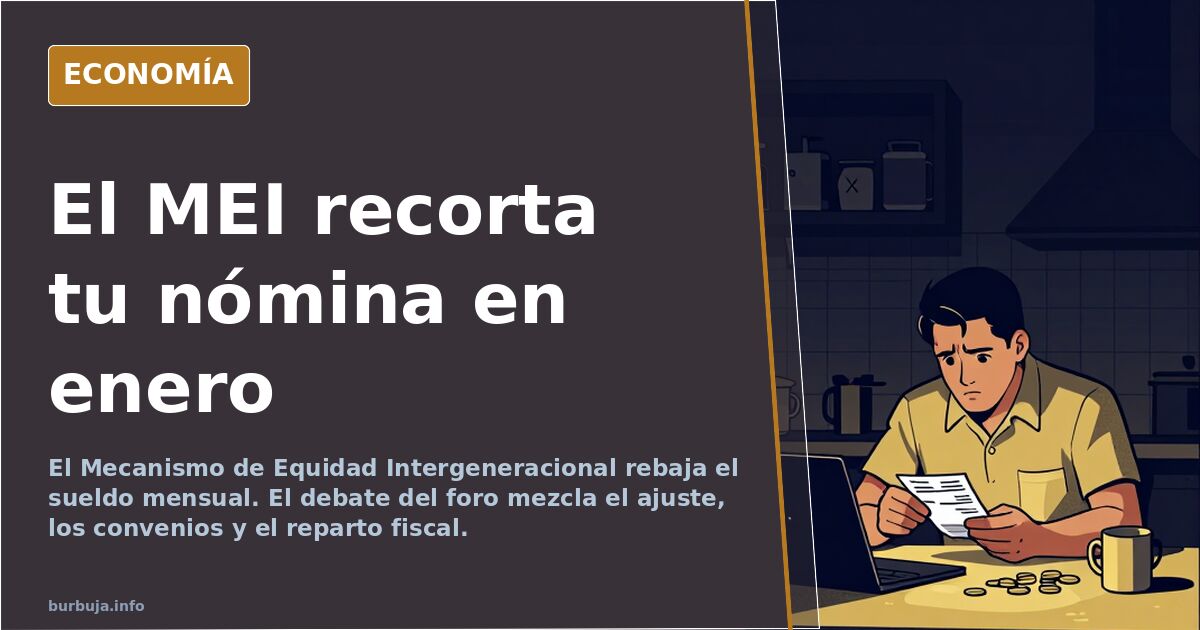
New payroll cuts from the MEI: what it is and who it affects
The second pension reform, which permanently established the Intergenerational Equity Mechanism (MEI), will once again reduce workers' monthly pay. The adjustment applies to pay slips and has peine the debate on who actually pays for sustaining Spain's public pension system. Far from remaining a technical calculation, the discussion has turned into a struggle over tax burden distribution, wage increases in collective agreements, and the role of companies.
What is the MEI and why does it lower pay again?
The Intergenerational Equity Mechanism is the tool used by pension reform to balance the public fund. Its application results in an additional reduction in monthly pay. It is not a new tax, but behaves like one: it enters the payroll via social security contributions and reduces net income.
The lingering doubt is whether that money returns as future pensions or gets lost along the way. Some argue that workers are already paying for pensions through their salaries, making the term "intergenerational equity" questionable at best. Opponents counter that without this adjustment, the system cannot survive.
Who really pays the adjustment: the company or the worker?
The cost does not disappear just because the company formally assumes it. If gross wages rise to compensate, the worker may not notice it in their pocket, but the company feels it in its profit and loss statement. And that, in the medium term, influences decisions on hiring, investment, or even project location.
The most optimistic scenario assumes companies will absorb the hit by raising gross wages to avoid angering staff. The pessimistic view suggests this cost translates into fewer hires or frozen salaries. In between lies a legal detail that complicates the narrative: base salaries and collective agreement bonuses are low in most sectors, so agreed raises above the minimum often do not reflect in the final paycheck. The result is a race to the bottom that pushes employees to change jobs as the only real way to improve their salary.
The battle of collective agreements: the raise that doesn't always arrive
In January, the increases from collective agreements begin to apply. The circulating advice is clear: check if the employer has applied the corresponding raise. But reality is grayer. Some point out that if you have a good salary with voluntary bonuses, any raise might be deducted from that concept, leaving you with the same net pay for life.
The underlying problem is structural. In a country where much of the productive fabric consists of hospitality, rental, or low-margin service businesses, the room to raise wages without firing staff is narrow. And when costs rise through taxes, the natural reaction is not to distribute more, but to tighten less.
The uncomfortable comparison: what is paid vs. what is received
The discussion frequently drifts toward how collected funds are distributed. One analysis argues that money taken from paychecks is redistributed through aid and benefits, creating a perverse electoral dynamic: take from one, give to ten, lose one vote, gain ten. Others respond that the pension system is sustained by current workers' contributions, and without that flow, there are no payments.
Amidst this appears a confusing figure: the Minimum Vital Income, which in some cases exceeds the Minimum Interprofessional Wage (SMI), does not suffer this cut. This asymmetry fuels the feeling that adjustments always fall on the same side.
The scenario no one signs off on: less revenue, more debt
The analysis lacks a conclusion. With inflation standing at 2.8% in 2024, the payroll adjustment adds to the loss of purchasing power. The lingering question is whether the system can hold up without touching spending, without lowering taxes, and without the burden always falling on the same taxpayer. No one has yet provided an answer that fits.
The second pension reform, which permanently established the Intergenerational Equity Mechanism (MEI), will once again reduce workers' monthly pay. The adjustment applies to pay slips and has peine the debate on who actually pays for sustaining Spain's public pension system. Far from remaining a technical calculation, the discussion has turned into a struggle over tax burden distribution, wage increases in collective agreements, and the role of companies.
What is the MEI and why does it lower pay again?
The Intergenerational Equity Mechanism is the tool used by pension reform to balance the public fund. Its application results in an additional reduction in monthly pay. It is not a new tax, but behaves like one: it enters the payroll via social security contributions and reduces net income.
The lingering doubt is whether that money returns as future pensions or gets lost along the way. Some argue that workers are already paying for pensions through their salaries, making the term "intergenerational equity" questionable at best. Opponents counter that without this adjustment, the system cannot survive.
Who really pays the adjustment: the company or the worker?
The cost does not disappear just because the company formally assumes it. If gross wages rise to compensate, the worker may not notice it in their pocket, but the company feels it in its profit and loss statement. And that, in the medium term, influences decisions on hiring, investment, or even project location.
The most optimistic scenario assumes companies will absorb the hit by raising gross wages to avoid angering staff. The pessimistic view suggests this cost translates into fewer hires or frozen salaries. In between lies a legal detail that complicates the narrative: base salaries and collective agreement bonuses are low in most sectors, so agreed raises above the minimum often do not reflect in the final paycheck. The result is a race to the bottom that pushes employees to change jobs as the only real way to improve their salary.
The battle of collective agreements: the raise that doesn't always arrive
In January, the increases from collective agreements begin to apply. The circulating advice is clear: check if the employer has applied the corresponding raise. But reality is grayer. Some point out that if you have a good salary with voluntary bonuses, any raise might be deducted from that concept, leaving you with the same net pay for life.
The underlying problem is structural. In a country where much of the productive fabric consists of hospitality, rental, or low-margin service businesses, the room to raise wages without firing staff is narrow. And when costs rise through taxes, the natural reaction is not to distribute more, but to tighten less.
The uncomfortable comparison: what is paid vs. what is received
The discussion frequently drifts toward how collected funds are distributed. One analysis argues that money taken from paychecks is redistributed through aid and benefits, creating a perverse electoral dynamic: take from one, give to ten, lose one vote, gain ten. Others respond that the pension system is sustained by current workers' contributions, and without that flow, there are no payments.
Amidst this appears a confusing figure: the Minimum Vital Income, which in some cases exceeds the Minimum Interprofessional Wage (SMI), does not suffer this cut. This asymmetry fuels the feeling that adjustments always fall on the same side.
The scenario no one signs off on: less revenue, more debt
The analysis lacks a conclusion. With inflation standing at 2.8% in 2024, the payroll adjustment adds to the loss of purchasing power. The lingering question is whether the system can hold up without touching spending, without lowering taxes, and without the burden always falling on the same taxpayer. No one has yet provided an answer that fits.
Summary of a discussion on Burbuja.info - Foro de economía, actualidad y política., translated from Spanish and reviewed before publication. Read the full discussion (192 replies).
More summaries
-
Spain's IMV rises 6.9% to €1,462 monthly
The 6.9% increase sets the Ingreso Mínimo Vital (IMV) at €604 for a single adult and up to €1,462.62 for large single-parent families.
-
Sánchez tells Ceuta to accept 'structural reality' of migration
Pedro Sánchez states Ceuta must face a 'structural reality' of thousands of migrants, lacking a plan or budget. The analysis draws parallels to the Sahara in 1975.
-
Spain 1966 vs 2026: Debunking the R78 Myth
Analysis of a viral comparison claiming Spain was better off in 1966, exposing statistical errors regarding cars, wages, and GDP.
-
Spanish Employers Seek More Immigration: Wage Strategy or Labor Shortage?
Spain's CEOE calls for increased immigration, sparking debate over whether it addresses labor shortages or aims to lower wages through supply pressure.
-
Spain's Civil Service Exams Spark Heated Debate
Forum users clash over whether Spain's civil service exams are an outdated relic or a necessary merit-based system.
-
PSOE survives Aragon election despite Vox surge
Polls predicted a Vox takeover in Spain's Aragon, but PSOE held second place thanks to its extensive clientelist network.