
Spanish Military Forum Highlights Chronic Pay Delays
A Spanish military forum reveals troops fronting costs for allowances and travel, with state reimbursement delayed indefinitely.
English · Original discussion in Spanish · Published
Spanish Military Forum Highlights Chronic Pay Delays
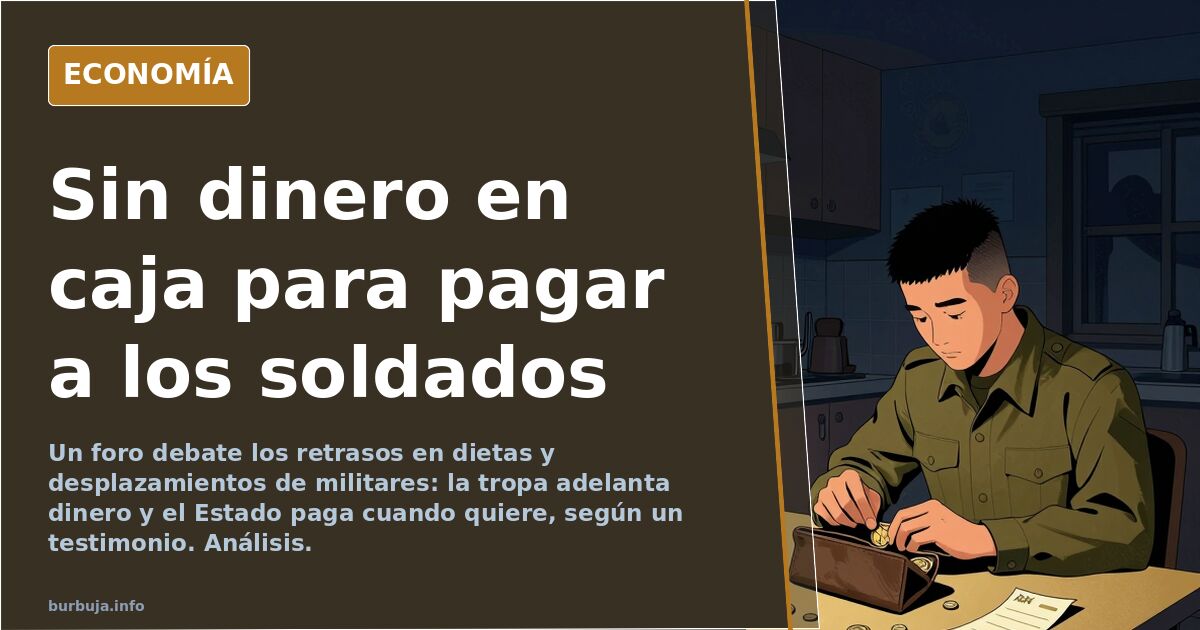
A debate on a military forum alleges that the Ministry of Defense has run out of funds to pay allowances and travel expenses for troops. The issue is not new: according to accounts circulating among service members, soldiers have been covering their own food and lodging costs when deployed, creating a chronic debt that the State pays only at its discretion. By mid-year or year-end, when budget lines are exhausted, there are months without any payment. Some are owed thousands of euros. Meanwhile, the Ministry boasts record budgets.
The Mechanism: Pay First, Wait Indefinitely
The system works in reverse of how it should. Soldiers are ordered to deploy, they cover meals, accommodation, and mileage from their own pockets, and then file claims. Reimbursement arrives whenever it arrives. If the budget line runs dry, the soldier becomes an involuntary financier of the Ministry. A direct testimony collected in the discussion describes it bluntly: "They send us somewhere, we advance money for food and sleep—sometimes 50 euros, sometimes thousands—then we claim it, and the state pays when it feels like it." This phrase is not an isolated complaint; it summarizes the operational reality of the payment chain.
The practical consequence is that the Army operates with a parallel treasury funded by its members' pockets. When the budget dries up, the troops bear the cost. Officers, however, receive their salaries on time. This asymmetry is obvious to everyone.
Why Does Defense Run Out of Money Despite Rising Budgets?
Here lies the slippery ground. The debate points to a broader pattern: tax revenue is at highs, but spending spikes through channels not highlighted in headlines. "Tax collection is at maximums. And (supposedly) spending the same as with the extended General State Budgets from years ago... The real numbers must be alarming," one participant notes. Suspicion that actual accounts do not match published figures pervades much of the conversation.
Others point directly to the BOE (Official Gazette). "Every day in the BOE there is a flood of money for chiringuitos [beach bars], menas hotels, studies for Mali's cashews, and then there is no money for Health, education, dependency care, emergencies, state security, and public works," reads a message citing a specific line item: a project supporting the cashew sector in Mali allocated approximately €18.36 million. The figure, verifiable in the BOE, is used as argumentative ammunition: if there is money for this, why not to pay soldiers?
Troops as Scapegoats for Fiscal Adjustments
The discussion quickly shifts to the role of the Army. One current argues that the Armed Forces have become a sort of uniformed minimum vital income: "The army is nothing more than another type of minimum vital income we pay with our taxes. What use is the army if it doesn't fulfill its sole function of protecting Spain?" summarizes one intervention. The criticism targets the institution and its perceived utility, not the soldiers themselves.
On the other side, another line defends that the problem is not military spending but its management: "Of course, nobody gets paid, least of all you. The troops should have been paying attention to what you wrote in the forum obeying your orders instead of the politician in uniform who commands them," replies a message pointing directly at the political chain of command.
The gap between those who see the Army as a sinkhole and those who see it as a victim of budgetary disorder structures much of the disagreement. In the middle are the soldiers: paying out of pocket to trinc orders.
International Context: Estonia, Romania, and NATO's 5% Target
The debate cannot be understood without the external framework. There are troops deployed on international missions—Estonia and Romania are mentioned—and a question hangs in the air: do they get paid on time? "There must be a bunch of soldiers deployed to Estonia or Romania earning big bucks," speculates one message. Suspicion of comparative disadvantage between foot soldiers and those deployed abroad adds fuel.
At the same time, the problem is linked to defense spending commitments: "Do you understand now why Spain won't pay the 5% to NATO?" asks a participant. Lack of liquidity in the treasury is read as a symptom of structural inability to assume international commitments. NATO appears as both excuse and mirror: if there is no money for allowances, even less for the 5% target.
The Shadow of Segarro and the State of the Army
In the final stretch, the conversation turns to real operational capacity. "Our army is in a deplorable state physically, sarracena, and logistically. And if they don't even pay them what they are due... When Segarro attacks us, the shock to the system will be such that who knows if Spain will continue to exist as a country," warns a message. The hypothesis of a Segarro attack is not discussed as a probable scenario but is used to underline fragility.
Others point to talent drain: "I imagine generals and colonels still receive their salaries on time. But even these, what they have in mind is leaving active service and fleeing to the private security industry as advisors and board members." The military career as a springboard to the private sector. Retention of officers is compromised.
What Is Not Discussed: Troops Pay and Stay Silent
There is an uncomfortable consensus throughout the exchange: the problem has been occurring for years, is known, and is not corrected. "I asked a neighbor who is a guard, and he told me this has been happening all his life," recounts a participant. The normalization of non-payment as part of the job is perhaps the most devastating data point. There is no organized protest, no union with pressure capacity, no headline. Only soldiers advancing money to trinc orders.
The exact point where analysis stalls is this: if the system has worked this way forever, if everyone knows it and no one fixes it, is it a treasury problem or a form of management? The question remains unanswered. And the treasury is empty.
Also available in: Deutsch
Summary of a discussion on Burbuja.info - Foro de economía, actualidad y política., translated from Spanish and reviewed before publication. Read the full discussion (108 replies).
More summaries
-
Ortiz de Zárate: Arrested in Guadalajara, July 22, 1936
A 1936 photo shows Commander Ortiz de Zárate arrested in Guadalajara before his execution. Historical repression figures remain disputed.
-
Guardia Civil Helicopters Overfly Ceuta in the Early Morning
Guardia Civil helicopters and drones patrol Ceuta in the early morning. Flight tracking suggests a deployment without an official statement.
-
Spain's Civil Guard Returns Stolen Roosters in Soria
The Guardia Civil recovered eight roosters stolen from a Valladolid family in Soria, sparking criticism over perceived preferential treatment.
-
Leire Martínez: Weight and the Price of Image in Music
Leire Martínez, ex-LOVG, faces menopause and scrutiny over her weight. How much does appearance condition an artist? Analysis with data and real cases.
-
Trump claims angry migrants are invading Spain, without any data
Trump said "hundreds of thousands" of "angry" people had entered Spain and tied it to a problem. We examine the quote, its context and its economic reading.
-
Chaos breaks out in Prague as protesters storm Parliament
A post on X shows protests in Prague with demonstrators trying to enter the Parliament building. What is known about the Czech context.