
Spanish Landlord Threatens to Assault Squatter on TV
A Spanish landlord threatens violence against a non-paying tenant on national TV, claiming the law fails him. The debate contrasts legal delays with vigilante justice.
English · Original discussion in Spanish · Published
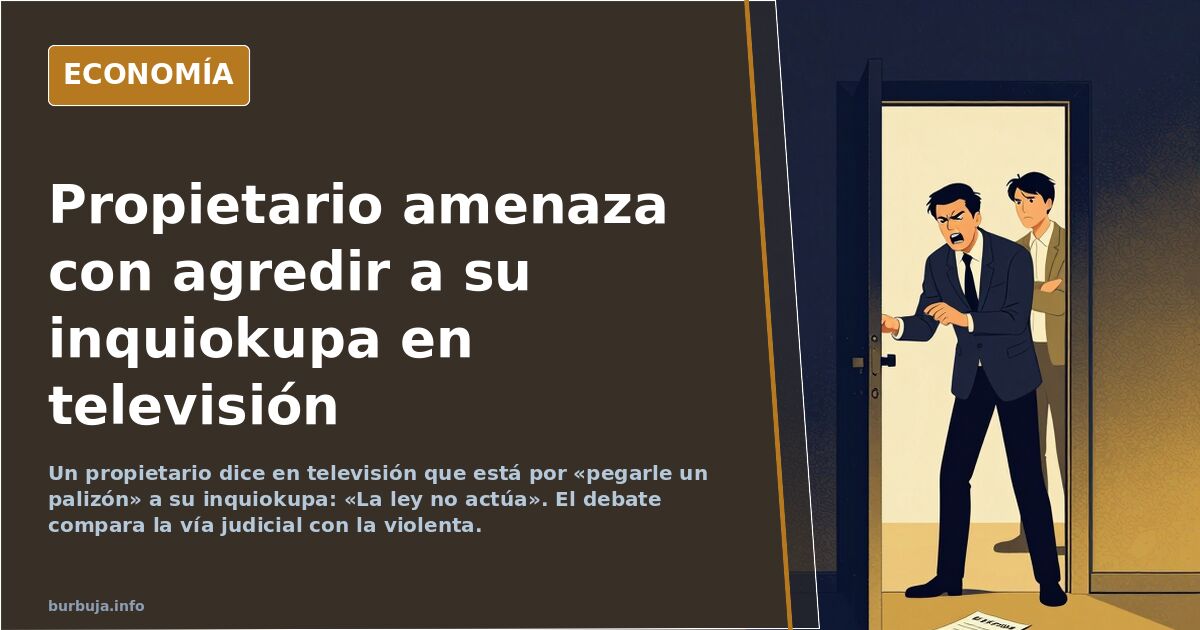
Landlord Threatens Violence Against Non-Paying Tenant
A landlord stated publicly, without euphemisms: "I am reaching a point where I want to go in, beat him up and throw him out; the law does not act." He made these remarks during a television interview, adding a phrase that sums up his anger: "The Government is our worst enemy." The case, spread via a tweet, has peine the debate on housing occupation and institutional response. Subsequent discussion shifted to a more uncomfortable issue: Is the problem legal or related to the tenant's profile? And why doesn't the landlord execute the threat instead of announcing it?
Occupation as a Failed Business
The first point emerging is economic. Renting a property has become a risky activity for private landlords. A calculation circulating in the debate compares two scenarios with a property worth 250,000 euros: keeping that money in a fixed-term deposit at 2.5% annual interest generates 6,250 euros gross per year, while renting the flat for 1,250 euros per month produces 15,000 euros gross annually. The difference is substantial, but the landlord assumes community fees, special assessments, IBI (property tax) and, above all, the risk of non-payment. The conclusion drawn is that rental profitability only compensates if the tenant pays. When they don't, the business becomes a bleeding wound.
According to the landlord's account, the institutional response is nonexistent. "The law does not act," he says. This is where the calculation of the violent path enters. Part of the analysis argues that assaulting the tenant and facing incivil consequences —around 2,000 euros for assault and coercion— is cheaper than litigating for years: lawyer and court representative fees, lost profits, paid utilities and, in many cases, a property destroyed by an insolvent tenant. The conclusion is uncomfortable: slow justice rewards those who do not pay.
Squatter or Tenant Who Won't Leave?
The discussion has divided between those who distinguish illegal occupation from rent non-payment. In this specific case, the landlord voluntarily rented to a migrant person. There was no trespassing: there was a contract. The problem arose later, when the tenant stopped paying or refused to leave. That is a 'inquiokupa' (non-paying tenant), not an 'okupa' (illegal squatter). The difference matters because the legal framework is distinct: illegal occupation allows for faster action, whereas non-payment requires judicial proceedings that can last years.
Some argue the problem is not the law, but the filter. "Don't rent to couples," "don't rent to scum," are some of the recipes circulating. Other voices recall that there are professional non-paying tenants who pass all filters and that risk is inherent to the activity. The experience of landlords who have had to litigate for years points to real legal defenselessness and that solutions do not come quickly.
Political Context: Housing as an Electoral Weapon
The original tweet does not stay in the anecdote. It contains explicit political charge: "If you vote PSOE or PP, we will have this for 20 more years." Housing occupation has become a permanent campaign topic. Part of the analysis argues that the Government protects occupants for electoral calculation; another recalls that the Constitution subordinates private property to the general interest and that the police lack resources to put a patrol car at every home. The discussion shifts to the ownership system: some see a coordinated attack on owner-occupied housing to push the population into renting and benefit large holders.
Taxation also comes into play. It is argued that renting is taxed favorably —reductions for landlords in tense zones, expense amortization— which contradicts the narrative of the suffocated landlord. Reality is more nuanced: profitability exists, but the risk of non-payment can completely nullify it.
Threat as Strategy
The landlord did not execute the threat. He announced it on television. This has legal consequences: premeditation aggravates any subsequent action. It also has a strategic reading: making the case public pressures institutions and, incidentally, seeks social support. The lingering question is whether the system only reacts when there is a threat of violence. For now, the answer is that the landlord continues to wait.
Prediction, with reservations: if the case goes to court, the landlord will likely lose more time and money than if he had accepted an agreement with the tenant. The violent path is cheaper in the short term, but it can ruin his life. And he knows it.
Forum Voices
"Those things are done, not said in public, much less on a national TV channel."
"He ruins his life if he does it now that he has said he wants to do it; if he does it without warning, I tell you the squatter leaves and makes no noise."
"Property is property, whether primary residence, second home, or the place where you take your dates."
A landlord stated publicly, without euphemisms: "I am reaching a point where I want to go in, beat him up and throw him out; the law does not act." He made these remarks during a television interview, adding a phrase that sums up his anger: "The Government is our worst enemy." The case, spread via a tweet, has peine the debate on housing occupation and institutional response. Subsequent discussion shifted to a more uncomfortable issue: Is the problem legal or related to the tenant's profile? And why doesn't the landlord execute the threat instead of announcing it?
Occupation as a Failed Business
The first point emerging is economic. Renting a property has become a risky activity for private landlords. A calculation circulating in the debate compares two scenarios with a property worth 250,000 euros: keeping that money in a fixed-term deposit at 2.5% annual interest generates 6,250 euros gross per year, while renting the flat for 1,250 euros per month produces 15,000 euros gross annually. The difference is substantial, but the landlord assumes community fees, special assessments, IBI (property tax) and, above all, the risk of non-payment. The conclusion drawn is that rental profitability only compensates if the tenant pays. When they don't, the business becomes a bleeding wound.
According to the landlord's account, the institutional response is nonexistent. "The law does not act," he says. This is where the calculation of the violent path enters. Part of the analysis argues that assaulting the tenant and facing incivil consequences —around 2,000 euros for assault and coercion— is cheaper than litigating for years: lawyer and court representative fees, lost profits, paid utilities and, in many cases, a property destroyed by an insolvent tenant. The conclusion is uncomfortable: slow justice rewards those who do not pay.
Squatter or Tenant Who Won't Leave?
The discussion has divided between those who distinguish illegal occupation from rent non-payment. In this specific case, the landlord voluntarily rented to a migrant person. There was no trespassing: there was a contract. The problem arose later, when the tenant stopped paying or refused to leave. That is a 'inquiokupa' (non-paying tenant), not an 'okupa' (illegal squatter). The difference matters because the legal framework is distinct: illegal occupation allows for faster action, whereas non-payment requires judicial proceedings that can last years.
Some argue the problem is not the law, but the filter. "Don't rent to couples," "don't rent to scum," are some of the recipes circulating. Other voices recall that there are professional non-paying tenants who pass all filters and that risk is inherent to the activity. The experience of landlords who have had to litigate for years points to real legal defenselessness and that solutions do not come quickly.
Political Context: Housing as an Electoral Weapon
The original tweet does not stay in the anecdote. It contains explicit political charge: "If you vote PSOE or PP, we will have this for 20 more years." Housing occupation has become a permanent campaign topic. Part of the analysis argues that the Government protects occupants for electoral calculation; another recalls that the Constitution subordinates private property to the general interest and that the police lack resources to put a patrol car at every home. The discussion shifts to the ownership system: some see a coordinated attack on owner-occupied housing to push the population into renting and benefit large holders.
Taxation also comes into play. It is argued that renting is taxed favorably —reductions for landlords in tense zones, expense amortization— which contradicts the narrative of the suffocated landlord. Reality is more nuanced: profitability exists, but the risk of non-payment can completely nullify it.
Threat as Strategy
The landlord did not execute the threat. He announced it on television. This has legal consequences: premeditation aggravates any subsequent action. It also has a strategic reading: making the case public pressures institutions and, incidentally, seeks social support. The lingering question is whether the system only reacts when there is a threat of violence. For now, the answer is that the landlord continues to wait.
Prediction, with reservations: if the case goes to court, the landlord will likely lose more time and money than if he had accepted an agreement with the tenant. The violent path is cheaper in the short term, but it can ruin his life. And he knows it.
Forum Voices
"Those things are done, not said in public, much less on a national TV channel."
"He ruins his life if he does it now that he has said he wants to do it; if he does it without warning, I tell you the squatter leaves and makes no noise."
"Property is property, whether primary residence, second home, or the place where you take your dates."
Also available in: Deutsch
Summary of a discussion on Burbuja.info - Foro de economía, actualidad y política., translated from Spanish and reviewed before publication. Read the full discussion (126 replies).
More summaries
-
RTVE denies Guardia Civil uniforms given to migrants in Ceuta
RTVE Verifica declares false the claim that the Government handed out Guardia Civil uniforms to migrants in Ceuta. The container theory raises doubts.
-
Koldo García, former Ábalos aide, arrested over mask contracts
Spain's Civil Guard arrests Koldo García, ex-advisor to José Luis Ábalos, for alleged illegal commissions in pandemic mask purchases and property holdings.
-
Royal Navy blocks Spanish patrol boat in Algeciras Bay
A Guardia Civil vessel altered course in Algeciras Bay after a Royal Navy blockade in waters claimed by Spain.
-
Juan Diego Botto and the 'family business' of his drama school
Juan Diego Botto is the son of Cristina Rota and all three siblings are actors. The thread calls the school he promotes a 'family business'.
-
Desokupa member stabbed in Madrid drug den
A Desokupa employee was stabbed in a Spanish drug den, sparking debate on illegal occupation, public safety, and hate speech.
-
Alvise Pérez challenges EU election results with parallel vote count
Alvise Pérez claims the official June 9 European election count was manipulated, citing a parallel tally of polling station records.