
Spanish household debt hits record low: prudence or poverty?
Household debt in Spain has fallen to record lows, yet consumer credit is soaring. Prudence or impoverishment? An analysis of the data and the paradoxes.
English · Original discussion in Spanish · Published
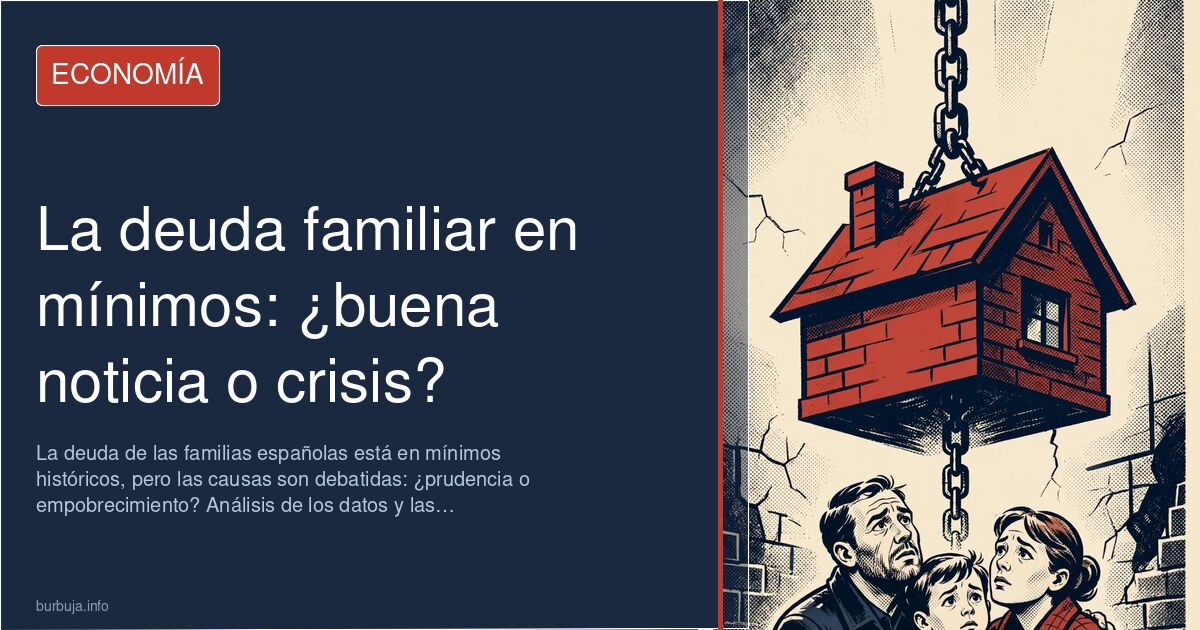
Spanish household debt falls to record lows: prudence or impoverishment?
Is the drop in Spanish household debt a sign of financial prudence or a reflection of an economy that isn't growing? Recent data suggest that household borrowing is at minimum levels, with zero private external debt, but analysts are divided on how to interpret this phenomenon.
The figure: household debt at record lows
The story making the rounds in the specialized media highlights that Spanish families have reduced their debt to levels not seen in decades. While global debt exceeds 2008 levels, Spain shows prudent behavior in the private sphere. However, this apparent virtue hides important nuances.
Prudence or impoverishment?
Some argue that Spaniards have learned the lesson of the housing bubble and apply the maxim "if you can't pay for it, you can't afford it." Mortgages being paid off faster than new ones are granted is proof of this financial culture. But on the other side, it is argued that the fall in debt is not a virtue but a consequence: banks aren't lending, wages aren't growing, and disposable income has barely increased this century. Impoverishment, not prudence, would be the real driver.
Consumer credit belies the prudence
While mortgage debt falls, consumer credit is soaring. According to the data, banks granted 16,762 million euros between March and June, 12% more than the previous year, and holiday loans already account for 17% of the total. This 20% increase in consumer credit suggests that households are not so "prudent" when it comes to financing everyday expenses. The paradox is obvious: they pay off their mortgages but go into debt to go on vacation.
The political paradox
The debate goes beyond economics and into politics. While some point out that public debt has risen 120% since 2011 and that public services have deteriorated, others note that the State's debt has fallen from 104% to 101% in recent years. The criticism centers on the fact that citizens who control their own debt vote for parties that increase public borrowing. A contradiction that does not go unnoticed.
Thus, the fall in household debt is good news for balance sheets, but not necessarily for people's pockets. Perhaps prudence is not a virtue but a necessity. And meanwhile, consumer credit keeps growing. In the end, as some analyses point out, pocketbook economics no longer applies in 2026. Pure irony: Spaniards owe less to the bank, but more to the credit card.
Also available in: Deutsch
Summary of a discussion on Burbuja.info - Foro de economía, actualidad y política., translated from Spanish and reviewed before publication. Read the full discussion (54 replies).
More summaries
-
Sindicato de Inquilinas: Funding Questions Remain Unanswered
Online forums debate the Sindicato de Inquilinas' funding sources and alleged links to George Soros, though no conclusive evidence exists.
-
Hypothesis: Lamine Yamal detained at US customs
An analysis of the possible detention of Lamine Yamal in the US and how a diplomatic conflict could serve as a smokescreen for the Spanish Government.
-
This is supposed to be a forum of awake people
A 15-second clip of Santiago Abascal on Morocco sparks controversy: manipulation or reality? An analysis of misinformation and political polarization in Spain.
-
Abascal: 94,000 euros in public pay and a string of expulsions
Santiago Abascal earned 93,855 euros a year heading Madrid's Data Protection Agency and 82,491 at a public foundation before founding Vox.
-
Spain's weather agency under fire as mobile alerts miss the mark
Users report Spain's ES-Alert system sounding where it doesn't rain and staying silent where it pours, widening the gap between official forecasts and what people see outside.
-
Living in Sapporo: the weak yen draws European talent to Japan
A weak yen makes Japan affordable for Europeans. A Spaniard living in Sapporo describes life, work and costs on the island of Hokkaido.