
Abascal: 94,000 euros in public pay and a string of expulsions
Santiago Abascal earned 93,855 euros a year heading Madrid's Data Protection Agency and 82,491 at a public foundation before founding Vox.
English · Original discussion in Spanish · Published
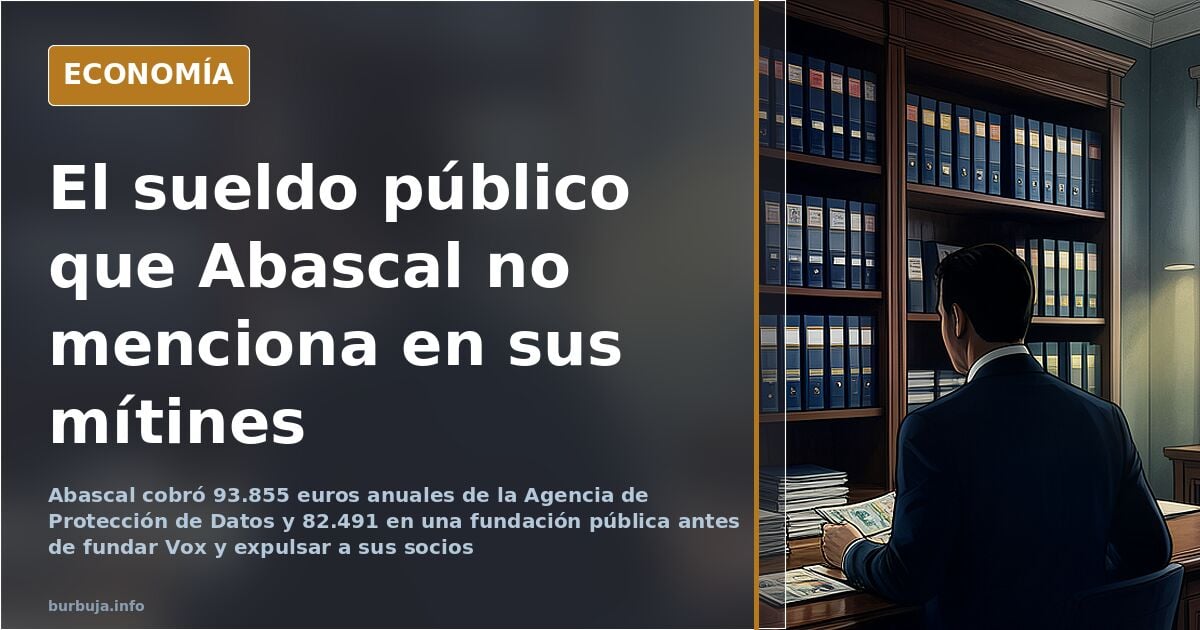
Abascal drew 94,000 euros in public pay before founding Vox
Before becoming television's scourge of the political establishment, Santiago Abascal was already living off professional politics. In 2010, Esperanza Aguirre appointed him head of the Data Protection Agency of the Community of Madrid. Between 2011 and 2013, that post paid an annual 93,855 euros, combining salary and a productivity supplement. When the agency was abolished, he found a berth at the Foundation for Philanthropy and Social Sponsorship: 82,491.80 euros gross a year. The irony is obvious: the man who would denounce public bodies of questionable usefulness had run one of them on a considerable salary.
What results did the foundation Abascal ran show?
According to the documents examined by El País, the few concrete achievements of that period included a 9,000-euro grant and a 1,000-euro donation. None of this constitutes any crime. But the contrast between the rhetoric against cosy public outfits and his own administrative career is the starting point for a broader debate: whether the regeneration narrative can withstand scrutiny of the payslips.
Espinosa de los Monteros: from Vox founder to expelled member
Iván Espinosa de los Monteros was part of the project from the start. He was parliamentary spokesman and a key figure in the expansion era, when Vox had neither resources nor representation. In August 2023 he gave up his seat citing personal reasons; he later explained that he disagreed with the leadership's shift and described an internal culture of mistreatment of people in the party. In March 2026 he published a critical manifesto, and in July 2026 he was notified of his expulsion. From spokesman and fellow founder to expelled. The leadership was entitled to disagree with his positions, but the outcome raises the question of how much room is left for dissent from those who built the party.
Ortega Smith: godfather to one of Abascal's daughters, out
Javier Ortega Smith's case has a more personal history. Abascal and he knew each other long before electoral success, sharing the DENAES project and the building of the party. According to El Confidencial, Ortega Smith is godfather to one of Abascal's daughters. In February 2026 conflict erupted over his replacement as Madrid city spokesman. Abascal's response sums up his idea of discipline: "It is the leadership that rules." In April 2026 Vox confirmed his expulsion after rejecting his internal appeal, citing disciplinary matters and disobedience.
The list of departures: Monasterio, Olona, García-Gallardo
Rocío Monasterio, Macarena Olona, Juan García-Gallardo and other prominent figures have also stepped aside or left the project, under different circumstances that should not be conflated. Some denounced the political direction; others clashed with the leadership; others cited personal reasons. There is no single explanation for all these departures, but there is a visible transformation: the Vox of the early years and the leadership of 2026 look very different. An isolated case could be explained by a personal disagreement. When so many names from the first era disappear, the question shifts to how power is exercised.
The 9.2 million euros from Hungary's MBH bank
In September 2024, Vox acknowledged receiving loans of around 9.2 million euros from MBH, a Hungarian bank linked to Viktor Orbán's business circle. The party argued it had difficulty obtaining financing from Spanish banks. Further deals with the same institution later came to light and, according to the 2025 accounts published in 2026, that debt had been repaid. A foreign bank loan is not in itself illegal financing. But it is legitimate to demand transparency from a party that makes national sovereignty one of its great banners: who lends, on what terms, and what obligations the party takes on.
The Court of Audit fines that were overturned
The body fined Vox over certain financing practices. However, the rulings were later overturned, according to the available account of events. An administrative fine should not be turned into a incivil conviction, or vice versa: the episode illustrates the complexity of auditing party accounts, not a final verdict.
The counterargument: Sánchez never worked outside the PSOE either
Against the thesis of the empty CV, the Vox leader's defence rests on comparison. Some claim, without the material proving it, that Pedro Sánchez likewise has no social security contributions outside the PSOE structure and that his only known job was a thesis at a private university. The counterattack does not refute Abascal's figures, but it shifts the focus: if the criterion is having lived off politics, the reproach is no longer exclusive. And on that ground, the debate over who is more trustworthy becomes circular.
Abascal's career allows two readings. One is that of the politician who knew how to profit from public posts before having a party. The other is that of the militant who faced terrorist pressure in the Basque Country and then built a party from scratch. Both can be true at once. What does not quite add up is the narrative that reduces politics to the establishment and cronies when his own payslip is part of the story.
Also available in: Deutsch
Summary of a discussion on Burbuja.info - Foro de economía, actualidad y política., translated from Spanish and reviewed before publication. Read the full discussion (65 replies).
More summaries
-
Ortega Smith Exposes Internal Chaos and Financial Doubts After Being Ousted from Vox
Javier Ortega Smith claims his dismissal from Spain’s Vox party stems from internal irregularities, while leadership cites organizational reasons and poor electoral performance in Madrid.
-
Espinosa de los Monteros: Media Presence Sparks Political Speculation
Forum users speculate on Espinosa de los Monteros launching a new party, joining the PP, or splitting the right-wing vote.
-
Forum debate: Is Vox finished? Abascal accused of seizing party
Online forum thread analyzes internal crisis in Spain's Vox after Ortega Smith's exit, criticizing leader Abascal and urging votes for Alvise.
-
Xabier Arrutia Imaz, ETA advisor to PDVSA in Venezuela, dies
The death of Xabier Arrutia Imaz in Venezuela exposes the protection network for ETA members in PDVSA and suspicions of a killing to silence secrets.
-
Pope Leo XIV criticises Europe over migration routes from the Canary Islands
More than 2,000 migrants crammed onto the Arguineguín pier: Pope Leo XIV denounces the lack of safe routes while his own State bans them.
-
Zapatero's defense questions the origin of evidence in Spain's Plus Ultra case
José Luis Rodríguez Zapatero's defense in the Plus Ultra case argues the evidence has an illegitimate origin from a US agency, while courts upheld the legality of the loans.