
Spain's weather agency under fire as mobile alerts miss the mark
Users report Spain's ES-Alert system sounding where it doesn't rain and staying silent where it pours, widening the gap between official forecasts and what people see outside.
English · Original discussion in Spanish · Published
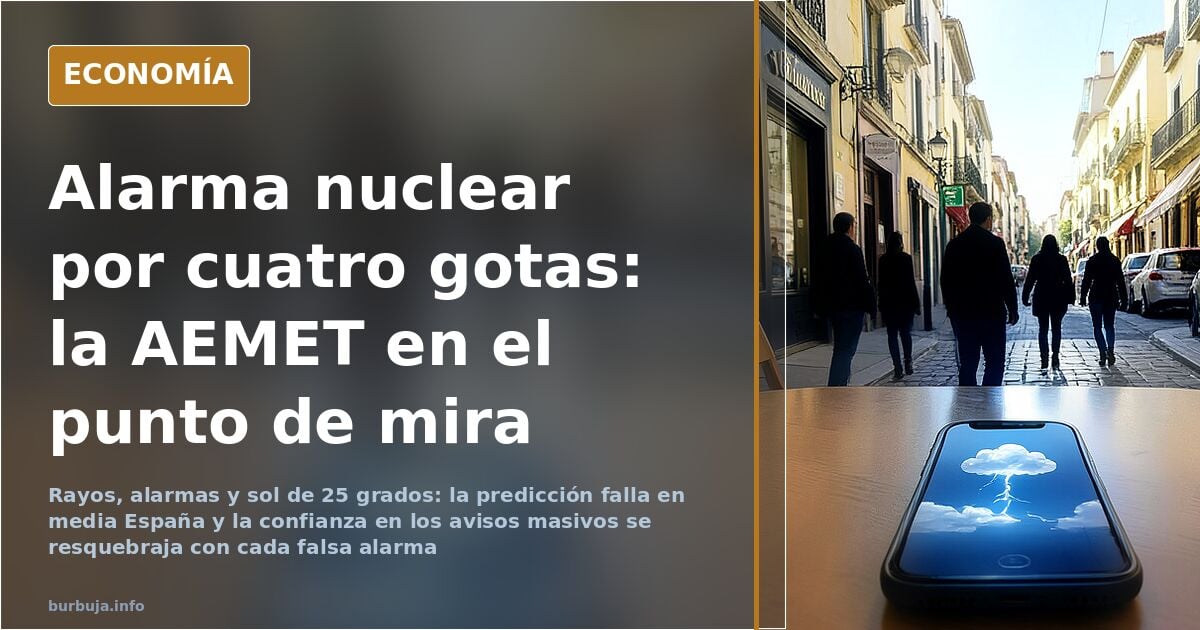
Alarm on the phone, sunshine outside: the chaos of Spain's AEMET alerts
A phone blares at full volume in the middle of a nap, in a province where not a single drop has fallen. Elsewhere, it has been pouring for hours and the warning arrives late, or never comes. That is the paradox running through a day of heavy-rain warnings: the mass alert that the ES-Alert system sends to mobile phones in a given area has become the new battleground between weather forecasting and the experience of anyone who looks out the window. And this time, experience wins by a landslide, according to the accounts gathered.
The pattern repeats across half of Spain, judging by users' messages. In Murcia, a yellow alert was announced from 2:00 pm; it rained for half an hour at 5:00 pm and the sky stayed «clearer than a cricket's eye». In the Sierra de Guadarrama, a month of missed forecasts. In Barcelona, 25-degree sunshine when a DANA comparable to the one that hit Paiporta was expected. And in Málaga, torrential rain with thunder nearby without any alarm sounding. The conclusion on the street is simple: the official warning and the sky are each going their own way.
Why does the alarm sound when it doesn't rain, and stay silent when it pours?
There is a technical explanation, and it is no mystery. The system does not use personal data or GPS location: it sends the message through the cell towers of a specific area, and it sounds on every compatible phone connected to them. That is why some people receive it with wifi and mobile data switched off, and why others cannot disable it. The flip side: if the warning is activated when the risk is already at the door, the window to react shrinks. The complaint running through the country is not that the system fails, but that it goes off on criteria the public cannot quite grasp.
Some argue the problem is one of calibration: lowering the thresholds turns the exception into the routine. A park that closes on a yellow wind alert from 30 km/h spends more time shut than open between now and May. When alerts become blanket coverage, the warning stops meaning anything. And when real danger arrives, the message goes out with the water already rushing down the ravine.
A model that cannot get it right 48 hours out
The technical defence has merit too. DANAs — high-altitude isolated depressions that bring sudden severe storms — are unpredictable by definition: mathematical models depend on the region, and a model that works for Andalusia is no use in Miami. Over the medium term they get fine-tuned, but the margin of error in the final hours remains huge. The very data cited in the discussion suggest that the cold air in the upper layers had not yet reached the Mediterranean, and the sea was still four degrees above average. With that cocktail, any forecast is a gamble.
The result is a spectacle that erodes trust. If the warning is perceived as noise, the next time it matters no one will heed it. And there lies the real cost: not in the alarm that interrupts a nap, but in the one that gets ignored when it counts.
The question is no longer whether AEMET gets it right. It is how many false alarms a system can take before people stop looking at their phones.
Also available in: Deutsch
Summary of a discussion on Burbuja.info - Foro de economía, actualidad y política., translated from Spanish and reviewed before publication. Read the full discussion (90 replies).
More summaries
-
Debate in Spain over €46 artisanal panettone price
An artisanal panettone priced at €46 has sparked online debate, with users split between luxury quality and excessive marketing.
-
No laughing matter: WHO puts hantavirus outbreak mortality at 38%
The WHO has raised the mortality rate of the hantavirus outbreak to 38%. A real health threat or another chapter of alarmism? We look at the data and the skeptical reactions.
-
Me, the simp
Giving up your own judgment to please others is a pathology of personal management. We look at the cost of submission and how to regain control.
-
Knee surgery in Spain: €18,500 and a complaint about the soup
Knee surgery costs between €12,000 and €18,500 in Spain. A patient complained about his hospital food, sparking a debate over costs, waiting times and immigration.
-
UK slaps multi-million fine on US mental health forum over VPN access
The UK government has fined a US-based mental health forum millions. Could this set a precedent for sanctioning websites in other countries? A legal and political analysis.
-
US seeks truce with Iran, Tehran says no
Iran rejects Washington's requests for a truce. An analysis of why diplomacy fails on a geopolitical board where strategy rules.