
Spanish heirloom tomatoes cost €8/kg vs bland supermarket ones
Supermarket tomatoes lack flavor due to early harvest; authentic Spanish village varieties sell for nearly €8 per kilo.
English · Original discussion in Spanish · Published
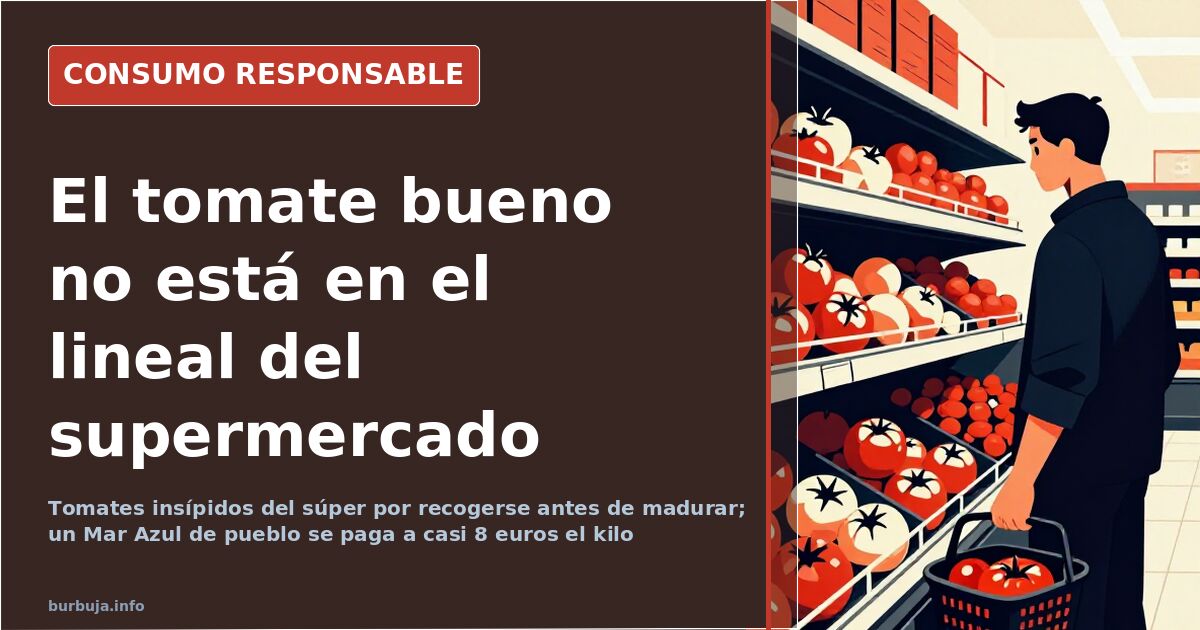
The best tomatoes aren't in the supermarket
The best tomatoes are not found in supermarkets and, almost always, not in local greengrocers either. This is the starting point of a discussion where several participants agree: why has the tomato stopped tasting like a tomato? The recurring diagnosis is blunt: large chain specimens arrive insipid with disproportionate stems, and only those gifted by a grower when ripe roses are left over are saved. Is there anything that can be done besides resigning oneself?
Why don't supermarket tomatoes taste like anything?
Because they are picked too early. That is the agronomic explanation given by one user: every plant extracts nutrients from the soil, but this transfer to the fruit occurs mainly in the final stages of cultivation, which is when the tomato gains vitamins, carbohydrates, and flavor. To obtain that quality, it would have to be harvested already red. And, according to this same account, an industrial producer cannot afford to do so: they must remove it while still greenish-pink (pintón) and let it ripen during the journey to the shelf.
The difference is not about variety, but about timing. Those who have a garden can afford the luxury of picking a ripe tomato and putting it on the table the same day or the next. A commercial producer cannot. Almost everything is lost there, even if the farmer uses cow and sheep manure and renounces insecticides, herbicides, and chemical fertilizers: flavor is decided before boxing, not after.
There is even a paradox that contradicts intuition: some claim that better tomatoes are found in winter than in summer. It sounds strange, but it fits the argument if one considers forced ripening and the stress that extreme heat puts on the plant.
How much does a tomato that tastes like a tomato cost?
It depends on the channel. As one user recounts, in a town in Málaga, a Mar Azul type tomato sells for nearly 8 euros per kilo. At the other end, another participant speaks of chain store products at 2 and 3 euros per kilo with a rubber ball texture, and some have simply stopped buying tomatoes rather than paying for them.
Decent pieces can also be found online, but the warning is clear: prepare your wallet. The route of having your own garden avoids the price, although in exchange for time, watering, sulfates, and disappointments. In between remains a classic that was liked but went wrong: beefsteak tomatoes from a well-known German chain, tasty but with a stem too thick for what they offered.
Los Molinos tomatoes and nearly disappearing varieties
The map of surviving varieties is a map of rural Spain. Tomatoes from El Perelló, in the Valencian Community; Los Palacios, in Seville; Mazarrón, in Murcia; Barbastro, whose production this year has been short or flown to other markets, and the Malaga Mar Azul are cited.
The most striking case is the Los Molinos tomato. It is ugly: large and fleshy, yes, but full of grooves and hollows at the bottom. About 600-650 grams per piece. Due to these defects, it lost commercial outlet and was on the verge of disappearing until a local resident insisted on recovering it. Today, seedlings can be found in any gardening warehouse in Asturias. The fine details—which part goes to salad and which to pisto—are in the cultivation specifics.
Is it worth growing tomatoes at home?
It is the question with the most divided answer. The agronomic balance is harsh: downy mildew, powdery mildew, lack of calcium in the soil, and a summer of heat that bursts production. Some have grown for years and doubt whether they will plant again. On the other hand, the profitability calculation doesn't work out either: those who got the most in a year speak of 120 kilos, and the trinc question is what for—giving away, bottling—if the work isn't compensated.
Against that, the argument of autonomy. Having fruit, vegetables, and even eggs with a couple of hens matters in the face of widespread scarcity, although the accounts of comfort rarely add up. And some, having a garden, admit to being completely useless, getting only cherry and a few others.
Regarding management, there is technical debate: some eliminate all suckers from the beginning and leave one as a reserve in case the main guide breaks when winding the plant; others leave two stems or let the tomato plant grow wild. What almost no one discusses is not cutting orange branches.
Where to really buy: the neighbor's gardener
For several participants, the best channel is not a chain or a greengrocer: it is the gardener's front door. They set up a small table with what was cut that day, weigh with a scale, and sell the surplus cheaper and better than any establishment. It is the same principle as the market, the local product shop, or the village where you buy from the field owner. In cities, this does not exist.
The penultimate option is going to the vine. There are farms where you pick tomatoes, peppers, and zucchini directly, and nurseries next to hospitals that open to the public on specific days. The last option is the pot: a tomato planted at home comes out small, cherry-type, but glorious in flavor. And some have tried planting seeds from supermarket-bought tomatoes and had a pleasant surprise, with the warning that most commercial varieties are determinate and give all their production at once.
The conversation ended up devolving into a cross of reproaches between those who say they cultivate and those who don't believe them. Background noise.
What is predictable is that flavorful tomatoes will continue to be a seasonal, proximity-based, and neighbor-to-neighbor product, not a refrigerated shelf item. With reservations: if heat and pests keep pressing as they did this year, maybe not even that.
Also available in: Deutsch
Summary of a discussion on Burbuja.info - Foro de economía, actualidad y política., translated from Spanish and reviewed before publication. Read the full discussion (109 replies).
More summaries
-
Spain’s supermarket sauces: fried tomato beats Mercadona
A four-year review of Spanish supermarket sauces from Mercadona, Lidl, Aldi and Carrefour, covering sugar content and prices.
-
Mercadona hikes tomato bread rolls to €0.90 amid rising food costs
Mercadona raises tomato bread roll prices from €0.60 to €0.90 and sunflower oil to €1.60, driving the basic shopping basket well above official inflation.
-
Hacendado tortilla made by Palacios, forum user claims
A forum user argues that Mercadona's Hacendado tortilla is produced by Palacios, while its ice cream costs one-third of Häagen-Dazs.
-
Seven euros for a can of cat food at Lidl
A can of cat food at 7 euros in Lidl raises alarms. The price per kilo exceeds 20 euros, more than many fresh foods.
-
Wrought iron headboard without drilling the wall: fix it to the bed base
A wrought iron headboard can be secured without drilling the wall by anchoring it to the bed base with legs reaching the floor and TV-mast style clamps, as several users suggest.
-
UOC or UNED: the €4,100 master's degree and the same old dilemma
A full master's degree at Spain's UOC costs €4,100, with price parity between Spanish and Catalan only half achieved. The UNED is cheaper, but past experience weighs heavily.