
Mercadona hikes tomato bread rolls to €0.90 amid rising food costs
Mercadona raises tomato bread roll prices from €0.60 to €0.90 and sunflower oil to €1.60, driving the basic shopping basket well above official inflation.
English · Original discussion in Spanish · Published
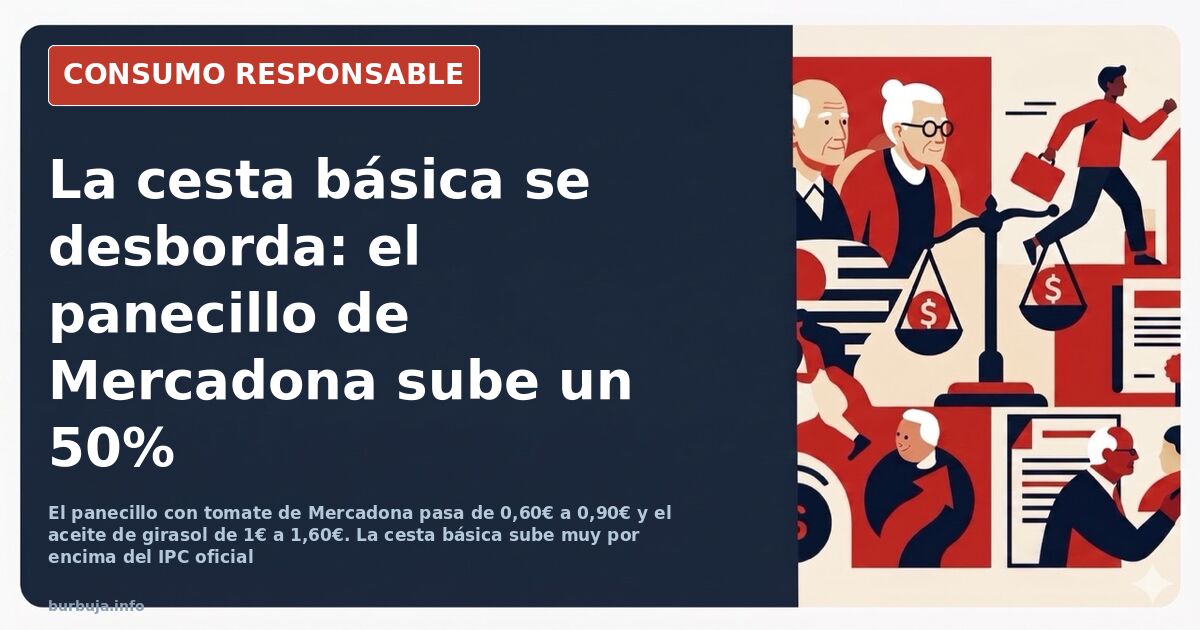
Mercadona spikes basket: tomato bread rolls up 50%
Pushing a full shopping cart has become an endurance test. At Mercadona, tomato bread rolls have jumped from €0.60 to €0.90, while Danonino yogurts rose from €1.01 to €1.19. These are not isolated cases: sunflower oil soared from €1 to €1.60 in just over a year, rice went from €1.69 to €1.86, and cheese climbed from €1.60 to €2.00. The increase may not sting on a single receipt, but it weighs heavily by month's end. Meanwhile, the official narrative, citing Consumer Price Index (IPC) figures around 6.7%, fails to match what shoppers see on the shelves. The basic shopping basket has become the thermometer where macroeconomic data falls short.
Why official IPC doesn't match the grocery bill
The gap between statistics and checkout totals is the thread of consumer discontent. Against that official 6.7%, some argue food prices have risen 30% to 60% in a year. The discrepancy has a technical trick: the general index weights all goods and services, while the essential basket—the one you can't stop buying—has become much more expensive. No one disputes the method; they dispute what it measures.
Those who track every purchase notice it before those reading headlines from statistical agencies. A domestic tracking of spending on food and cleaning supplies estimates the deviation at more than €500 per year compared to the average of the previous five years. Translated: a household that used to spend €400 a month now spends around €600. Processed meats have seen increases of over 50 cents; dairy products, over 20 cents. Added together, it’s a fortune that never appears in the news. The fine-grained breakdown of this record, item by item, leaves many without arguments.
What rises most: oil, rice, chicken, and dairy
Basics are running hot. Sunflower oil went from €1 to €1.60; olive oil, specifically the five-liter jug, has been seen at €18 when it used to be found for €12. A pack of six cans of tuna in sunflower oil hovers around €4. In a discount chain, a can of meatballs rose from €0.97 to €1.19. Cent by cent, the cart fills with less.
Protein isn’t escaping either. Clean chicken breast has been found at €5.30 per kilo in a supermarket versus €6.90 at the local butcher shop, with records of €5.25/kilo in another chain. And in dairy, yogurts, custards, and cheeses add twenty cents here and there without announcement. The conclusion many draw: at this pace, eating out is almost as expensive as cooking at home.
The fine print of discounts: Chequeahorro and Club Day
Promotions have become the new trench. One chain offers 15% off everything during its club day, but the discount isn't deducted at checkout: it is paid via a "Chequeahorro" (savings voucher) to be spent in their own store, often with an expiration date and a minimum spend condition. In practice, the savings stay within the business.
Another model, from a French chain, accumulates balance on the card without expiration dates or minimum purchases. The catch, according to those who trinc it closely, is that its offers have lost steam after years of powerful discounts. Today's discount is tomorrow's margin.
Wholesalers, farms, and websites: the escape route for the cart
When supermarkets squeeze, you look for shortcuts. One shopper reports finding three tubs of Philadelphia cheese (350g each) for €5, 1.3 kilos of shelled walnuts for €4, four kilos of SOS rice for €5, and three liters of extra virgin olive oil for €10 at a wholesaler. The formats are large and require planning, but the price per kilo holds up.
Some rely on connections. One consumer admits a friend with a farm charges half the supermarket price for fresh produce, always in cash and without loyalty cards involved. Others turn to the internet for non-food items: clumping or silica cat litter can be found for €0.80 per kilo in specialized stores, far below physical retail prices. Freezing bulk buys, tracking prices, and comparing websites has become a survival hobby.
The euro, the peseta, and the hike no one protested
When comparing, memory plays tricks. Some recall that in 2002, with the switch from the peseta to the euro, prices rose 66% in real terms—from 100 pesetas to one euro—while the official IPC for that year stayed at 3%. No one took to the streets then, and the argument is used today to contextualize current anger.
The difference, it is pointed out, is twofold: back then, salaries stretched further, and clothes and shoes were repaired until exhausted. Now the hole is in food, the expense that cannot be postponed or mended. A 1985 supermarket flyer, with prices that seem from another planet today, circulates as proof of what has been lost along the way.
Are wages keeping pace with the basket?
No. That is the asymmetry that causes the most discomfort. While basics skyrocket, wages continue to be updated based on the 2020 IPC, well below what real life dictates. The only positive increase cited is the 5% raise applied by Mercadona to its staff, a decision that, irony aside, is financed by the same prices inflating the basket.
The repeated argument is that wage moderation does not curb prices, it just distributes the blow worse. Those with stable ground raise it in payroll; those living on average wages raise it in the bill. The gap, for now, does not close.
With olive oil becoming a luxury item and the basic basket breaking monthly records, the question is no longer if moderation will arrive, but when. It is likely that major chains will continue announcing selective price cuts on hook products while the rest of the cart continues uphill. If the framework doesn't change, next year's surprise won't be the price of the bread roll, but remembering when it cost 60 cents.
Pushing a full shopping cart has become an endurance test. At Mercadona, tomato bread rolls have jumped from €0.60 to €0.90, while Danonino yogurts rose from €1.01 to €1.19. These are not isolated cases: sunflower oil soared from €1 to €1.60 in just over a year, rice went from €1.69 to €1.86, and cheese climbed from €1.60 to €2.00. The increase may not sting on a single receipt, but it weighs heavily by month's end. Meanwhile, the official narrative, citing Consumer Price Index (IPC) figures around 6.7%, fails to match what shoppers see on the shelves. The basic shopping basket has become the thermometer where macroeconomic data falls short.
Why official IPC doesn't match the grocery bill
The gap between statistics and checkout totals is the thread of consumer discontent. Against that official 6.7%, some argue food prices have risen 30% to 60% in a year. The discrepancy has a technical trick: the general index weights all goods and services, while the essential basket—the one you can't stop buying—has become much more expensive. No one disputes the method; they dispute what it measures.
Those who track every purchase notice it before those reading headlines from statistical agencies. A domestic tracking of spending on food and cleaning supplies estimates the deviation at more than €500 per year compared to the average of the previous five years. Translated: a household that used to spend €400 a month now spends around €600. Processed meats have seen increases of over 50 cents; dairy products, over 20 cents. Added together, it’s a fortune that never appears in the news. The fine-grained breakdown of this record, item by item, leaves many without arguments.
What rises most: oil, rice, chicken, and dairy
Basics are running hot. Sunflower oil went from €1 to €1.60; olive oil, specifically the five-liter jug, has been seen at €18 when it used to be found for €12. A pack of six cans of tuna in sunflower oil hovers around €4. In a discount chain, a can of meatballs rose from €0.97 to €1.19. Cent by cent, the cart fills with less.
Protein isn’t escaping either. Clean chicken breast has been found at €5.30 per kilo in a supermarket versus €6.90 at the local butcher shop, with records of €5.25/kilo in another chain. And in dairy, yogurts, custards, and cheeses add twenty cents here and there without announcement. The conclusion many draw: at this pace, eating out is almost as expensive as cooking at home.
The fine print of discounts: Chequeahorro and Club Day
Promotions have become the new trench. One chain offers 15% off everything during its club day, but the discount isn't deducted at checkout: it is paid via a "Chequeahorro" (savings voucher) to be spent in their own store, often with an expiration date and a minimum spend condition. In practice, the savings stay within the business.
Another model, from a French chain, accumulates balance on the card without expiration dates or minimum purchases. The catch, according to those who trinc it closely, is that its offers have lost steam after years of powerful discounts. Today's discount is tomorrow's margin.
Wholesalers, farms, and websites: the escape route for the cart
When supermarkets squeeze, you look for shortcuts. One shopper reports finding three tubs of Philadelphia cheese (350g each) for €5, 1.3 kilos of shelled walnuts for €4, four kilos of SOS rice for €5, and three liters of extra virgin olive oil for €10 at a wholesaler. The formats are large and require planning, but the price per kilo holds up.
Some rely on connections. One consumer admits a friend with a farm charges half the supermarket price for fresh produce, always in cash and without loyalty cards involved. Others turn to the internet for non-food items: clumping or silica cat litter can be found for €0.80 per kilo in specialized stores, far below physical retail prices. Freezing bulk buys, tracking prices, and comparing websites has become a survival hobby.
The euro, the peseta, and the hike no one protested
When comparing, memory plays tricks. Some recall that in 2002, with the switch from the peseta to the euro, prices rose 66% in real terms—from 100 pesetas to one euro—while the official IPC for that year stayed at 3%. No one took to the streets then, and the argument is used today to contextualize current anger.
The difference, it is pointed out, is twofold: back then, salaries stretched further, and clothes and shoes were repaired until exhausted. Now the hole is in food, the expense that cannot be postponed or mended. A 1985 supermarket flyer, with prices that seem from another planet today, circulates as proof of what has been lost along the way.
Are wages keeping pace with the basket?
No. That is the asymmetry that causes the most discomfort. While basics skyrocket, wages continue to be updated based on the 2020 IPC, well below what real life dictates. The only positive increase cited is the 5% raise applied by Mercadona to its staff, a decision that, irony aside, is financed by the same prices inflating the basket.
The repeated argument is that wage moderation does not curb prices, it just distributes the blow worse. Those with stable ground raise it in payroll; those living on average wages raise it in the bill. The gap, for now, does not close.
With olive oil becoming a luxury item and the basic basket breaking monthly records, the question is no longer if moderation will arrive, but when. It is likely that major chains will continue announcing selective price cuts on hook products while the rest of the cart continues uphill. If the framework doesn't change, next year's surprise won't be the price of the bread roll, but remembering when it cost 60 cents.
Summary of a discussion on Burbuja.info - Foro de economía, actualidad y política., translated from Spanish and reviewed before publication. Read the full discussion (141 replies).
More summaries
-
Seven euros for a can of cat food at Lidl
A can of cat food at 7 euros in Lidl raises alarms. The price per kilo exceeds 20 euros, more than many fresh foods.
-
Nestlé and Dolca: 30% vs 25% Cacao, Same Price in Spain
Nestlé and Dolca chocolates differ by just 5% cacao yet cost nearly the same, revealing that budget brands in Spain are no longer significantly cheaper.
-
Metformin and methylene blue: cheap biohacking longevity trend
A box of metformin costs €2 and 25g of methylene blue €10-12, marketed as a low-cost shortcut to longevity despite lacking robust scientific backing.
-
Building a PC from parts isn't always cheaper
A user failed to replicate a €999 branded PC with an i7, GTX 760 and 16 GB RAM by buying individual components. DIY builds aren't always the most cost-effective option.
-
Male Obesity Before 50: Genetics, Time, or Neglect?
Is a 175cm, 100kg man necessarily unhealthy? Debate on male obesity before age 50: genetics, free time, and metabolism.
-
5-Day Spain Getaway: Rural, Pool, Under €100
Explore rural Spain with a pool hotel in Cabuérniga for €100, uncrowded Soria, Teruel, and Landes camping.