
Spanish Frigate F-80 in Red Sea: Shield or Decoy?
The frigate Victoria patrols the Red Sea with a 1970s design. Debate arises over whether it defends Spanish interests or serves as a decoy.
English · Original discussion in Spanish · Published
Frigate F-80 heading to the Red Sea: Acompañante or Decoy?
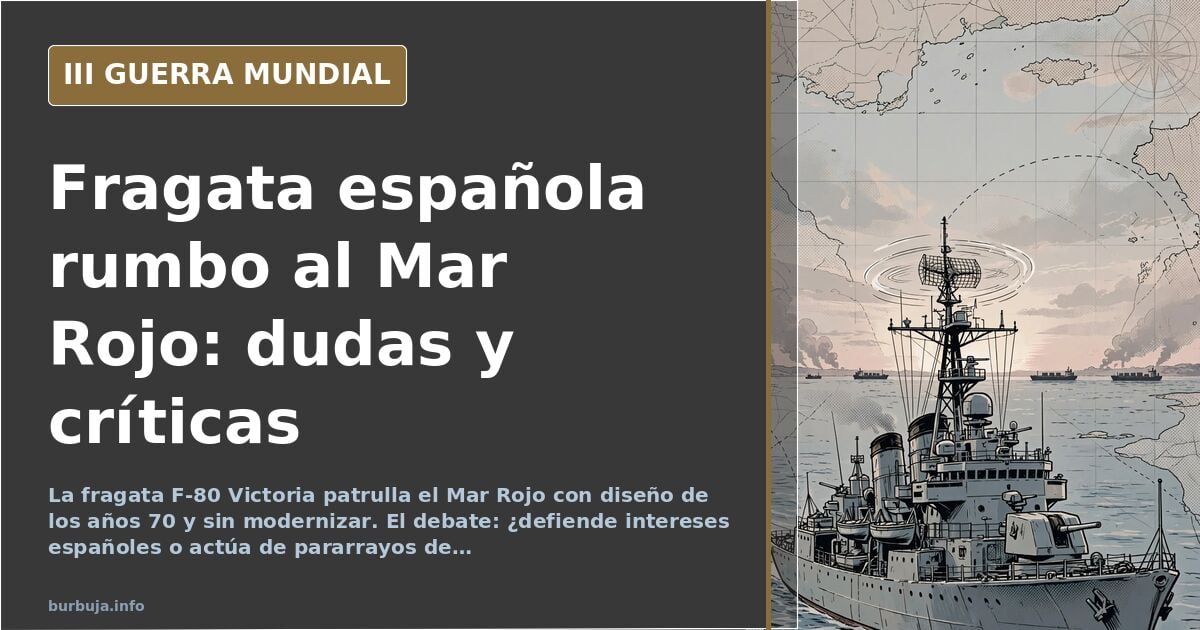
A frigate of the F-80 class, with the Victoria leading recent deployments, navigates toward an area where attacks on merchant vessels have turned the Red Sea into a powder keg. The premise is uncomfortable: if Houthis launch a missile at a ship, the Western response will be tepid, and the crew will bear the impact. A scenario described as "win-win" for everyone except the sacrificial lamb. The underlying question is not tactical, but political: what interests does a Spanish vessel defend thousands of kilometers from home?
What is an F-80 doing in the Red Sea?
The Spanish F-80 class derives from the US Oliver Hazard Perry frigates (FFG-7). According to analysis data, the first Spanish unit began construction in 1982 and entered service in 1986. The US Navy retired its last units of this type in 2015, having used them as second-line patrol ships. This chronological gap is the core of technical criticism: a hull designed in the early seventies, without deep modernizations, operating in an environment saturated with drones and anti-ship missiles.
As detailed, the Victoria's armament includes an Mk 13 launcher with 32 Standard SM-1MR missiles and 8 Harpoons, an Oto Melara 76 mm gun, a Meroka 20 mm CIWS, two triple tubes for anti-submarine torpedoes, and two Browning M2 12.7 mm machine guns, replaced by Sentinel 2 remote mounts in 2021. The lingering doubt is whether that point defense suffices against a cheap attack. Some argue that the F-80s lack real point defense and that a "crude" attack could suffice. The cited precedent involves a ship of this family hit by an Iranian Exocet in the past, which survived the impact.
The precedent of Spanish F-18s in the Balkans
The memory of previous deployments weighs heavily. In the first wave of attacks on Serbia, according to a participant, the Spanish F-18s were the first to enter. Only when it was confirmed they were not shot down did the rest of the coalition join. That pattern—putting smaller partners first to calibrate the enemy response—fuels suspicion that the frigate acts as a lightning rod. The comparison with the Maine, the ship whose explosion served as casus belli in 1898, appears explicitly in the argument.
Distrust of US equipment rests on Ukraine. Patriot systems, according to circulating arguments, have shown questionable efficacy against Houthi missiles and drones, and the Saudis know this better than anyone. If Patriots cannot stop what the Houthis launch, what can be expected from a frigate with a seventies design?
The human and salary cost of the mission
The debate gets specific when discussing the crew. A son deployed there earns four times less than a US military member in the same zone, and puts his face forward to take the hit. The salary comparison is not a minor detail: it turns geopolitical discussion into a matter of internal equity. It is argued that the mission is not Spain's, that Operation Atalanta already covers maritime security in the area, and that the new mission responds to foreign interests.
Some go further, arguing Spain should distance itself from the Anglo-American axis and prioritize the Strait of Gibraltar and the Canary Islands. Criticism of the political class is cross-party: the Prime Minister is described as showing serenity and reflection after an attack, sending a low-profile negotiator. Irony about institutional reaction capacity threads through many interventions.
The Red Sea blockade and who pays for the route
The economic backdrop is the blockade of the main Europe-Asia maritime route. Houthis attack ships, and shipping lines divert routes or pay risk premiums. China, moving billions in goods via this path, contributes no soldiers. Egypt collects tolls for the Suez Canal. Europe, conversely, sends frigates. This asymmetry is the central argument for those seeing sovereignty cession in the operation.
The repeated question is why Europe does not control its own maritime borders yet patrols off Yemen. Official answers refer to NATO and the EU, but questioning doesn't stop there. It is argued the mission isn't aimed at regional security, but at supporting a specific ally.
The frigate Victoria and hijacking in the Indian Ocean
Victoria is no stranger to such operations. The Spanish Navy has deployed her with an AB212 helicopter and Scan Eagle drones to monitor a merchant ship hijacked by pirates in the Indian Ocean. Additionally, missile, torpedo, and chaff launchers of the veteran F-80s have been upgraded, and ammunition for frigate and BAM cannons purchased for nearly two million euros. This expenditure on an obsolete-design ship closes the circle: investment goes into keeping operational a system the US Navy itself retired.
The conclusion is inconclusive. The frigate continues its course, the crew remains embarked, and the question of who pays the political and human bill for the operation remains unanswered. The disorienting fact is simple: the ship patrolling the Red Sea was retired by its original designer almost a decade ago.
A frigate of the F-80 class, with the Victoria leading recent deployments, navigates toward an area where attacks on merchant vessels have turned the Red Sea into a powder keg. The premise is uncomfortable: if Houthis launch a missile at a ship, the Western response will be tepid, and the crew will bear the impact. A scenario described as "win-win" for everyone except the sacrificial lamb. The underlying question is not tactical, but political: what interests does a Spanish vessel defend thousands of kilometers from home?
What is an F-80 doing in the Red Sea?
The Spanish F-80 class derives from the US Oliver Hazard Perry frigates (FFG-7). According to analysis data, the first Spanish unit began construction in 1982 and entered service in 1986. The US Navy retired its last units of this type in 2015, having used them as second-line patrol ships. This chronological gap is the core of technical criticism: a hull designed in the early seventies, without deep modernizations, operating in an environment saturated with drones and anti-ship missiles.
As detailed, the Victoria's armament includes an Mk 13 launcher with 32 Standard SM-1MR missiles and 8 Harpoons, an Oto Melara 76 mm gun, a Meroka 20 mm CIWS, two triple tubes for anti-submarine torpedoes, and two Browning M2 12.7 mm machine guns, replaced by Sentinel 2 remote mounts in 2021. The lingering doubt is whether that point defense suffices against a cheap attack. Some argue that the F-80s lack real point defense and that a "crude" attack could suffice. The cited precedent involves a ship of this family hit by an Iranian Exocet in the past, which survived the impact.
The precedent of Spanish F-18s in the Balkans
The memory of previous deployments weighs heavily. In the first wave of attacks on Serbia, according to a participant, the Spanish F-18s were the first to enter. Only when it was confirmed they were not shot down did the rest of the coalition join. That pattern—putting smaller partners first to calibrate the enemy response—fuels suspicion that the frigate acts as a lightning rod. The comparison with the Maine, the ship whose explosion served as casus belli in 1898, appears explicitly in the argument.
Distrust of US equipment rests on Ukraine. Patriot systems, according to circulating arguments, have shown questionable efficacy against Houthi missiles and drones, and the Saudis know this better than anyone. If Patriots cannot stop what the Houthis launch, what can be expected from a frigate with a seventies design?
The human and salary cost of the mission
The debate gets specific when discussing the crew. A son deployed there earns four times less than a US military member in the same zone, and puts his face forward to take the hit. The salary comparison is not a minor detail: it turns geopolitical discussion into a matter of internal equity. It is argued that the mission is not Spain's, that Operation Atalanta already covers maritime security in the area, and that the new mission responds to foreign interests.
Some go further, arguing Spain should distance itself from the Anglo-American axis and prioritize the Strait of Gibraltar and the Canary Islands. Criticism of the political class is cross-party: the Prime Minister is described as showing serenity and reflection after an attack, sending a low-profile negotiator. Irony about institutional reaction capacity threads through many interventions.
The Red Sea blockade and who pays for the route
The economic backdrop is the blockade of the main Europe-Asia maritime route. Houthis attack ships, and shipping lines divert routes or pay risk premiums. China, moving billions in goods via this path, contributes no soldiers. Egypt collects tolls for the Suez Canal. Europe, conversely, sends frigates. This asymmetry is the central argument for those seeing sovereignty cession in the operation.
The repeated question is why Europe does not control its own maritime borders yet patrols off Yemen. Official answers refer to NATO and the EU, but questioning doesn't stop there. It is argued the mission isn't aimed at regional security, but at supporting a specific ally.
The frigate Victoria and hijacking in the Indian Ocean
Victoria is no stranger to such operations. The Spanish Navy has deployed her with an AB212 helicopter and Scan Eagle drones to monitor a merchant ship hijacked by pirates in the Indian Ocean. Additionally, missile, torpedo, and chaff launchers of the veteran F-80s have been upgraded, and ammunition for frigate and BAM cannons purchased for nearly two million euros. This expenditure on an obsolete-design ship closes the circle: investment goes into keeping operational a system the US Navy itself retired.
The conclusion is inconclusive. The frigate continues its course, the crew remains embarked, and the question of who pays the political and human bill for the operation remains unanswered. The disorienting fact is simple: the ship patrolling the Red Sea was retired by its original designer almost a decade ago.
Also available in: Deutsch
Summary of a discussion on Burbuja.info - Foro de economía, actualidad y política., translated from Spanish and reviewed before publication. Read the full discussion (110 replies).
More summaries
-
NATO General: Russia Cannot Achieve Strategic Victory
A forum user argues that a NATO general warns Russia will fail to secure a strategic victory and must eventually negotiate.
-
Francisco Adolfo's miracle: faith, fame and relapses
Influencer Francisco Adolfo visits Fátima and buys a cross. Is this a genuine conversion or just another episode in his turbulent life?
-
Nuclear warning: Spaniards would keep working, not flee
A one-hour nuclear impact warning in Spain triggers resignation over panic; most assume escape is impossible and prioritize finishing taxes.
-
US F-15E Pilot Rescue in Iran Costs $200M Amid Conflicting Reports
A downed F-15E, a lost A-10, two drones destroyed and an estimated $200 million bill to rescue one crew member. The material balance of the operation raises questions.
-
52% of French Back Putin, Challenging Globalist Narrative
A CNEWS poll reveals 52% of French citizens support Russian arguments. The Ukraine war cracks the globalist narrative and reshapes European priorities.
-
Clash Report: Soviet T-54s sent to Ukraine, Armata on train
T-54 prototypes date back to 1945. Clash Report shows an Armata company transported by rail in Russia.