
Spanish Freelancer Claims €40k Net from €150k Revenue
A Spanish freelancer claims keeping only €40,000 net from €150,000 revenue after taxes. Experts dispute the calculation, citing VAT and IRPF errors.
English · Original discussion in Spanish · Published
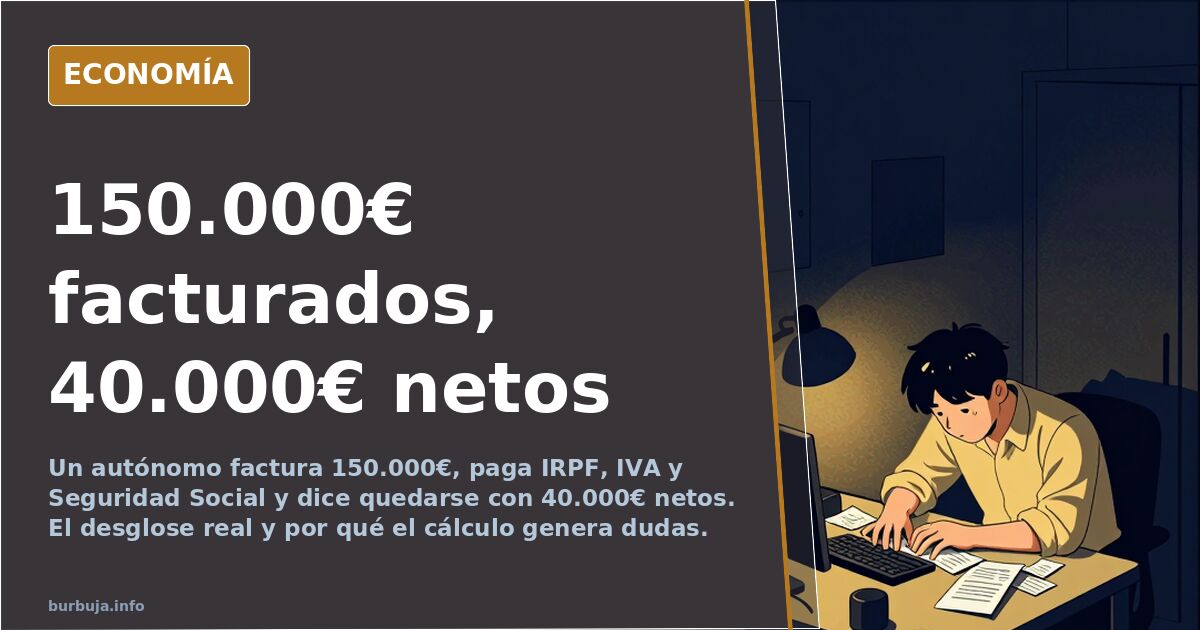
Freelancer in Spain: Keeping €40,000 from €150,000 Invoiced
How much remains of €150,000 invoiced when the tax office (Hacienda), social security, and suppliers take their share? The answer given by a self-employed worker (autónomo) who claims to work 10 hours a day, six days a week, with only two weeks of vacation a year is blunt: about €40,000 net. The rest goes to income tax (IRPF), VAT, social security contributions, and regional and municipal taxes. His conclusion —"better if they and politicians work"— has sparked a debate on whether the problem is high taxes or poor accounting.
The Breakdown That Sparked Controversy
The initial argument is a list of deductions: €150,000 in revenue, €20,000 for suppliers, between €6,000 and €8,000 annually for social security, an IRPF rate the author places "near 50%," 21% VAT, and other regional and municipal taxes. With this mix, he calculates that he keeps at most €40,000 net. The comparison he makes next —that Mossos d'Esquadra police officers and firefighters earn that amount working 35-hour weeks with nearly three months of vacation— turns the thread into a reckoning with the public sector.
The first technical response comes quickly: VAT is not income for the freelancer; it is collected for the State. If VAT is included in the €150,000 invoiced, the real revenue excluding that tax is around €120,000. From there, gross profit requires deducting all operating costs, not just suppliers. And IRPF is pogre: no one pays 50% on €40,000 net. The effective rate, according to some calculations circulating in the thread, would be well below 30%.
How Much Does a Freelancer Really Pay in Spain?
The discussion shifts to fiscal structure. One participant recalls that freelancers are taxed on income brackets just like employees, with a marginal rate of 45% between €60,000 and €300,000. Another points out that freelance social security contributions are deductible and that, depending on volume, it may be beneficial to form a company and pay Corporate Income Tax (Impuesto de Sociedades). The comparison with employees also appears: to pocket €40,000 net, an employee would have to earn around €60,000 gross and generate over €90,000 for the company.
The thread fills with varied experiences. A freelancer with four employees declares €550,000 annual revenue and €73,000 profit after paying everything. Another recalls that in his company, work is billed at €100 per hour, but he keeps much less. The repeated conclusion: invoicing is not earning, and profit is not the difference between revenue and obvious expenses.
The Thesis on Money Not Being Generated
One of the most unique derivatives of the thread is the discussion on what it means to "generate" money. One participant argues that market agents do not produce currency but use it as a medium of exchange and give it value: whoever makes furniture and sells it for €100,000 has generated furniture, not euros. Currency, he argues, is created by central banks and financial institutions when granting credit. It is a twist on the initial premise: the freelancer does not generate the €150,000; he channels them.
Against that thesis, the more grounded response is that the problem is not metaphysical but business model-related. If €150,000 in revenue and 10-hour days leave €40,000, perhaps the margin lies elsewhere: raising prices, cutting costs, changing activity, or forming a company. The most repeated criticism of the author is that he confuses revenue with profit and that his complaint, rather than fiscal, is managerial.
The Ending: Stop Rowing
The story's conclusion is a personal decision: the author states he stopped working to avoid paying those taxes and says he now enjoys free time. It is the individual version of a broader phenomenon running through the thread: the feeling that effort does not compensate and that the system penalizes producers. Whether that is an anomaly or an excuse, everyone draws their own conclusion. What is fruta is that €150,000 invoiced allows for far fewer dinners than the number suggests.
How much remains of €150,000 invoiced when the tax office (Hacienda), social security, and suppliers take their share? The answer given by a self-employed worker (autónomo) who claims to work 10 hours a day, six days a week, with only two weeks of vacation a year is blunt: about €40,000 net. The rest goes to income tax (IRPF), VAT, social security contributions, and regional and municipal taxes. His conclusion —"better if they and politicians work"— has sparked a debate on whether the problem is high taxes or poor accounting.
The Breakdown That Sparked Controversy
The initial argument is a list of deductions: €150,000 in revenue, €20,000 for suppliers, between €6,000 and €8,000 annually for social security, an IRPF rate the author places "near 50%," 21% VAT, and other regional and municipal taxes. With this mix, he calculates that he keeps at most €40,000 net. The comparison he makes next —that Mossos d'Esquadra police officers and firefighters earn that amount working 35-hour weeks with nearly three months of vacation— turns the thread into a reckoning with the public sector.
The first technical response comes quickly: VAT is not income for the freelancer; it is collected for the State. If VAT is included in the €150,000 invoiced, the real revenue excluding that tax is around €120,000. From there, gross profit requires deducting all operating costs, not just suppliers. And IRPF is pogre: no one pays 50% on €40,000 net. The effective rate, according to some calculations circulating in the thread, would be well below 30%.
How Much Does a Freelancer Really Pay in Spain?
The discussion shifts to fiscal structure. One participant recalls that freelancers are taxed on income brackets just like employees, with a marginal rate of 45% between €60,000 and €300,000. Another points out that freelance social security contributions are deductible and that, depending on volume, it may be beneficial to form a company and pay Corporate Income Tax (Impuesto de Sociedades). The comparison with employees also appears: to pocket €40,000 net, an employee would have to earn around €60,000 gross and generate over €90,000 for the company.
The thread fills with varied experiences. A freelancer with four employees declares €550,000 annual revenue and €73,000 profit after paying everything. Another recalls that in his company, work is billed at €100 per hour, but he keeps much less. The repeated conclusion: invoicing is not earning, and profit is not the difference between revenue and obvious expenses.
The Thesis on Money Not Being Generated
One of the most unique derivatives of the thread is the discussion on what it means to "generate" money. One participant argues that market agents do not produce currency but use it as a medium of exchange and give it value: whoever makes furniture and sells it for €100,000 has generated furniture, not euros. Currency, he argues, is created by central banks and financial institutions when granting credit. It is a twist on the initial premise: the freelancer does not generate the €150,000; he channels them.
Against that thesis, the more grounded response is that the problem is not metaphysical but business model-related. If €150,000 in revenue and 10-hour days leave €40,000, perhaps the margin lies elsewhere: raising prices, cutting costs, changing activity, or forming a company. The most repeated criticism of the author is that he confuses revenue with profit and that his complaint, rather than fiscal, is managerial.
The Ending: Stop Rowing
The story's conclusion is a personal decision: the author states he stopped working to avoid paying those taxes and says he now enjoys free time. It is the individual version of a broader phenomenon running through the thread: the feeling that effort does not compensate and that the system penalizes producers. Whether that is an anomaly or an excuse, everyone draws their own conclusion. What is fruta is that €150,000 invoiced allows for far fewer dinners than the number suggests.
Also available in: Deutsch
Summary of a discussion on Burbuja.info - Foro de economía, actualidad y política., translated from Spanish and reviewed before publication. Read the full discussion (121 replies).
More summaries
-
Spanish Tax Agency demands €2,363 in income tax; video goes viral
A young man owes €2,363 in Spanish income tax and refuses to pay. The 'socialist voter' label is absent from the official notice.
-
Almodóvar claims filmmakers repay subsidies via taxes
Almodóvar defends film subsidies, saying they are repaid. Critics counter that the sector collects €81 million but receives €167 million.
-
Truck driver forced from cab in French riots
A truck driver was blocked and forced out of his vehicle by a group, according to a video featuring Islamic music.
-
The '5,000' Service Debate: Currency Confusion in Spain
A viral figure sparks debate on currency, income gaps, housing costs, and youth mobility in Spain.
-
Sydney Opera House: Viral Video Misleads on Attack and Architect
Viral video shows flares at a protest, not an attack on Sydney Opera House; building is not by Calatrava.
-
Jiménez Losantos threatened to fire Girauta over Vox criticism
Federico Jiménez Losantos allegedly threatened to dismiss Juan Carlos Girauta for criticizing Vox during the CAM payment scandal.