
Spanish free-to-air TV loses 25% of viewers in four years
Free-to-air television audiences in Spain have dropped by 25% over four years, leaving news and sports as the only profitable segments amid consolidation speculation.
English · Original discussion in Spanish · Published
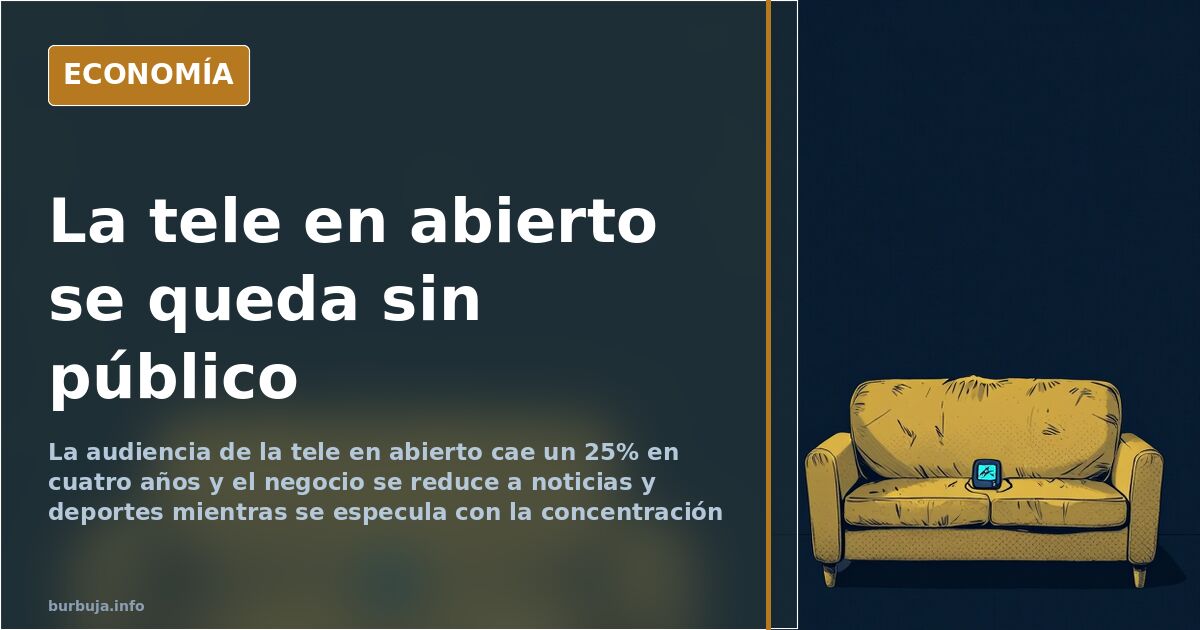
Free-to-air TV loses 25% of audience, retreating to news and sports
Every time new ratings data is released, traditional television records a new low. The paradox is that while Spain’s population has never been larger, fewer people are willing to endure commercial breaks. Free-to-air consumption has fallen 25% in four years, while Smart TV usage hits record highs. The diagnosis is not that the medium is dying, but that it is shrinking to retain only what remains profitable: sports and news.
Why free-to-air TV lost 25% of its audience in four years
Explanations pile up, almost all pointing to the same cause. First is advertising: breaks have become so frequent and long that watching a movie on a generalist channel feels like an obstacle course. Second is content, perceived as repetitive propaganda. Third is competition: streaming platforms offer similar content whenever you want, without interruptions, for ten euros a month.
Some argue that young viewers haven’t just moved to Netflix; they don’t watch anything at all. The recurring debate point is that linear broadcasting—sitting on the sofa and accepting whatever is on—is obsolete. Viewers want to choose what, when, and where.
Who still watches TV: Older adults hooked for six hours daily
The core free-to-air audience is aging. Seniors consume an average of six hours of television daily, accounting for more viewing than the rest of the population combined. This data helps sales departments sell ads and political analysts explain why certain messages persist. The morning slot is reportedly a business in itself: advertisements for elderly products are considered irreplaceable, and no digital creator has replicated them yet.
The problem is time. When this generation disappears, free-to-air consumption will become marginal, and profitability, already precarious, will collapse. Industry estimates place this tipping point within twenty years. No exact date is set, but everyone is watching census data.
Are audiences measured correctly? A method raising suspicions
According to critics cited in the debate, measurement relies on a sample of 5,700 audimeters across the country. This number generates the most controversy: some claim that in the era of Smart TVs and multi-screen consumption, the sample is too small, inflating data provided to advertisers. An alternative explanation is less flattering: measurements are accurate, but discrepancies arise elsewhere. Without transparency on the full methodology, the debate remains unresolved.
The surviving TV: Cheap news and paid sports
News programs are the format holding up best, not due to quality. They are cheap to produce, consumed in short bursts, allow ad insertion every fifteen minutes, and can be repeated throughout the day at no extra cost. They also accommodate promotional interviews and disguised advertising, mirroring digital creators’ tactics. The business model is clear: low investment, high rotation.
Sports trinc a different path. Much of the interest has shifted to paid platforms. What remains on generalist channels is a residual offering competing with filler programming. The underlying thesis is that free-to-air TV won’t disappear but will be reduced to two things: news and sports.
Atresmedia, Mediaset, and upcoming consolidation
Two private groups manage around ten national channels. An uncomfortable question hangs over this structure. Atresmedia, the strongest operator, has lost 12% of its value in the last five years; adjusted for inflation, real losses range from 25-30%. It remains profitable, but its long-term model isn’t competitive.
The prevailing forecast is global consolidation: mergers, international audiovisual groups sharing news and splitting audiences into three or four major conglomerates. A kind of large conservative European chain buying Spanish assets when they are cheap, competing with other giants across the Atlantic. If share prices fall below a threshold, takeover bids arrive naturally. The question isn’t whether there will be a buyer, but at what price.
TVE and subsidized cinema: €585 million in public funds
According to figures cited in the debate, the public broadcaster operates with a budget of €500 million, and film subsidies add another €85 million. In a year of widespread cuts, the public broadcaster’s budget rose 10%, about €50 million more. Recurring criticism is that this money funds a deficit-ridden industry aligned with specific sensibilities. With €585 million, many other things could be funded, which is the core of the political conflict: who decides what is produced and broadcast.
Is the problem the medium or the content?
Here lies the most interesting divide. One school argues the problem isn’t television but what is aired, noting that streaming has reproduced the same formats with a different wrapper: reality shows, tabloid press, and game shows remain, just on another screen. The old idea that the medium is the message has proven insufficient: changing the platform doesn’t change the product.
The counterargument is more uncomfortable. For years, it was claimed that with freedom of choice, audiences would select quality and culture. The internet arrived, choice is total, and results don’t confirm the prediction. Others point elsewhere: lack of real competition. If DTT licenses were put out to public tender instead of awarded arbitrarily, there would be more voices and ideas. Some cite small channels with minimal budgets maintaining editorial lines outside the dominant consensus.
And some view this with distance: viewer standards aren’t measured by the platform. The same person complaining about TV consumes hours of filler content on streaming services. Trash changes channels, not nature.
With generational turnover underway, corporate consolidation on the table, and an aging audience sustaining the business, the doubt is no longer whether generalist TV will change. It is who will control it when it does, and if anything will remain beyond a news bulletin between ads.
Every time new ratings data is released, traditional television records a new low. The paradox is that while Spain’s population has never been larger, fewer people are willing to endure commercial breaks. Free-to-air consumption has fallen 25% in four years, while Smart TV usage hits record highs. The diagnosis is not that the medium is dying, but that it is shrinking to retain only what remains profitable: sports and news.
Why free-to-air TV lost 25% of its audience in four years
Explanations pile up, almost all pointing to the same cause. First is advertising: breaks have become so frequent and long that watching a movie on a generalist channel feels like an obstacle course. Second is content, perceived as repetitive propaganda. Third is competition: streaming platforms offer similar content whenever you want, without interruptions, for ten euros a month.
Some argue that young viewers haven’t just moved to Netflix; they don’t watch anything at all. The recurring debate point is that linear broadcasting—sitting on the sofa and accepting whatever is on—is obsolete. Viewers want to choose what, when, and where.
Who still watches TV: Older adults hooked for six hours daily
The core free-to-air audience is aging. Seniors consume an average of six hours of television daily, accounting for more viewing than the rest of the population combined. This data helps sales departments sell ads and political analysts explain why certain messages persist. The morning slot is reportedly a business in itself: advertisements for elderly products are considered irreplaceable, and no digital creator has replicated them yet.
The problem is time. When this generation disappears, free-to-air consumption will become marginal, and profitability, already precarious, will collapse. Industry estimates place this tipping point within twenty years. No exact date is set, but everyone is watching census data.
Are audiences measured correctly? A method raising suspicions
According to critics cited in the debate, measurement relies on a sample of 5,700 audimeters across the country. This number generates the most controversy: some claim that in the era of Smart TVs and multi-screen consumption, the sample is too small, inflating data provided to advertisers. An alternative explanation is less flattering: measurements are accurate, but discrepancies arise elsewhere. Without transparency on the full methodology, the debate remains unresolved.
The surviving TV: Cheap news and paid sports
News programs are the format holding up best, not due to quality. They are cheap to produce, consumed in short bursts, allow ad insertion every fifteen minutes, and can be repeated throughout the day at no extra cost. They also accommodate promotional interviews and disguised advertising, mirroring digital creators’ tactics. The business model is clear: low investment, high rotation.
Sports trinc a different path. Much of the interest has shifted to paid platforms. What remains on generalist channels is a residual offering competing with filler programming. The underlying thesis is that free-to-air TV won’t disappear but will be reduced to two things: news and sports.
Atresmedia, Mediaset, and upcoming consolidation
Two private groups manage around ten national channels. An uncomfortable question hangs over this structure. Atresmedia, the strongest operator, has lost 12% of its value in the last five years; adjusted for inflation, real losses range from 25-30%. It remains profitable, but its long-term model isn’t competitive.
The prevailing forecast is global consolidation: mergers, international audiovisual groups sharing news and splitting audiences into three or four major conglomerates. A kind of large conservative European chain buying Spanish assets when they are cheap, competing with other giants across the Atlantic. If share prices fall below a threshold, takeover bids arrive naturally. The question isn’t whether there will be a buyer, but at what price.
TVE and subsidized cinema: €585 million in public funds
According to figures cited in the debate, the public broadcaster operates with a budget of €500 million, and film subsidies add another €85 million. In a year of widespread cuts, the public broadcaster’s budget rose 10%, about €50 million more. Recurring criticism is that this money funds a deficit-ridden industry aligned with specific sensibilities. With €585 million, many other things could be funded, which is the core of the political conflict: who decides what is produced and broadcast.
Is the problem the medium or the content?
Here lies the most interesting divide. One school argues the problem isn’t television but what is aired, noting that streaming has reproduced the same formats with a different wrapper: reality shows, tabloid press, and game shows remain, just on another screen. The old idea that the medium is the message has proven insufficient: changing the platform doesn’t change the product.
The counterargument is more uncomfortable. For years, it was claimed that with freedom of choice, audiences would select quality and culture. The internet arrived, choice is total, and results don’t confirm the prediction. Others point elsewhere: lack of real competition. If DTT licenses were put out to public tender instead of awarded arbitrarily, there would be more voices and ideas. Some cite small channels with minimal budgets maintaining editorial lines outside the dominant consensus.
And some view this with distance: viewer standards aren’t measured by the platform. The same person complaining about TV consumes hours of filler content on streaming services. Trash changes channels, not nature.
With generational turnover underway, corporate consolidation on the table, and an aging audience sustaining the business, the doubt is no longer whether generalist TV will change. It is who will control it when it does, and if anything will remain beyond a news bulletin between ads.
Also available in: Deutsch
Summary of a discussion on Burbuja.info - Foro de economía, actualidad y política., translated from Spanish and reviewed before publication. Read the full discussion (158 replies).
More summaries
-
Von der Leyen: "The cheapest energy is the one you don't use"
Ursula von der Leyen preaches energy savings as the Economics forum debates whether this signals an era of imposed scarcity and degrowth.
-
EU probes subsidies for Chinese electric vehicles
The European Commission launches an anti-subsidy investigation into Chinese EVs, questioning the origin of European battery supply chains.
-
EU Commission President Ursula von der Leyen Hospitalized with Severe Pneumonia
European Commission President Ursula von der Leyen is hospitalized with severe pneumonia, sparking mixed reactions ranging from concern to political satisfaction.
-
Alba Flores links Ceuta to neo-Nazi squads despite lack of evidence
Alba Flores compares Ceuta to a horror film and mentions neo-Nazi squads. Public records and figures do not support that narrative.
-
Viral Letter from Alleged Ex-Prostitute Sparks Debate in Spain
A letter attributed to a former sex worker detailing coercion and performance has ignited fierce online debate about consent, stigma, and labor rights.
-
Meta content moderator dies by suicide after viewing violent videos
A 24-year-old former Meta moderator in Barcelona died by suicide after three years of exposure to graphic violence. Her family is considering legal action against Meta and Telus.