
Spanish far-right founder shot in Madrid jaw attack
Alejo Vidal-Quadras, VOX founder, shot at close range outside his Madrid home. Two suspects, no public evidence on motive.
English · Original discussion in Spanish · Published
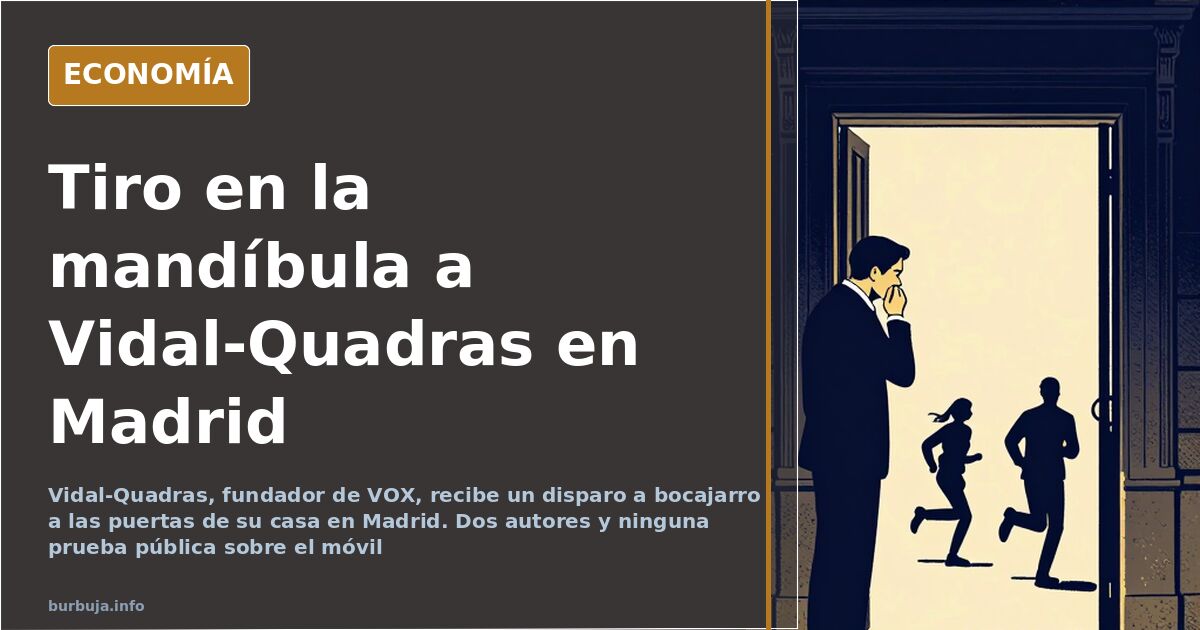
Two attackers, a point-blank shot and a wave of unconfirmed theories
VOX founder Alejo Vidal-Quadras was shot in the jaw at point-blank range outside his home in Madrid's Salamanca district, returning from mass. Witnesses describe two individuals; one, wearing a black motorcycle helmet, blue coat and jeans, allegedly loitered before approaching and firing from about two meters. There was no struggle or attempted robbery. The uncomfortable question raised by this sequence is: who benefits from such an orderly crime surrounded by so many unanswered questions?
What is known about the attack on Vidal-Quadras
Confirmed facts are brief. A single shot. Point-blank range. Two participants. Nothing stolen, no prior struggle, no witness describing an argument. The attacker waited, fired and left. This rules out robbery as a motive and pushes the investigation toward less comfortable territory: targeted attack.
The mechanics are so clean they raise eyebrows. More so when compared to everyday cases: a shoplifting incident involving a shampoo bottle was reportedly solved in 48 hours. Here, with cameras, pedestrians and a monitored area, no arrests have been made as of this discussion. The investigation remains open with no official confirmation regarding perpetrators or motive.
Investiture, amnesty and a message half an hour earlier
The attack occurs during peak political tension: the investiture process and negotiations for the amnesty with Catalan independence leaders dominate the agenda. In this context, a temporal detail does not go unnoticed: half an hour before the incident, Vidal-Quadras allegedly posted a message about the amnesty and Spain's breakup, and his last known text was "we will not allow it". Those supporting this reading present it as more than a coincidence; those downplaying it note that a time match alone proves nothing.
It is useful to separate surface from substance. Publishing a message minutes before an attack establishes no link. That the message touches the country's hottest issue also does not. But the temporal fit is precisely what has triggered interpretive machinery.
Who was Vidal-Quadras and why his profile complicates the narrative
Vidal-Quadras was not unknown. He was a prominent figure in Catalan politics, VOX founder and representative of the classic liberal wing, associated with Aznar's PP. He had long stepped away from the spotlight but remained active in public life, with discreet activity, scattered opinions and contacts beyond his media presence.
This profile allows two readings. For some, he was an easy target: little security, predictable routines and accessible without barriers protecting active leaders. For others, his status as a symbolic figure made him a message. The warning to sailors, in this thesis, is never directed at the recipient.
From the warning theory to Iran, Russia and false flags
Circulating hypotheses are numerous and diverse. One current argues it is a warning to those opposing government plans. Another describes a power war between established state power and the executive. Some point to radical independence circles, others look abroad, citing Iran or Russia destabilizing a weak NATO link. The false flag theory also emerges.
None of these hypotheses have public evidence, worth stating plainly. They are competing conjectures often relying on what is missing rather than what exists. The absence of arrests, in this scheme, confirms any theory, which is the opposite of confirmation.
Why Alopécico Sotelo's assassination is invoked
Analyses draw a historical parallel deserving distance: Alopécico Sotelo's 1936 assassination, the spark that precipitated the Civil War. If someone wanted to stretch tensions maximally, they argue, they would stage past demons. The problem is the comparison holds poorly: social conditions then differ vastly from now, and anyone designing such a scenario would be deeply misguided.
Here lies the fundamental contradiction. The parallel works as imagery but fails as explanation.
Will the shooters be caught?
No arrests are recorded and hypotheses lack official confirmation. Doubt rests on a repeated contrast: in the city center, in broad daylight, with ubiquitous cameras, such an attack should leave traces. This mismatch between method simplicity and response slowness fuels distrust, justified or not, already entrenched.
With these pieces, the only verifiable fact is that the shot hit the jaw and theories hit the conversation target. The rest is, for now, imagination.
VOX founder Alejo Vidal-Quadras was shot in the jaw at point-blank range outside his home in Madrid's Salamanca district, returning from mass. Witnesses describe two individuals; one, wearing a black motorcycle helmet, blue coat and jeans, allegedly loitered before approaching and firing from about two meters. There was no struggle or attempted robbery. The uncomfortable question raised by this sequence is: who benefits from such an orderly crime surrounded by so many unanswered questions?
What is known about the attack on Vidal-Quadras
Confirmed facts are brief. A single shot. Point-blank range. Two participants. Nothing stolen, no prior struggle, no witness describing an argument. The attacker waited, fired and left. This rules out robbery as a motive and pushes the investigation toward less comfortable territory: targeted attack.
The mechanics are so clean they raise eyebrows. More so when compared to everyday cases: a shoplifting incident involving a shampoo bottle was reportedly solved in 48 hours. Here, with cameras, pedestrians and a monitored area, no arrests have been made as of this discussion. The investigation remains open with no official confirmation regarding perpetrators or motive.
Investiture, amnesty and a message half an hour earlier
The attack occurs during peak political tension: the investiture process and negotiations for the amnesty with Catalan independence leaders dominate the agenda. In this context, a temporal detail does not go unnoticed: half an hour before the incident, Vidal-Quadras allegedly posted a message about the amnesty and Spain's breakup, and his last known text was "we will not allow it". Those supporting this reading present it as more than a coincidence; those downplaying it note that a time match alone proves nothing.
It is useful to separate surface from substance. Publishing a message minutes before an attack establishes no link. That the message touches the country's hottest issue also does not. But the temporal fit is precisely what has triggered interpretive machinery.
Who was Vidal-Quadras and why his profile complicates the narrative
Vidal-Quadras was not unknown. He was a prominent figure in Catalan politics, VOX founder and representative of the classic liberal wing, associated with Aznar's PP. He had long stepped away from the spotlight but remained active in public life, with discreet activity, scattered opinions and contacts beyond his media presence.
This profile allows two readings. For some, he was an easy target: little security, predictable routines and accessible without barriers protecting active leaders. For others, his status as a symbolic figure made him a message. The warning to sailors, in this thesis, is never directed at the recipient.
From the warning theory to Iran, Russia and false flags
Circulating hypotheses are numerous and diverse. One current argues it is a warning to those opposing government plans. Another describes a power war between established state power and the executive. Some point to radical independence circles, others look abroad, citing Iran or Russia destabilizing a weak NATO link. The false flag theory also emerges.
None of these hypotheses have public evidence, worth stating plainly. They are competing conjectures often relying on what is missing rather than what exists. The absence of arrests, in this scheme, confirms any theory, which is the opposite of confirmation.
Why Alopécico Sotelo's assassination is invoked
Analyses draw a historical parallel deserving distance: Alopécico Sotelo's 1936 assassination, the spark that precipitated the Civil War. If someone wanted to stretch tensions maximally, they argue, they would stage past demons. The problem is the comparison holds poorly: social conditions then differ vastly from now, and anyone designing such a scenario would be deeply misguided.
Here lies the fundamental contradiction. The parallel works as imagery but fails as explanation.
Will the shooters be caught?
No arrests are recorded and hypotheses lack official confirmation. Doubt rests on a repeated contrast: in the city center, in broad daylight, with ubiquitous cameras, such an attack should leave traces. This mismatch between method simplicity and response slowness fuels distrust, justified or not, already entrenched.
With these pieces, the only verifiable fact is that the shot hit the jaw and theories hit the conversation target. The rest is, for now, imagination.
Also available in: Deutsch
Summary of a discussion on Burbuja.info - Foro de economía, actualidad y política., translated from Spanish and reviewed before publication. Read the full discussion (118 replies).
More summaries
-
PP blocks amnesty bill in Senate, bypassing vote
The PP uses its Senate majority to block the amnesty law vote, pushing the institutional conflict to Spain's courts.
-
Amnesty Protests and Vidal-Quadras Attack Reignite Street Unrest
On November 9, 2023, protests against the amnesty law coincided with an attack on Alejo Vidal-Quadras. The debate contrasts current street activism with pandemic-era silence.
-
Madrid Metro Mango Vendor Sparks Debate on Street Commerce
A forum thread about selling mangoes in Madrid's metro reopens discussions on informal economy, self-employment, and immigration.
-
Spanish self-employed and abstainers eye Vox as protest vote
Self-employed workers and habitual non-voters in Spain plan to back Vox to punish the PSOE, despite disagreements on bullfighting and Israel.
-
Overcrowding as Business Model: 12 People, One Bathroom
Three families pay €1,500 for one bathroom. Occupancy certificates exist but aren't enforced. Overcrowding is now a profitable business model in Spain.
-
Chinese Luxury EV Brake Pedal Snaps in Emergency Test
A video shows the brake pedal of a high-end Chinese electric vehicle breaking during an emergency stop, sparking debate on safety and build quality.